Prayer
Muslims believe that there is only one God – Allah. This belief is called The belief in the oneness of Allah. It is acknowledged in the First Pillar of Islam: There is no god but God. and it is expressed in the A declaration of faith that consists of the statement "There is no god except Allah, Muhammad is the Messenger of Allah." The First Pillar of Islam.. Muslims believe that only Allah is worthy of worship. Worshipping anything or anyone else amounts to The sin of regarding anything as an equal or partner of Allah., which is the greatest sin and means holding anything to be equal or above Allah.
All praise is Allah’s alone, the Lord of the World … You alone do we worship and of you only do we seek help.
The five daily prayers (Salah)
The five daily prayers which are the second Pillar of Islam. refers to five prayers that Muslims perform every day. Each of the five prayers is performed at a specific time of day:
Prayer is seen as daily communication with Allah. Salah encourages self-discipline and keeps Muslims in close contact with Allah. This gives them the strength to remain committed to living a good and purposeful life. The The Recitation or Reading. Allah’s eternal utterance revealed to the Prophet Muhammad by the Angel Jibril as his final revelation to humankind. says:
And when you have finished your prayer remember God - standing and sitting and lying down and when you are once again secure, observe your prayers fully. Verily, for all believers, prayer is indeed a sacred duty linked to particular times [of day].
Praying the same set prayers to the same routine as Muslims all over the world is a sign of solidarity with all other Muslims. It shows that everyone is equal.
Preparing for prayer
Before praying, Muslims prepare by performing an important set of actions so that all of their focus can be on God:
- Ablutions, which means ritual washing called Ritual washing before salah (prayer)., which Muslims perform so that they are spiritually clean.
- Meeting place for prayer, worship and community for Muslims. have washrooms where this washing can be performed. The ritual involves washing faces, hands and feet under running water.
- If water is not available, sand or dust can be used as a sign of spiritual washing.
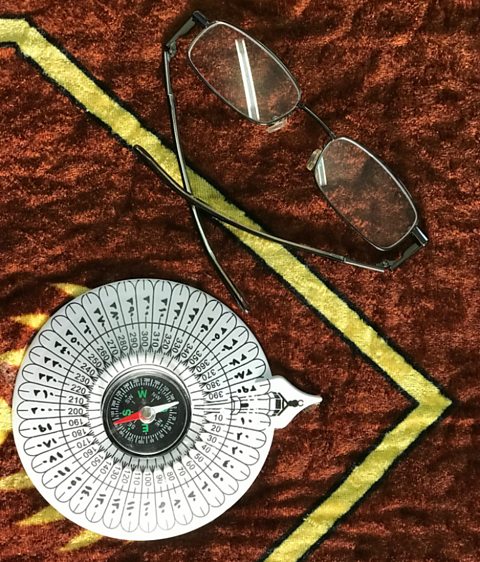
- Facing the city of City where the Prophet Muhammad was born, and where the Ka’bah is located - often spelt Mecca. (Mecca), called The direction Muslims face when performing Salah - towards the Ka'bah in Makkah (Mecca).. In a mosque, the Niche in the wall of a mosque at the point nearest to Makkah that the congregation faces to pray. marks the direction of prayer. If prayer is not taking part in a mosque, a compass on a prayer mat can be used to show the right direction.
- The statement of intention made by Muslims beginning compulsory prayer. means making a conscious intention to pray. Prayer starts with a declaration of niyyah, showing that the worshipper is making an intentional effort to set time aside to communicate with God.
Rak’ahs (actions)
Each prayer cycle, or A unit of bodily actions and recitations from the Qur'an said during prayer. Each prayer consists of various numbers of rak’ahs., includes saying “Allahu akbar”, which means “God is great”, multiple times. Muslims also recite the first Division of the Qur’an (114 in total). of the Qur’an during each prayer cycle.
The Qur’an instructs Muslims to keep Allah in mind when they have finished praying: Once the prayer is over, disperse throughout the land and seek the bounty of Allah. And remember Allah often so you may be successful (Surah 62:10).
Salah – differences between Sunni and Shi’a Muslims
Muslims, or Shi’ites, who believe in the Imamah, leadership of Ali and his descendants after the Prophet Muhammad. Muslims combine some prayers, such as the midday and afternoon prayers. Therefore, they may only pray three times a day. Muslims who believe in the successorship of Abu Bakr, Umar, Uthman and Ali as leaders of the Muslim community after the Prophet Muhammad. Muslims only combine prayers if they have a good reason to – for example, if they are travelling.
Shi’a Muslims also often use natural elements when praying – for example, some place a piece of clay at the spot where their head rests. The movements that Sunni and Shi’a Muslims make during prayer can also differ. For example, Shi’a Muslims pray with their hands by their sides, whereas Sunni Muslims pray with their hands either folded or by their sides.
Question
What is wudu?
Wudu is ritual washing (ablution) before performing Salah.
