Juicy Salif by Philippe Starck
Question
A student has chosen the design piece Juicy Salif by Philippe Starck / Alessi as a subject for question seven. Consider what they might say and then look at their preparatory work.
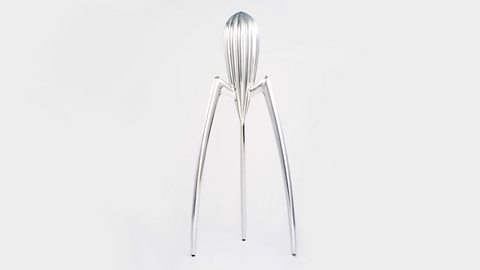
© Alessi and Philippe Starck. Image: Alamy Stock Photo
Consideration of function
- Philippe Starck said:
The real reason for such an object to exist is not only to squeeze a lemon but also to provoke conversations around it
. - Unlike a traditional lemon squeezer, there is no built-in dish to collect the juice. This means juice can be squeezed directly into a glass or bowl.
- The ridged, pointed form of the lemon squeezer ensures that the juice is directed into the container placed below reasonably effectively.
- Unlike other lemon squeezers, the design does not collect the pips. This means the user will have to remove them from the juice. This was not a major consideration for Starck who intended the product to be as much an attractive object as a functional lemon squeezer.
- The design is taller than other squeezers to allow a container to be placed under it. The legs are thin and make the design appear light. But the squeezer’s height, the tripod form and its small rubber feet mean the design may appear less stable than a conventional squeezer.
Use of materials and/or technology
- The product is made from cast and polished aluminium. Aluminium is a good choice as this metal does not react with the acidic fruit juice.
- Aluminium is a lightweight metal and this has led to complaints about the stability of the product. A heavier material may have helped to prevent the design from slipping while in use.
- Aluminium can be cast and polished easily, making this product suitable for mass production and making it more accessible to a wider audience.
Use of techniques
- The Alessi company had asked Philippe Starck to design a butter dish. Shortly after this, while he was on holiday, Starck sketched the idea for this design on a napkin while waiting to be served in a restaurant.
- The product is mass-produced by Alessi using an industrial casting technique which allows the organic, sculptural form to be created.
- The product was finished by polishing to give it the highly reflective, futuristic look which appeals to its target market of young, urban professionals. This finish also allows it to be easily cleaned.
Working methods
- Starck never stops designing and was in a pizzeria when he quickly sketched the idea on a napkin. The form he designed was then developed into a real product.
- Starck had been commissioned by Alessi to design a butter dish. Instead, he came up with the Juicy Salif. This was typical of how Starck worked with clients. This led to Alberto Alessi referring to Starck as their ‘designer terrible’ but also making him one of their star designers.
- Like many contemporary product designers, Starck relies on a team of engineer specialists to make his vision a reality. The concept of Juicy Salif was developed from his original sketch by the engineering team at Alessi, who worked out the technical details of its construction and its mass-production.
Consideration of aesthetics
- The design has an appearance of the squid which inspired the idea, with its long legs and organic form. This gives it a striking appearance.
- Aesthetics is about the emotional appeal of the product and Starck has made the lemon squeezer very appealing to the consumer by giving it a unique ‘personality’ through its unconventional zoomorphic form based on a squid.
- The product has a tactile aesthetic because of the polished finish, ridged surface and sculptural form. These elements combine to ensure that it is a desirable object despite its lacking some functionality of other lemon squeezers.
Consideration of style
- The style works well for the Alessi brand. The company is known for quirky, humorous household products which catch the attention. The Juicy Salif is an unusually styled lemon squeezer which reflects their look.
- The use of polished aluminium, combined with the organic form and spindly legs, gives the lemon squeezer a futuristic style making it appear ahead of its time.
- The product’s sculptural style ensures that it can be displayed like a piece of art when it is not in use.
- Starck intended that the product act as a conversation starter, and its unique style helps it to fulfil that purpose.
Consideration of target market/audience
- The Juicy Salif is more expensive than a regular lemon squeezer and much cheaper products are available, so this product is priced to appeal to design-conscious consumers with disposable income, who value designer items.
- The product had to appeal to fans of Alessi who collect their kitchenware so it was important that it had the quirky style the company is known for. The Juicy Salif became one of their most successful and iconic designs, so is highly collectable.
- Alessi customers tend to be urban professionals, who like to have the latest items in their homes. Starck’s highly original design for the Juicy Salif meant that it became a status symbol in the 1990s and was featured in many interiors magazines, increasing its desirability.
One visual element – form
- The ridged form of the head of the lemon squeezer ensures that juice is channelled down into the container below.
- The form of the head of the squeezer is designed so that a lemon will easily fit over the top and the pointed end underneath helps direct the juice into the container, making juice collection more efficient.
- Because of the thin, tripod form of the legs the squeezer is less stable than a squeezer with a dish that sits directly on a surface. The user has to hold onto the squeezer with a delicate pressure so that it does not slip when pressure is applied. This makes the functionality of the design less practical.
- The organic, tripod form makes the design look futuristic, like an alien, which makes it stand out amongst other lemon squeezers.
Impact of social, cultural, and/or other influences
- Starck’s father was an aeronautical engineer and Starck spent much of his childhood playing underneath his father’s drawing board. Being around this influence of aeronautical invention impacted on many of his designs, including the Juicy Salif which has an aerodynamic form, allowing juice to flow down into a container.
- Starck came to prominence during the post-modern design era. Postmodernism was a reaction against minimalist, modernist design with its ‘form follows function’ principle. Postmodern design was often humorous and full of contradictions. The Juicy Salif is a postmodern design with its eccentric approach to function and its quirky appearance.
- Starck is influenced by nature, which had an impact on the biomorphic design of the Juicy Salif. The design also has the appearance of a seedpod sprouting.
- The comic books and toys of his childhood influenced his design aesthetic which can be seen in the Juicy Salif, with many thinking the product looks like a comic book spaceship.
