Allegory by John Bellany
Question
A student has chosen the artwork Allegory by John Bellany as a subject for question one. Consider what they might say and then look at their preparatory work.
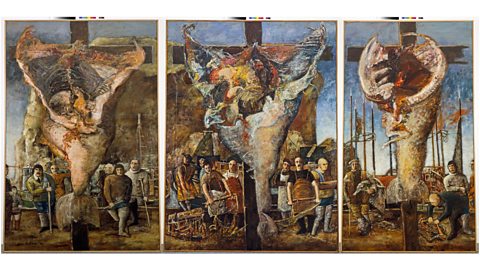
John Bellany, Allegory, National Galleries of Scotland. Purchased 1988. © The Estate of John Bellany. All Rights Reserved 2019 / Bridgeman Images
Use of materials and/or technology
- Oil paint on hardboard has been used. The paint has been applied in an expressive way. This has been achieved through textural brushwork which has been built up in layers, using quick, fluid strokes.
- Dry brushwork has been used to apply the paint in some areas. This adds another complex layer of texture to the surface.
- The oil paint has allowed Bellany to achieve subtle, variations in colour through the blending and layering of the paint. The way the paint has been layered has allowed him to harmonise the colours throughout the painting.
Use of scale
- Each of the three panels is over two meters high so this vast, monumental scale creates a high level of The visual impression made on the viewer. Many elements contribute to visual impact, for example imagery, colour and style. .
- The central panel is wider than the two side panels so its bigger scale attracts your eye to this panel first.
- The scale of each panel varies as the widths are all different. This is unusual and creates an unbalanced feeling which helps to create an atmospherte of unease.
- The scale of each panel varies as the widths are all different. This is unusual and creates an unbalanced feeling which helps to create an atmospherte of unease.
Use of techniques
- Oil paint has been applied thickly in an energetic way with textural, fluid brushwork. This makes the painting expressive rather than highly realistic.
- Although, there is some realism created through the use of tone, the figures and fish have been stylised in a way which is very typical of Bellany. The features of the fishermen have been simplified and exaggerated so that the painting is instantly recognisable as one of his works.
- Bellany has distorted the Perspective relates to the idea of seeing, showing or suggesting depth and the distance between the viewer and the subject. and proportions in Allegory by placing the oversized gutted fish in the foreground, looming over the fisherment. This creates an uneasy, surrealistic scene which puzzles the viewer.
Working methods
- Bellany worked largely from memory, creating sketches first to work out the Arrangement of different elements within an artwork or design.. He often though about the theme for weeks before starting and Allegory contains many of his recurring themes, including the coastline of his childhood, religion and fishing.
- Bellany was a prolific artist and worked quickly, so although Allegory is a large work, it was still painted quickly in a spontaneous and expressive style.
- He combined some of his own personal symbols in a complex, unusual composition to create Allegory. The horizon line is low in the background, and the fishermen are arranged in a horizontal line in the midground behind the vertical lines created by the oversized crosses in the foreground. This balance of vertical and horizontal lines lead your eye around the painting.
Choice of subject matter
- He has included subject matter associated with his own upbringing in a fishing village, such as fishing nets and lobster pots. This makes it clear that the painting is set in a fishing community.
- It is not clear what the large gruesome objects in the foreground are at first, but these are oversized gutted fish which appear to have been crucified. This gives the painting a fantastical and religious element.
- There are a number of figures in the painting. It is clear from the way there are dressed, that they are fishermen. Some are wearing jumpers and waders and some have aprons on. Many are carrying objects associated with fishing which reinforces this theme.
- The strange contrast of religious symbols created by the crucified fish in the foreground and fishermen in the midground is intriguing and disturbing – it makes the viewer wonder what the painting is about.
Consideration of mood and atmosphere
- The mood is unsettling. The large, crucified fish in the foreground immediately attract your attention. They are not recognisable as fish straight away until you look at their tails. They look like something organic which has been torn apart and left open in a very gruesome way.
- The connotations of crucifixion add to the disturbing atmosphere. It make you think about cruel punishments and it makes you wonder why the fish have been shown in this way and what mood the artist is trying to convey.
- The mood is generally confusing as the scene is dark and fantastical. The fisherman appear to be going about their normal business behind the gutted fish which are lined up and crucified in the foreground. The arrangement is not naturalistic and the fishermen appear to have been posed in the composition.
Consideration of style
- Bellany is sometimes called an Expressionist. Some influence of the German Expressionists, particularly Max Beckmann, can be seen in his treatment of figures, This is evident in the simplified, but very stylised way he paints facial features in Allegory. The features are almost primitive and naïve.
- His style uses personal symbolism and compositional techniques to create a surrealistic, dream-like scene in Allegory. This is achieved through the symbolic subjects of fish, fishermen and religious crosses, and through the odd oversized gutted fish and staged-looking arrangement.
- His distinctive layered and expressive painting style can be seen in Allegory. He tends to use a similar muted, but expressive colour palette in his work from this period. This can be seen in Allegory with its cool blue background and warm neutral tones.
One visual element - colour
- A palette of warm neutral colours has been used along with cooler blues. Blue, which is a receding colour, has been used in the background and this helps the background to appear further back than the figures.
- The artist has harmonised the colours by using some blues and cooler colours throughout the fish and the fishermen’s clothing. This helps to give visual unity to the foreground and background.
- The blue in the sky has been graduated. It becomes lighter towards the horizon. This lightening of the colour helps create a sense of distance and helps the fishermen stand out, as their darker colours contrast. The sky is painted a darker grey on the left, which gives the impression of a foreboding storm approaching.
Impact of social, cultural, and/or other influences
- An allegory is a picture which can be interpreted to reveal a hidden meaning which can be applied to life in general. This is done by using symbolism. Allegories are sometimes religious and the composition of Bellany’s painting is based on a famous religious artwork – Grünewald's 'Isenheim' Altarpiece. Both works are done on panels, although Grünewald's is more symmetrical and contains four panels, whereas Bellany’s has three uneven panels.
- Religion dominated Bellany’s childhood. He attended church three times every Sunday. This has had an impact on the subject matter of the painting – the gutted fish are shown like a crucifixion scene, while the fishermen are said to represent Christ's family and the Roman soldiers.
- Bellany's religious experience presented a world of hellfire and brimstone, and caused him deep anxiety about the consequences of sin. Artists who were influenced by similar themes have had an impact on his work. These include Hieronymus Bosch, who painted disturbing surrealistic scenes of what he imagined happened to sinners in the afterlife. Although, Allegory is not as graphic, the crucified fish have similar connotations of punishment and suffering.
