African missionaries and Rhodes' confession
Expansion and empire
British involvement with Africa had begun with slavery and this had led to racist thinking about the inferiority of African peoples in relation to Europeans.
African missionaries
British A person who had been baptised or who is a believer in Jesus and his teachings. had been heavily involved in the campaigns to abolish the The system of trade between Britain, Africa and the Americas that depended on the transportation of enslaved Africans. and slavery itself. They saw success when both were abolished (in 1807 and 1833 respectively). Following The act of ending something, for example the ending of the trade in enslaved Africans., the campaigners kept a watchful eye on the states of Africa to make sure that slavery did not continue illegally. One of the aspects of this anti-slavery work was to encourage new kinds of trade and another was to bring the religion of Christianity to the native African peoples.
David Livingstone (1813-1873) was one of the leading A member of a religious group that travels to an area to do good works. from Scotland who was involved in exploring the territories of Central Africa in the mid-19th century. He was not very successful in converting the people to Christianity, but he did explore the region thoroughly and was responsible for encouraging more trade along the Zambezi River.
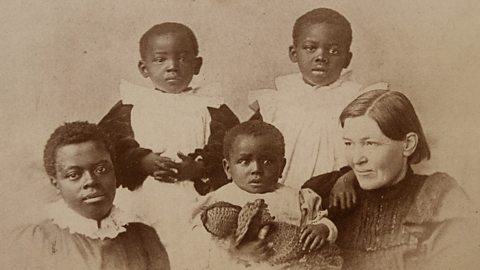
Mary Slessor (1848-1915) was also Scottish and a great admirer of Livingstone. She went to the southeastern part of present day Nigeria (Calabar) and worked tirelessly to improve the welfare of the local Efik and Okoyong people. She didn’t emphasise their conversion to the Christian faith, but focused on developing a more just and free society. One of her goals was to save the lives of children, especially twins, who were often the victims of local superstition and violence.
Rhodes’ confession
In South Africa, a young man named Cecil John Rhodes led the way in exploiting the diamond mines that were discovered in Kimberley in the north of the Cape Colony in the 1860s. Rhodes went to Oxford University after he had begun his diamond business activities. Then in 1877 he wrote down a statement of his vision for the All the territory across the world that was ruled by Britain. At its height in the 1920s it covered near a quarter of the world's land and included one fifth of the world's population. around the globe called ‘Confession of Faith’. He was utterly convinced of British superiority, which he extended to the Americans as fellow Anglo-Saxon peoples. His vision of British rule going from the bottom to the top of Africa (Cape to Cairo) lay behind his invasion of African territories in the south and the creation of the colony of Rhodesia (named after him in 1895).
Jingoism
There was a great deal of intense enthusiasm for British imperialism in the United Kingdom in the late 19th century. Some of these sentiments were Fear or hatred of strangers or foreigners. and some were Beliefs or behaviour that lead to discrimination towards an individual or group because of their race.. The term 'When a person believes that their country is always right and who is in favour of aggressive acts against other countries.' was used to describe this patriotic enthusiasm.
More guides on this topic
- Britain, migration and empire overview, c790 - present day
- Motives for migration to and from Britain - economics and commerce
- Motives for migration to and from Britain - religion and ideas
- Motives for migration to and from Britain - war and government
- Motives for migration to and from Britain - geographical summary
- Migration's effect on Britain - economics and commerce
- Migration's effect on Britain - religion and ideas
- Migration's effect on Britain - government
- How Britain gained an empire - economics and commerce
- How Britain gained an empire - war
- How Britain gained an empire - government
- How Britain gained an empire - geographical summary
- How Britain lost an empire - ideas, race and culture
- How Britain lost an empire - war and government
- How Britain lost an empire - geographical summary
- Britain: Migration, empires and the people - exam preparation
