English reforms of Indian ways and the Great Rebellion
Expansion and empire
The British had allowed the East India Company to operate independently in India up to the end of the 18th century, but they became concerned that the Company's men were getting too powerful. The term ‘nabob’ was used to describe English men who took power over Indian subjects and controlled more than just trade. Some nabobs were enthusiastic about Indian culture, took up native customs and married Indian women. This made the British establishment in London suspicious of the Company’s conduct in India and led to government intervention to control the power of the Company from 1784 onwards.
English reforms of Indian ways
Thomas Macaulay was a British official who wanted to transform India and introduce English ideas about government, education and morality to the country. Macaulay believed that western education in India would create a race of ‘brown Englishmen’. He passed the English Education Act for India in 1835.
One British change that caused great anger amongst Indians was the so-called ‘Doctrine of Lapse’ which was introduced by Lord Dalhousie in 1848. This was a British law that banned an Indian prince without a natural heir from adopting a successor. Unlike 19th century England, in India adopted children had the same legal status as biological children. Under the new law, if an Indian prince did not have a natural heir then the British immediately took his land. This interference in Indian traditions upset the Indian princes.
The Great Rebellion
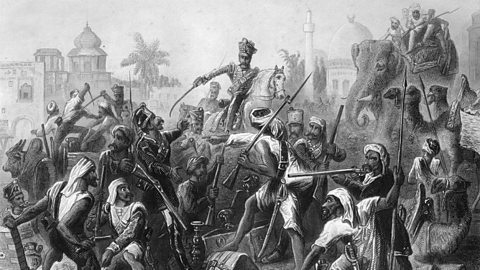
Relations between the Indian soldiers (sepoys) in the armed forces that the East India Company kept in India and the British authorities were very poor in the 1850s. There were rumours that the new bullet cartridges were greased with animal fat that would be unclean for either Hindus (beef fat) or Muslims (pork fat). The sepoys felt that the British did not respect their religion and this was a major reason for their mutiny in 1857 that prompted the Great Rebellion.
- In April 1857, during the Great Rebellion, 85 sepoys refused to use the new cartridges which they felt were unclean.
- The 85 sepoys were court-martialled and imprisoned. At the sentencing, the British humiliated the sepoys by stripping their uniforms and shackling their ankles in front of 4000 other sepoys.
- Shocked by the humiliation they had witnessed, the 4000 sepoys mutinied. They quickly overwhelmed the British and the imprisoned sepoys were released.
- The sepoys then began to shoot every British man, woman and child in sight.
- When the British troops eventually restored control, they executed thousands of sepoys and other Indians.
After the chaos and carnage of the rebellion, the British government centralised control of the Indian Empire to Westminster and took away the East India Company’s power.
More guides on this topic
- Britain, migration and empire overview, c790 - present day
- Motives for migration to and from Britain - economics and commerce
- Motives for migration to and from Britain - religion and ideas
- Motives for migration to and from Britain - war and government
- Motives for migration to and from Britain - geographical summary
- Migration's effect on Britain - economics and commerce
- Migration's effect on Britain - religion and ideas
- Migration's effect on Britain - government
- How Britain gained an empire - economics and commerce
- How Britain gained an empire - war
- How Britain gained an empire - government
- How Britain gained an empire - geographical summary
- How Britain lost an empire - ideas, race and culture
- How Britain lost an empire - war and government
- How Britain lost an empire - geographical summary
- Britain: Migration, empires and the people - exam preparation
