Competitive factors
Competitive factors cover how businesses who offer similar products or services affect each other. This includes:
- imitators
- price wars
- product differentiation
- promotional campaigns
Imitators
When a successful product is introduced, rival organisations will often respond by trying to undercut it by quickly producing cheaper alternative versions.
Price wars
Companies may start a price war in order to gain customers and increase market.
A price war happens when companies compete for customers by dropping their prices below the rate of their competitors. A price war can be good for customers as they can get the goods and services they want at lower prices.
In a price war, prices can drop so low that none of the competing companies can make much of a profit on the goods.
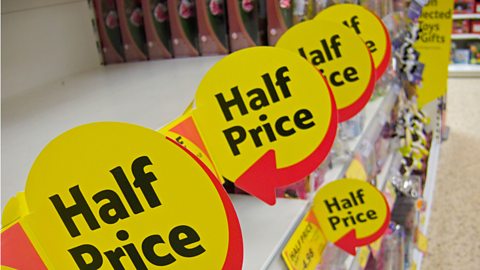
The size of the competitor may also affect a business. A small furniture shop may find itself in trouble if a new IKEA open up near it. IKEA can buy their supplies and manufacture products in bulk, which reduces costs. They can pass on these cheaper prices to customers.
Supermarkets have a competitive advantage over smaller grocery stores as they are able to offer A product sold at a loss, in order to attract customers to attract customers. This is when goods or services are advertised and sold at below cost price. Its purpose is to attract customers into the supermarket on the assumption that they will go on to buy other products at full price. Large supermarkets are able to deal with these losses because they are small amounts compared to the business’s overall profits. A small furniture shop may find itself in trouble if a larger furniture retailer opens next to it. The larger firm can buy their supplies.
Product differentiation
Businesses can become more competitive by making products that stand out from the competition in terms of price, quality or service. This is called product differentiation. Methods of creating product differentiation include:
- Establishing a strong brand image (personality) for a good or service.
- Making the unique selling point of a good or service clear. For example, opening a chain of discount shops with the tagline 'Quality items under a pound'.
- Other competitive factors, such as a product having a better location, design, appearance or price than rivals.
- Rivals may introduce new products or variants that better meet the needs and wants of target customers.
Promotional campaigns
Businesses can invest in techniques to attract customers away from their competitors - eg social media campaigns, or direct marketing. If competitors don't respond this could result in loss of sales and profits for them.
