Sacraments - Eucharist
Different Christian beliefs about sacraments
For Christians who broke away from the Roman Catholic Church during the Reformation. They believe in the teachings of the Bible but reject the authority of the Pope., only baptism and the Eucharist are sacraments. This is because they only believe in the sacraments performed by Jesus in the The teachings of Jesus and the apostles..
Other Christian A group within a religion. Christian denominations include, for example, Roman Catholic and Anglican denominations. recognise other sacraments. The A group of Christians who accept the Pope in Rome as their leader. Church recognises seven sacraments, which are performed at special or challenging times in a person’s life when there is a need for God’s grace.
A day in the life of Catholic student and photographer, Jason
Some Christians, such as Quakers, do not perform any sacraments at all. They instead think of all actions as Holy, related to God. Connected to a religious purpose.. They believe that rituals are not needed to communicate with God or receive his grace.
Communion (or Eucharist)
Jesus took bread, and when he had given thanks, he broke it and gave it to his disciples, saying, ‘Take and eat; this is my body.’ Then he took a cup, and when he had given thanks, he gave it to them, saying, ‘Drink from it, all of you. This is my blood of the covenant, which is poured out for many for the forgiveness of sins.’
The bond uniting Christians with each other and with Jesus, celebrated by most Christians through a service of remembrance of the Last Supper. Bread and wine (or a non-alcoholic substitute for wine) are blessed and shared. refers to a bond uniting Christians with each other and with Jesus. Most Christians celebrate Communion through a service of remembrance, where they remember Jesus’ words and actions during the The meal that Jesus had with his disciples the night before he died where he gave them bread and wine to symbolise his body and blood.. St Paul reminds Christians that Jesus told them to share out bread and wine in memory of him and his The act of giving something precious to another person or to God. for humanity (1 Corinthians 11:23–6).
During Communion, bread and wine are blessed and shared. This service is regarded by many Christians as a sacrament and is often called the A service celebrating the sacrificial death and resurrection of Jesus Christ, using elements of bread and wine..
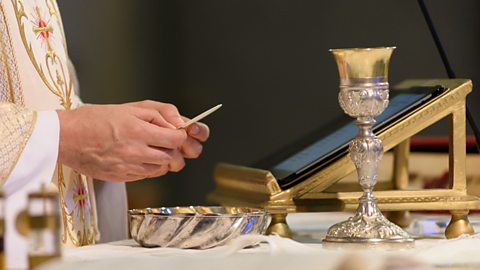
Eucharist in Catholic and Eastern Orthodox Churches
The bread and wine are very important to A group of Christians who accept the Pope in Rome as their leader. and A branch of Christianity, eg the Church in Greece.. This is because they believe that during Holy Communion, the bread and wine are transformed into the flesh and blood of Jesus Christ while still seeming to be bread and wine. This is called Catholic belief that the bread and wine is changed into Christ's body and blood at the Eucharist..
Catholics are given bread by the priest and wine from a shared cup, whereas Orthodox Christians take the bread and wine from the same spoon.
Communion in Anglican Churches
Similarly to Catholics, An adjective describing the Church of England or a member of the Church of England. Christians take the bread from the priest and the wine from a shared cup at Communion. However, they differ from Catholics and Orthodox Christians because they believe in consubstantiation. This is the belief that the bread and wine contain Jesus’ spiritual presence, but do not literally transform into his body and blood.
Question
What do Catholic and Orthodox Christians believe about the bread and wine used at the Eucharist?
They believe that the bread and wine are transubstantiated, meaning that although they appear the same, they have miraculously become the body and blood of Jesus.
