Baptism
Jesus’ cousin For Christians, the person who came to prepare the way of the Messiah, Jesus Christ, and who baptised him in the River Jordan. was the first Jew to use Rite of initiation involving immersion in, or sprinkling or pouring of water; a sacrament marking the start of Christian life. to symbolise the To pardon someone for something that they have done wrong. of sins. He baptised Jesus, and baptism remains important for Christians. This is because after his The Christian belief that Jesus rose from the dead on the third day after the crucifixion. The rising from the dead of believers on the Last Day in a new, or risen, life., Jesus told his followers that they too should be baptised:
No one can enter the kingdom of God unless they are born of water and the Spirit.
Following this instruction, baptism is practised by nearly all Christian A group within a religion. Christian denominations include, for example, Roman Catholic and Anglican denominations.. Christians believe that baptism cleanses people from The tendency to sin in all human beings, believed to be inherited from Adam, 'the first man'. and welcomes a Christian into God’s family.
Infant baptism
Some Christians baptise babies as soon as possible after they are born. This is known as infant baptism. Some Christians believe that Heaven can only be entered by those who are baptised. For these Christians, it is important to baptise babies as quickly as possible.
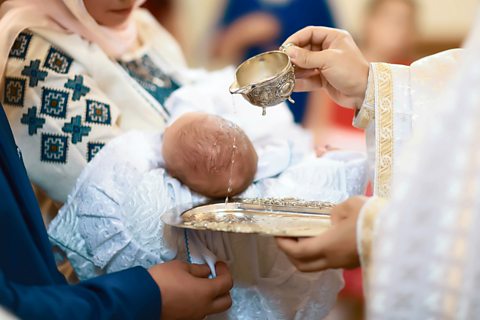
For Groups of Christians, especially found in eastern Europe, who rejected the idea of the Bishop of Rome being the sole leader of the Christian Church., infant baptism involves To fully cover someone with water as part of the baptism ceremony.. In other denominations, priests use holy oil to make the sign of the cross on the baby’s head before sprinkling the baby with Water that has been blessed by a priest or member of the clergy.. The priest repeats Jesus’ instruction to baptise … in the name of the Father, Son and Holy Spirit (Matthew 28:19).
There are other elements to a baptism service. For example, Someone who promises to guide their godchild in religious matters in a Christian baptism ceremony. promise to reject evil on behalf of the child. At the end of the ceremony, the priest gives the child’s guardians a lit candle, which symbolises receiving the light of Christ.
Believers’ baptism
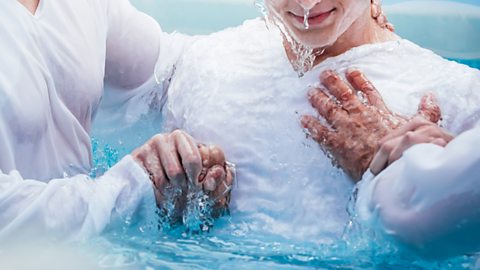
The baptism of people who are old enough to understand the meaning of the rite. is practised by Group, or church, placing particular emphasis on the gospel and the scriptures as the sole authority in all matters of faith and conduct., A member of the Baptist Church, or a Christian who practices believers' baptism. and A Church that emphasises certain gifts, eg healing the sick, which were granted to the first believers on the Day of Pentecost.. These denominations teach that baptism should only occur once somebody is an adult because:
- Becoming part of a faith community is an important commitment that people should choose for themselves.
- Christians should follow Jesus’ example as closely as possible, and he was baptised as an adult.
- The Bible seems to support adult baptism - there are no examples of babies being baptised in the Bible.
- Jesus does not recommend baptising people as soon as they are born. In the Bible, a person called Nicodemus asks Jesus,
How can someone be born when they are old?. Jesus replies,
You must be born again (John 3:4, 7). This shows that baptism (being “born again”) was practised on adults (people who are “old”), rather than infants.
Believers’ baptism involves total immersion, where the person being baptised walks into a special pool and is fully submerged three times before walking out into their new life.
Question
What does baptism do?
Baptism cleanses a person of Original Sin and makes them fully part of the Christian community.
