Festivals
There are many festivals in the Jewish calendar that are very important. Not only do they allow for communities to gather together but they also link Jews to their past.
Rosh Hashanah
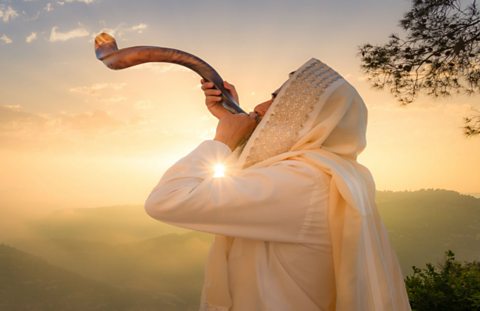
The Jewish New Year festival. is a two-day celebration that marks the beginning of the Jewish New Year. In the UK, Jewish New Year usually occurs in the early autumn. This is a time for Jews to focus on their relationship with God and consider any wrongdoings of the past year. The festival is often associated with the A ram's horn that is blown like a trumpet, especially during Rosh Hashanah and Yom Kippur. as this is blown every day during the last month of the year and on Rosh Hashanah itself. The sound is a call to Remorse for your past actions..
The Law; teaching. The word Torah can be used in a narrow sense to mean the first five books of the Hebrew Bible (The Five Books of Moses) and also in a wider sense to include the whole of the Hebrew Bible and the Talmud. also advises that Rosh Hashanah should be a day of rest:
You are to have a day of Sabbath rest, a sacred assembly commemorated with trumpet blasts. Do not do any of your ordinary work.
During Rosh Hashanah, Jews spend a lot of time in the Building for Jewish public prayer, study and assembly. and reading from the Torah. Jews often eat apples dipped in honey during Rosh Hashanah to symbolise the hope for a sweet or pleasant new year. Jews also take part in the A cleansing ceremony which takes place during the Jewish festival of Rosh Hashanah., or casting away ceremony. During the ceremony, a prayer is said near water as it is believed the water can cleanse the sins of the people taking part.
Yom Kippur
Yom Kippur falls ten days after Rosh Hashanah and is considered among many Jews to be the holiest day of the year. In Hebrew it is known as ‘the day of atonement’. For this reason, no work is done during Yom Kippur. Many Jews fast for 25 hours to help them focus on God. This is one of the Commandments or laws in Judaism. in the Torah. During this time, Jews ask God for forgiveness for all that they have done wrong.
Attendance at the synagogue is central to the celebration of Yom Kippur.
Differences among Jews in celebrating Yom Kippur
Some Jews who live by the Torah and rabbinic law (halakhah) and who only accept changes that can be supported by the Torah. prepare for Yom Kippur by taking a ritual bath at the mikveh (cleansing pool) the evening before Yom Kippur. They may also wear white robes as a sign of purity and cleanliness. Jews who have adapted their laws and practices as modern life has changed. are less likely to abide by a dress code as they do not follow the commandments in the Torah as strictly as Orthodox Jews.
Question
How do Jews celebrate Rosh Hashanah?
Jews spend a lot of time in the synagogue during Rosh Hashanah. They may also read from the Torah. Often they will eat apples dipped in honey. Jews may also take part in the Tashlich ceremony.
