Rituals – marriage and mourning
Much of Judaism is focused on marriage and family life. Therefore, the marriage ritual is central to Jewish life. Weddings usually take place in a Building for Jewish public prayer, study and assembly. and include lots of symbolism.
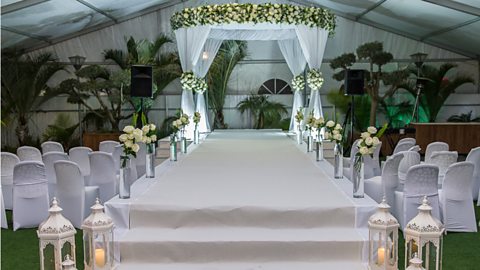
The wedding ceremony takes place under a A canopy used during a Jewish wedding. It is representative of the couple’s home. or canopy. This represents the home that the couple will build together as husband and wife. An important feature of the ceremony is the Jewish marriage contract stating the rights and obligations of both partners., which is a marriage contract in which the groom makes promises to his new wife.
Finally, a glass is broken by being stepped on. Jews have various interpretations of the meaning of this. Some believe it symbolises the destruction of the The central place of Jewish worship in Jerusalem from biblical times until AD70. in The capital city of Israel when Jesus was alive. The city where he was crucified, buried and rose again. whereas others believe it shows that love needs to be protected.
Mourning rituals
Death in Judaism triggers a series of important rituals. As soon as a Jew hears of the death of a loved one, they make a tear in their clothing to show their grief. The funeral is then arranged as quickly as possible. During the time before the funeral, the body is usually not left alone.
There are then various stages of mourning. These are called In Judaism this is a seven-day period of intense mourning following the burial of a close relation. During this period, all ordinary work is prohibited., The year of mourning required in Jewish custom for the loss of a parent. The kaddish, a prayer of mourning, must be said every day. and Yiddish word referring to the anniversary of the death of a close relative..
Stages of mourning
| Shiva | Avelut | Yahrzeit |
| The first seven days of mourning after the burial. Close family mourn during this time and some Jews will not leave the house. | If someone has lost a parent, they will mourn for a whole year. During this year they will not attend parties and will say a blessing called the Kaddish every day. | Yahrzeit is the anniversary of a death. The night before, many Jews light a candle in remembrance of the dead. The candle is kept burning for 24 hours. The Kaddish is said on this day. |
| Shiva | The first seven days of mourning after the burial. Close family mourn during this time and some Jews will not leave the house. |
|---|---|
| Avelut | If someone has lost a parent, they will mourn for a whole year. During this year they will not attend parties and will say a blessing called the Kaddish every day. |
| Yahrzeit | Yahrzeit is the anniversary of a death. The night before, many Jews light a candle in remembrance of the dead. The candle is kept burning for 24 hours. The Kaddish is said on this day. |
Differences in practices
Orthodox Jews are usually very strict in their observance of these rituals, but Reform and Jews who are willing to adapt religious law to modern life. choose which rituals to take part in. For example, for seven days after the death of a close relative, Orthodox Jews do not leave the house. Although some Reform and Liberal Jews do observe this ritual, it is more unusual among these groups.
