Synagogue
A Building for Jewish public prayer, study and assembly. is a place of Jewish worship, gathering and education about the Jewish faith. The word synagogue means ‘assembly’ and refers to the fact that many Jews gather together in the synagogue with the common purpose of worshipping God. The The collected 24 books of the Jewish Bible. There are three sections: Torah, Nevi'im and Ketuvim (TaNaKh). May also be spelled Tenakh. states that a multitude of people is a king’s glory (Proverbs 14:28) and encourages Jews to gather for worship.
Although every synagogue is slightly difference in appearance, there are some features that are found in every synagogue.
Facing Jerusalem
Wherever possible, synagogues face the city of The capital city of Israel when Jesus was alive. The city where he was crucified, buried and rose again.. For synagogues in the UK, this would be east. Jews ensure they are facing Jerusalem when they are praying. This reminds Jews of the The central place of Jewish worship in Jerusalem from biblical times until AD70..
The Ark
The The cabinet in the synagogue where the Torah scroll is kept. is a central element of the synagogue as it contains the Law; teaching. The word Torah can be used in a narrow sense to mean the first five books of the Hebrew Bible (The Five Books of Moses) and also in a wider sense to include the whole of the Hebrew Bible and the Talmud. scrolls. It is located on the wall that faces Jerusalem. It symbolises the ark that held the tablets that God gave to The man chosen by God to save the Jews from slavery and take them to the promised land. In the Qur'an he is a messenger chosen by God to give the revelation of the Torah to the Israelites..
The Torah scroll
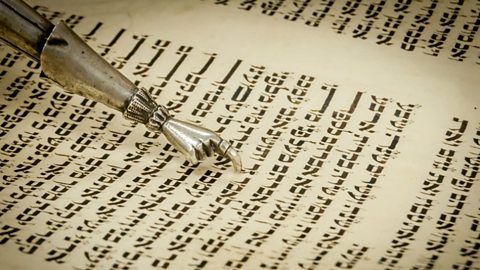
Inside the Ark are the Torah scrolls. These are wrapped and decorated ornately, usually with velvet or silk coverings. When they are read, a Hand-held pointer used in reading the Torah. is used. This is a pointing device used to follow the text so that the holy words are not damaged.
The bimah
The A raised platform primarily for reading the Torah in the synagogue. Also known as a dais. is a raised platform and is often found in the centre of the prayer hall. There is a reading desk, which the Torah is read from. The bimah represents the altar in the Temple.
The ner tamid
The ner tamid is placed above the Ark and is known as the everlasting light. The light is never put out as it represents the Seven-branched candelabrum which was lit daily in the Temple and is part of each synagogue. in the Temple, which was never allowed to be put out. This requirement is set out in the Torah:
Keep the lamps burning before the Lord.
The menorah
As well as the ner tamid, many synagogues also have a menorah. This represents the seven-branched candlestick that was always kept burning in the Temple.
Differences between Orthodox and Reform synagogues
Many of the differences between worship in Jews who live by the Torah and rabbinic law (halakhah) and who only accept changes that can be supported by the Torah. synagogues and worship in Jews who have adapted their laws and practices as modern life has changed. synagogues concern the roles of men and women. In Orthodox synagogues, women have much less responsibility within worship.
| Orthodox synagogues | Reform synagogues |
| There is separate seating for men and women | Men and women can sit together |
| Only men can read from the Torah | Both men and women can read from the Torah |
| Prayers are said in Hebrew | Prayers may be said in English |
| Orthodox synagogues | There is separate seating for men and women |
|---|---|
| Reform synagogues | Men and women can sit together |
| Orthodox synagogues | Only men can read from the Torah |
|---|---|
| Reform synagogues | Both men and women can read from the Torah |
| Orthodox synagogues | Prayers are said in Hebrew |
|---|---|
| Reform synagogues | Prayers may be said in English |
Question
Describe what the bimah is used for in the synagogue.
The bimah is often the central point of the synagogue as the Torah is read from here. It is a reminder of the altar in the Temple.
