Costume design
Costume is what the actors wear onstage. This can have a huge visual impact, as well as alerting the audience to character, place and the period of history in which the play is set. Choice of costume will vary according to the demands of the play. The costume designer must know the play well and be aware of the pace and structure of the piece. For example, it wouldn’t be practical if a character was working as a fireman and wearing an elaborate costume in one scene and relaxing at home in his own clothes in the next one. The symbolic addition of a hat in the first scene might be enough to represent the role and wouldn’t interfere with the flow from one scene to the next.
Production style and costume
The style of production will also greatly affect costume choices. A naturalistic production will aim to dress the character in an authentic costume that is as close as possible to what the characters would have actually worn in that setting. However, a Theatre in education piece might have a handful of actors playing many different parts. Most of the changes of character will be communicated by what the actors themselves do onstage using voice, body language etc. A simple costume might be used to enhance this, such as the addition of a hat, stick or shawl.
The costume designer will work closely with the director so that they have a shared vision. Perhaps the director has a particular colour scheme in mind for the piece. Or they may have chosen to set the play in a particular historical era which is not evident from the script, such as in a ‘modern’ production of a Shakespeare play. The costume designer must then select suitable garments and consider fabric and colours that are right for era and character.
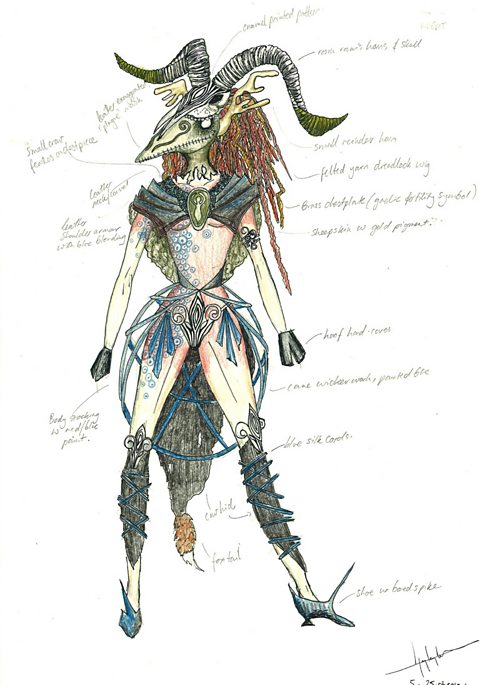
They will begin by producing sketches so the director can see what the characters will look like in relation to one another and then may make some sample costumes for characters to try. They must also work with the lighting designer as lighting can have a huge effect upon the visual impact of a costume.
Any Any object used on set or stage. Can help to denote time, place, character and add to the drama, eg Macbeth's letter read by Lady Macbeth. that an actor carries with them, such as glasses, an umbrella or a walking stick are also considered to be costume as they are an important part of the way a character is dressed.
