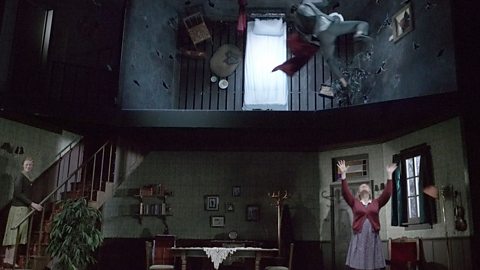
Lights and the lighting designer
Lights can be useful for defining different locations on the stage, creating mood and atmosphere, highlighting key moments of action and directing the audience’s focus. Lighting can denote time of year or day and can also be used in an The opposite of a realistic representation is an abstract representation where a character or concept may be symbolised in a poetic rather than literal way. or The use of images or things (usually physical, like a flag) that stand for or represent something else, usually something abstract like a nation. way, such as using a red light to symbolise danger or passion.
The lighting designer must also know the play very well. They work closely with the director to understand what they want to communicate in each scene and where the focus of the action onstage should be. They also work closely with the set designer, as they both play such a large role in the visual impact of a production. Often the realisation of the set designer’s artistic vision depends greatly upon the way their set is lit.
Increasingly Light-Emitting Diode. LEDs glow when current passes through them. is being used as technology advances. Lighting is also used in conjunction with state of the art ICT in productions like The Curious Incident of the Dog in the Night-Time.
The lighting designer designs lighting cues. That means they decide when to move from one lighting state to the next. A sudden change to a different lighting state is called a snap and a slow change where one state overlaps another is called a fade.
Just like set design, the style of lighting must suit the production. A A form of theatre designed to create the illusion of reality for an audience. Originated in the late 19th century. production of a Chekov play would not use symbolic lighting. A A performance or production which conveys meaning in an abstract/symbolic rather than realistic way. piece like Steven Berkoff’s Metamorphosis might use lighting that was more abstract and stylised.