Explore Earth with these 5 fascinating facts!
1. There weren't always seven continents
You might know that there are currently seven continents that make up the Earth:
Africa, Asia, Europe, North America, South America, Oceania and Antarctica.

However, many years ago, the Earth looked very different to how it does today. Around 250 million years ago, all of the continents were joined together as one supercontinent called Pangea. Over time, this huge mass of land split apart due to continental drift, eventually creating the seven separate continents we know today.
Some very simple proof that the continents used to be connected is visible on a map of the world. Look at the map. Can you work out where the continents were connected? South America links together like a jigsaw puzzle to Africa.
Other evidence for this process is found in fossils. There are similar fossils on both sides of the Atlantic - including the fossil remains of land animals that would have been unable to swim across from one side to the other.
2. Earth's core is as hot as the surface of the Sun
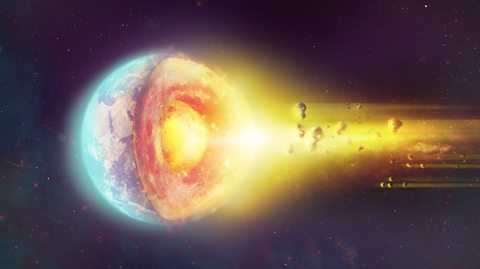
Well, in 2016, scientists found that the inner core of the Earth is much hotter than was once thought. When researchers used a new way of measuring the temperature, they found that the Earth’s inner core, made up of crystalline iron, is about 6000 degrees Celsius. With the surface of the Sun about the same temperature, it turns out part of our Earth is as hot as the Sun!
3. The days are getting longer
You might believe that the definition of a day has always been 24 hours, but since our planet was formed around 4.6 billion years ago, the length of a day has been gradually growing.
A day is the time period of a full rotation of the Earth with respect to the Sun. Over billions of years, the moon has been slowing down a full rotation of the earth due to the tides that the moon helps create.
Scientists believe that when the Earth was formed, a day was around only six hours long. This has gradually increased to the 24 hours we know today, but it’s still increasing! Unfortunately, this won’t make your weekends longer; the length of a day is only increasing by about 1.7 milliseconds every century. That means it would take around 200 million years to add an hour to your Saturday.
4. Earth isn’t a perfect sphere
Although our world is definitely not flat, it’s not a perfect sphere either.
The fancy name for the shape of the Earth is an oblate spheroid, meaning that it bulges around the equator. Earth's diameter from North to South Pole is 12,714 kilometres (7,900 miles), while through the equator it is 12,756 kilometres (7,926 miles).
Scientists have also discovered that the Earth is continuing to bulge due to the melting ice caps caused by climate change.
5. Climate change is causing flowers to change colour

To protect themselves from the rising temperatures and ozone levels caused by climate change, certain plants are darkening the colour of their petals.
Although the changes can’t be seen to the human eye, pollinators such as bees can see them. The UV-absorbing pigments in flowers work like sun cream to protect sensitive cells and pollen from harmful radiation.
Can't get enough of Earth and space?
Curious about our planet and its solar neighbourhood? Bitesize has got you covered.
