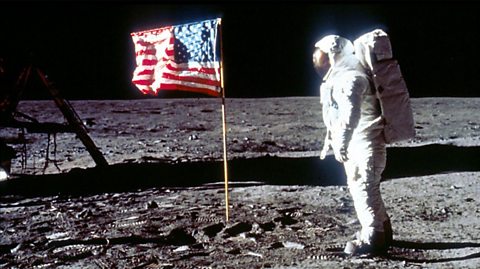
The Sun is hot, so it must be made of fire. Astronauts are so far away from Earth, they experience no gravity. Right?
Wrong.
Even though we've learned so much about space over the years, there are still a few common myths about the solar system that don't quite add up.
BBC Bitesize explores the truth about some of the things we get wrong when it comes to space.

The Sun is a big ball of fire
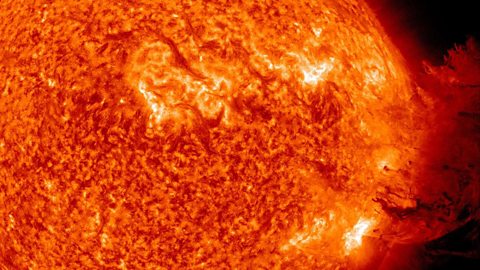
It may be hot (15 million°C at its core, in fact), but the Sun isn’t just one massive open flame.
It actually gives off heat and light through a process called nuclear fusion, where hydrogen atoms crash into one another creating helium.
You’ll explode if you go into space without a suit on
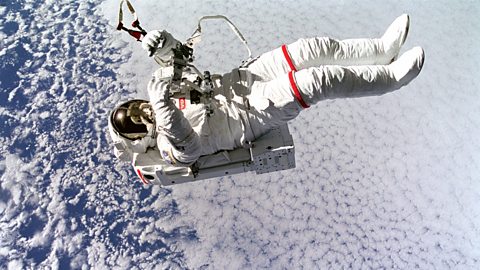
It’s a commonly peddled myth, especially in old science fiction movies, but it’s actually completely false.
The nitrogen in your body would expand and you’d bloat severely, and you'd eventually die. However, your skin is far too tough to let everything explode out of it.
The first animal in space was a dog

Laika was an adorable Russian dog that launched on Sputnik 2 in 1957. It was the first animal to orbit the Earth, however it wasn’t the first animal in space.
This title is reserved for the humble fruit fly. A few were launched into space by American scientists in 1947, to help them study radiation.
Astronauts experience zero gravity because they are far away from the Earth
 Image source, NASA
You’ve probably seen videos of astronauts like Tim Peake floating around the International Space Station, and you may think this has something to do with being so far away from Earth’s gravitational pull.
However, 90% of the Earth’s gravity actually reaches the ISS. So why do they float? It’s because they’re in what’s called ‘free fall’.
This means that in a vacuum, all objects fall at the same acceleration, regardless of their mass. Astronauts therefore are falling towards Earth at the same rate as the space station, so look like they are floating inside of it.
There’s a dark side of the moon
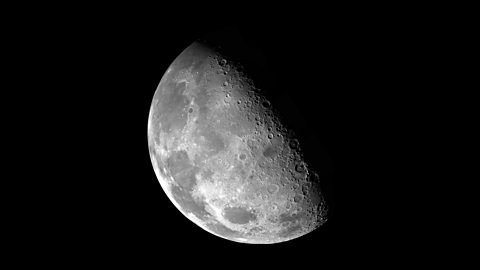 Image source, NASA
There is a side of the Moon that, from Earth, we can never see. This much is true. However, it’s a complete myth that it is in complete darkness all the time.
The Moon has daytime and night-time just as the Earth does, though each lasts two weeks, so both sides get sunlight at some point.
The reason it’s been historically called the ‘dark side’ is because it’s mysterious, and until recently, not much was known about it.
China have launched probes to explore the far side of the Moon, to learn more. However, the first images of the far side of the moon were taken in 1959.
Written in collaboration with the education team at Jodrell Bank Discovery Centre.
This article was published in October 2018 and updated in February 2026
Five times songs got things about space wrong
Can you really surf the sun? Is it worth waiting for a star to fall?
Hot sauce and over 200 food options: What do astronauts really eat in space?
From christmas dinner to birthday cake, BBC Bitesize takes a look at the tasty treats astronauts have whilst they are floating around in space
Astronaut Tim Peake's five favourite space films
How do you feel watching a movie version of space when you've experienced it in real life?