The wise and the wonderful
When you think of the stunning creatures that fly and glide through our skies – owls are bound to spring to mind. The beautiful birds come in different shapes, sizes and colours, but stand out for distinct features such as their striking eyes and soft feathers.
They have existed for millions of years. But how much do you know about them?
Here, BBC Bitesize takes a closer look and shares a number of facts about owls that you may not know. We’ve also taken a closer look at the different species, what they symbolise and much more!
What is an owl?
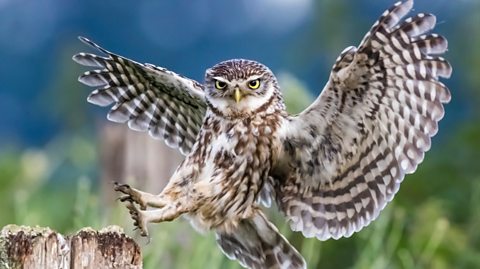
Also known as raptors, owls hunt, kill and eat animals and are birds of prey.They belong to the Strigiformes, which are primarily nocturnal – meaning active at night.
They are known for their large heads, hooked beaks, sharp talons, soft feathers and forward-facing eyes.
The Strigiformes are divided into two smaller groups or families. The Tytonidae family includes Barn Owls, Grass Owls and Bay Owls, and the Strigidae family includes “typical owls” such as Snowy Owls and Horned Owls.
A group of birds is called a flock. However, the common collective noun for a group of owls, is a parliament.
What types of owls are there?
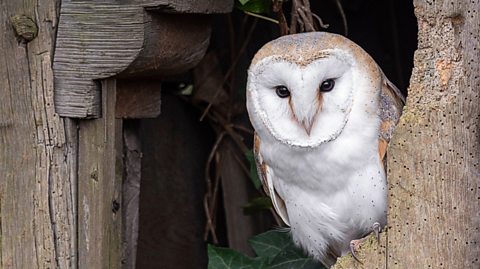
As mentioned above, there are numerous species that fall under different families, as well as live around the world. According to the Barn Owl Trust, there are five common types of owls in the UK – Barn Owls, Tawny Owls, Little Owls, Long-eared Owls and Short-eared Owls.
There are over 250 recognised species of owl,. They are found in most habitats, from mountains forests to the desert and beyond.
The Guinness World Records states that the earliest known species of owl is the Berruornis orbusantiqui, which date back approximately 57-60 million years.
The life span of owls varies depending on the species. Some do not survive infancy or only live for a few years, whereas others can live for decades, especially those in captivity or conservation areas.
What sound does an owl make?
Owls are usually associated with making a loud, hooting sound. But what sounds do they actually make?
Here, we focus on the common UK owls. They are Barn Owls, Tawny Owls, Little Owls, Long-eared Owls and Short-eared Owls.
According to the Woodland Trust’s guide to owl calls, the Barn Owl has earned the nickname “screech owl” for the screeching sound it makes. As for the Tawny Owl, they have the more stereotypical hooting sound we associate with owls.
However, the classic “twit twoo” sound is in fact made by two Tawny Owls – a male and a female. Little Owls tend to make short “woop” sounds or a sharper “kiew kiew” sound.
In Long-eared Owls, the male usually makes a soft “hoo” call, whereas the female makes a higher pitched “hoo” sound. However Short-eared male owls have a song consisting of fast and repetitive hoots.
Both male and females are also known to make screeching or more harsher barking sounds.
What do owls eat?
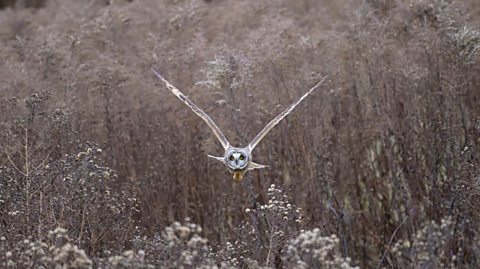
When you see owls flying, they may be about to get their food. When it comes to diet, this is diverse as various species live in different habitats.
As a result, their diet depends on their environment and the species that live there. Some eat invertebrates, like earthworms, spiders or other insects. Others hunt and eat rodents, such as mice or voles, and even small mammals and other birds.
Due to their environment, some species even specialise in hunting, killing and eating fish. These type of owls include African Fishing Owls and Asian Fish Owls.
Do owls have eyeballs?
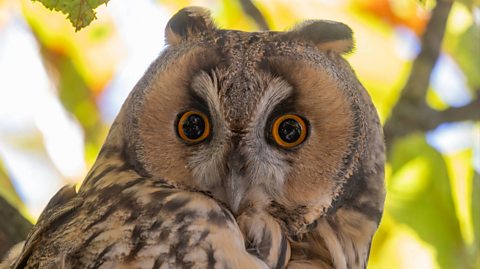
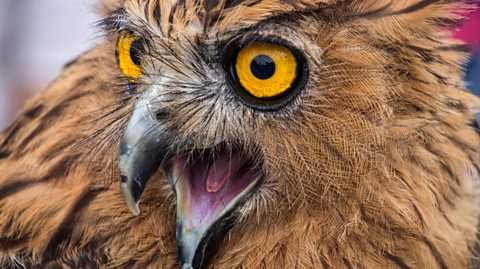
Now for the more random question – do owls have eyeballs? Owls often have yellow or brown eyes and, while they are well developed, they are not spherical eyeballs like those of humans.
They technically have elongated, tube shaped eyes. They are held in place in the skull by sclerotic rings, which are bony structures.
Their shape and size mean they cannot move or roll their eyes as humans do with their eyeballs. But that’s ok, as owls have the ability to turn their heads around to see the environment around them.
Another interesting fact is that they have three eyelids per eye. They all have different uses - one for blinking, one for sleeping and the third to keep the eye clean and protected.
Other fascinating facts about owls you may not know
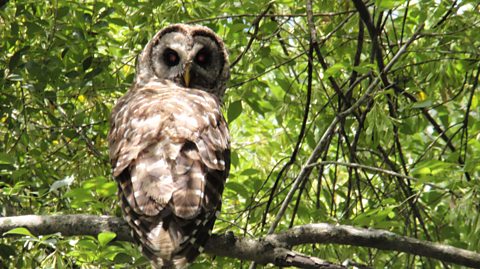
Owls cannot turn their head a full 360 degrees like some may believe. The correct measurement is movement of up to 270 degrees.
Their feathers not only provide camouflage for different species in their environment but help them fly silently. This enables them to swoop in and catch their prey without their movement being detected.
In the majority of species, female owls are bigger and heavier than males. Owls do not hibernate and as hunters, remain active in the winter.
What do owls symbolise and how are they portrayed?
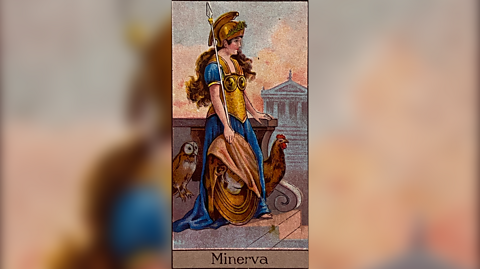
Throughout history, owls have been thought to represent wisdom. You may have also heard the idiom “as wise as an owl” used in day-to-day life.
This symbolism dates back centuries across various cultures. For example, in Greek mythology, an owl often accompanies Athena, the goddess of wisdom, strategy and warfare. The ‘owl of Athena’ is also known as the owl of Minerva – the Roman equivalent to the Greek goddess.
There is also a species of owl called the Little owl (Athena noctua). In Hinduism, owls are often associated with Lakshmi, goddess of wealth, good fortune and beauty.
In children’s literature, owl characters continue to symbolise wisdom and even magic. In A.A. Milne’s Winnie-the-Pooh, the Hundred Acre Wood is home to many animals, including the wise and educated Owl. In the Harry Potter book series, the lead character’s owl, Hedwig, is not only a messenger but also a companion.
But in literature, as well as other myths and folklore, they can also symbolise bad omens and even death. This can be found in older literary works, such as those of William Shakespeare.
This article was written in February 2026
