This article was first published in November 2020.
What advice would you give to your younger self if you could meet them now you’re a bit older and wiser? We asked this question to 12 super-talented performers and broadcasters who have all experienced direct or indirect racism.
In this series, they share their stories and talk about how they were judged as teenagers. Here we have Dev Griffin and Sèverine Howell-Meri to tell us about what it was like growing up and how they deal with what they see in the news and on social media today.
We also spoke to psychotherapist, Kemi Omijeh, for some advice on what you can do to take care of yourself from a psychological perspective, if you're affected by prejudice or racism. Look out for her tips further down the page.
Sèverine: She was very aware of racism and discrimination, but what she was missing was the vocabulary and the courage to articulate herself against it. She would often laugh along with it even though it really hurt when other people told her that her hair looks better when it’s straight, she would straighten it. When other people told her that her lips were too big, she would try and smile to make them look thinner – that was her way of dealing with it.
Dev: He experienced racists, name calling, he feels a real sense of injustice. If you’re black, if you’re brown, if you look different, you could be attacked just for looking how you do and that’s a really hard concept for him to get his head around.
Sèverine: She’d experienced it from very young – all throughout school as well. She identified it as people asking her which side she prefers more, her white family or her black family. People making comments about the shade of her skin, making comments about racism and saying that it doesn’t exist anymore.
Dev: I had a teacher – she got really annoyed instantly and she said, ‘stop standing round, you look like a thug down an alleyway’ and just kind of stormed off. I wasn’t doing anything, I was literally trying to be out of the way, and she probably never even thought anything of it. The way that I interpreted it was, oh, I’m going to go through life – regardless of how I carry myself, how I dress or what I’m doing, to somebody else, I’m just going to be a thug down an alleyway. I guess that still affects me now, as an adult, I feel like I have to carry myself a certain way. It’s not my job to go around teaching white people, ‘see we’re not all the same’ – that’s exhausting, that’s not on me to do that. I wish I’d worked that out sooner.
Sèverine: When things get hard, especially around year twelve, you will have teachers who will offer sessions with the school therapist – take them, because that is a space for you and you are allowed to have a space for you to be angry.
Archive footage: Black lives matter, I can’t breathe.
Newsreader: Protesters say they are seeing the impact
Dev: It’s such a hard thing to try and work out – you want to be informed about what’s going on in the world but you also don’t want it to negatively affect your mental health.
Sèverine: You guys have had a global pandemic, and you are having your exams to think about on top of all of the police brutality that is being brought to your screens every single day.
Dev: I feel like the part of our brain that is fight or flight that just tries to go into survival mode is in overdrive at the moment just trying to normalize everything that is happening. I think we can take some measures to try and look after ourselves.
Sèverine: Write things down, that is a really great, easy, accessible way for a lot of people to channel what they need to channel. There are tonnes of free meditation videos online – trying something new can also be a really great distraction from everything that’s going on.
Dev: It’s not on you to save the world on you own, what’s more important is that you look after yourself – that in it’s way is a protest. By looking after yourself, making sure that your mind is right so that when you’re maybe ready to have these conversations, or show your support in a different way, you’ll mentally be ready.

Dev Griffin
Dev Griffin is a radio and television presenter who’s worked on Radio 1 and Radio 1Xtra. His love of music has seen him DJ all over the UK, but in 2019 he moved from the DJ booth to the dancefloor when he joined the line-up for Strictly Come Dancing.
Dev is always up for a challenge: he made it to the finals of the Celebrity MasterChef contest and has also appeared on SAS Who Dares Wins for Stand Up To Cancer. Dev wants young people to look after their wellbeing and not allow racism to have a negative impact on their mental health.
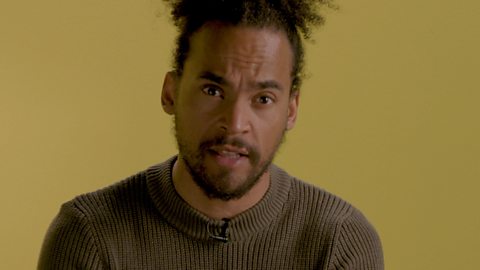
Present Dev on teenage Dev:
He experienced racists, name calling – he feels a real sense of injustice
Sèverine Howell-Meri
Actress, Sèverine Howell-Meri is known for playing Helen Young in the TV series, Hanna. She has also appeared in programmes like Doctors, Casualty and Us.
Sèverine was brought up in South West London and recently set up her own YouTube channel to offer practical tips to up-and-coming actors. She believes it’s important to get help and support if you’re experiencing racism.

Present Sèverine on teenage Sèverine:
When other people told her that her lips were too big, she would try and smile to make them look thinner
What can you do to take care of yourself if you're affected by racism?
We asked psychotherapist, Kemi Omijeh, to take a look at Dev and Sèverine's film and share her thoughts from a mental health perspective.

Kemi: What stood out to me in this video are the unconscious messages that black people receive that you’re not good enough, and that you’re different in a negative way. Comments about your lips, your hair, comments that liken you to “a thug,” and talk about the shade of your skin – these are all an attack on your identity. Whether this is a conscious intent or not, this falls under covert racism. Covert racism is still racism, it’s just more subtle and less direct.
You can help reaffirm your identity and who you are by taking the following steps:
Be aware and mindful of the messages you might be receiving – if you find yourself thinking that your lips are indeed “too big” or that “lighter skin is more attractive,” that “wearing a hoodie is intimidating” – take a moment to ask yourself why you’re believing this to be true, and how you came to that conclusion. Is it possible you’ve been exposed to images and messages in the media that you’ve internalised and accepted as the norm? Be clear in your mind about which opinions belong to you and which opinions belong to others
Actively challenge any stereotypes or slurs that might come your way – in certain situations, you may feel that you have to laugh along and that you can’t challenge a comment, and that’s okay. You can challenge in other ways. Try writing down everything that was wrong about what you heard and then write down positive things that you know to be true about yourself
Surround yourself with positive images – these might include photographs of people who look like you or have a similar background to you. This can act as a great protective barrier for those times when you experience racism. You don’t have to feel powerless against it, celebrating yourself – even in a small way – is an investment in your mental health. Good mental health is essential to your coping strategy against racism.
Be aware of your own fight-or-flight responses – in the film, Dev mentions the fight flight response. The fight flight response is something that we all have in built in us, it is how we react to feeling threatened. It is a physiological response that we often don’t have control over. There is a third response, freeze. So as an example, you have crossed the road without looking and suddenly a big truck is speeding down the road heading straight for you. Your fight response might be screaming, clenched fists. Your flight response would be running. Your freeze response might be being frozen to the spot and feeling numb. In this example even though the sensible thing would be to run, get out the away. Sometimes our brain just doesn’t work like that, particularly when we feel under threat, rational thought goes out of the window
There’s more than one way to respond – fighting on a daily basis is exhausting. Our body and our mental health can’t stay in fight mode all the time, so pause, take a break, seek rest, seek joy. You may begin to question your responses, why you are doing “nothing”, this could be a freeze response and is perfectly understandable.
If you need support
You should always tell someone about the things you’re worried about. You can tell a friend, parent, guardian, teacher, or another trusted adult. If you're struggling with your mental health, going to your GP can be a good place to start to find help. Your GP can let you know what support is available to you, suggest different types of treatment and offer regular check-ups to see how you’re doing.
If you’re in need of in-the-moment support you can contact Childline, where you can speak to a counsellor. Their lines are open 24 hours a day, 7 days a week.
There are more links to helpful organisations on the BBC Bitesize Action Line page for young people.
Notes to my teenage self: Danny Sapani and Abubakar Salim
Danny Sapani and Abubakar Salim talk about the racism they saw as teenagers and what they've learnt over the years.
Notes to my teenage self: Percelle Ascott and Remel London
Percelle Ascott and Remel London talk about the racism they experienced as teenagers and what they've learnt over the years.

Notes to my teenage self: Sir Lenny Henry and Kadeem Ramsay
Sir Lenny Henry and Kadeem Ramsay talk about the racism they experienced as teenagers and what they've learnt over the years.