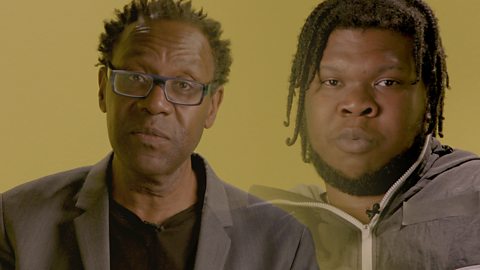
This article was first published in November 2020.
What advice would you give to your younger self if you could meet them now you’re a bit older and wiser? We asked this question to 12 super-talented performers and broadcasters who have all experienced direct or indirect racism.
In this series, they share their stories and talk about how they were judged as teenagers. Here we have Percelle Ascott and Remel London about what it was like for them growing up and how they deal with what they see in the news and on social media today.
We also spoke to psychotherapist, Kemi Omijeh, for some advice on what you can do to take care of yourself from a psychological perspective, if you're affected by prejudice or racism. Look out for her tips further down the page.
Percelle: He didn’t know the value of who he was, he didn’t know the value of where he came from, he didn’t understand the importance of being yourself. On his second week of school, he came into school with a new haircut which was a number one on the sides, a two on the top – a very normal haircut. He received isolation from his school due to the fact that they thought it was an extreme haircut, and from there he had to learn how to play a different type of game. Who he was inside was never going to be accepted.
Remel: I don’t think she experienced racism first-hand, but I know she was very aware that it’s something that can potentially happen. It does kind of make me think that she was probably thinking, this is a thing of the past – I probably won’t have to address this at any point so, I don’t think she saw it as an existing issue.
Percelle: I changed the way I looked – my hair, I texturized my hair to almost straighten it as much as I could. I was scared of people knowing where I was from because, then they would have this perception of me which they would write me off. You don’t know how to solve something if you don’t know that it’s broken, so you normalize it and you think that this is the way that life is supposed to go.
Remel: Having cousins that are boys, and being aware that boys might have to be mindful of the police, and things like that and having talks with aunties about their fears for their sons or even her. I’m sure she was just hopeful that it never would be a part of her life
Percelle: He was finishing school in Surrey at the age of 16 and went on to The BRIT School and where The BRIT School was located was in Croydon, so he was going back to an environment that he grew up in – an environment that he felt comfortable in, and people who looked like him, and a school which championed him to be different. And I think the process of removing fear from his choices was the biggest breakthrough in him discovering his triumph.
Archive footage: Black lives matter
Remel: I think it’s really important that we use social media to share information, educate ourselves, but at the same time, I feel like it can be information overload. So, if anything does feel distressing, I would say, flag it, don’t be afraid to report something if it’s too much or don’t be afraid to literally switch off. I don’t think it’s healthy to always be receiving negative images.
Percelle: It’s so difficult because you’re seeing people’s perspectives and it angers you because you’re seeing sometimes ignorance on that screen, and there’s nothing you can do about it. At that point, for me, I have to take time out and just decompress.
Remel: It is important to share news and information about some of the injustices so that we can do something about it, but at the same time, enough is enough.
Percelle: There are other sources out there, outside of your family and friends that you can go to and be given the type of support that you’re looking for.
Remel: First and foremost, you need to look after your mental health, your physical health, and then, once you know that you’re okay, you can think about how you can be an activist or how you can be a change maker.

Percelle Ascott
Percelle Ascott is an actor, writer and producer who was born in Zimbabwe. He played Benny in the CBBC’s show, Wizards vs Aliens and was also a regular on the television series, Youngers. Percelle has a passion for comedy and co-founded the YouTube channel, Wall of Comedy – a platform for original UK artists.
Percelle thinks it’s important to take time out from social media at times – this is something he puts into practice when he’s feeling upset or frustrated.
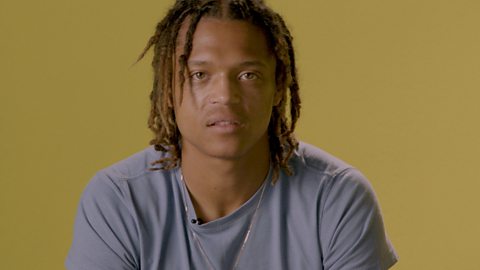
Present Percelle on teenage Percelle:
He didn’t know the value of who he was – he didn’t know the value of where he came from
Remel London
Remel London is a broadcaster and voice-over artist who’s presented shows on Radio 1Xtra and Capital Xtra, as well as the Sky 1 series, What’s Up TV. She graduated with a degree in broadcast journalism from the University of Leeds and has hosted a load of live events such as the Music for Youth Proms at the Royal Albert Hall and the MOBO Awards red carpet.
Remel believes it’s essential for young people to invest in their mental and physical health and to flag online content that might be distressing.
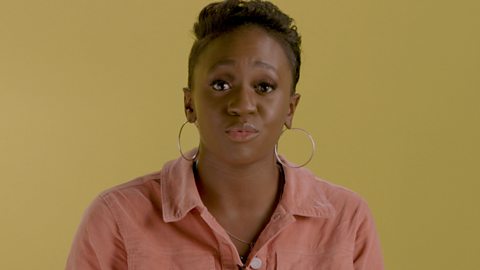
Present Remel on teenage Remel:
She was probably thinking this (racism) is a thing of the past. I probably won’t have to address this at any point
What can you do to take care of yourself if you're affected by racism?
We asked psychotherapist, Kemi Omijeh, to take a look at Percelle and Remel's film and share her thoughts from a mental health perspective.
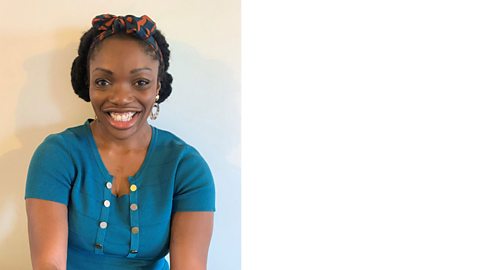
Kemi: In this clip, Percelle speaks about not knowing about his value and how a normal haircut he once got was perceived as ‘extreme’. What stood out for me, listening to the experiences discussed in this video was the theme of being made to feel uncomfortable in your skin, and having to shrink yourself and adapt your behaviour to appear non-threatening. It’s important you know that the fear and uncertainty don’t belong to you, so remember who you are. The fear, stereotypes and assumptions belong to the people who are making assumptions about you. You don’t have to act on those assumptions or change because of them. Yes it can hurt, particularly when you feel it’s wrong.
There are steps you can take to combat this:
Don’t subscribe to stereotypes and labels – you need to understand that labels and stereotyping are often a quick judgement, designed to place you in a box. You don’t have to stay in that box. If you stay in that box, how can you shine, be yourself? How can you challenge the stereotypes? Don’t be afraid to question stereotypes – particularly stereotypes targeted at you. You could reply to a comment with “what do you mean by that?” This can make the person making the stereotype pause and think about what they are saying and the impact it is having
Think about your identity – where you are from is just one aspect of who you are, not all you are. Your character is based on what you do and the choices you make. The choices you make should fulfil your passions and your best interests – they should not be based on fear
Create affirmations – this might help you to challenge stereotypes. Trying putting up some motivational words and saying them quietly to yourself. An example, “this black boy/girl will rise”
Know that being different is a positive thing – by nature, human beings generally want to conform, belong and fit in. Racism is designed to exclude you and point out your differences in a negative way. Remember, being different is a good thing. There is only one you. Your uniqueness is needed in the world. You have something good to offer the world and only you get to determine who you are
Create a safe space – you can protect yourself and your mental health by creating a safe sanctuary from the external world. Your home, or even your bedroom, can be your safe place. Your mobile phone links you to the external world – bringing the outside world inside – so be selective about what you allow in. You have a choice: you can switch off. A good support network could also be a type of sanctuary
Filter – diversify your feed, question and challenge the images and information coming at you, don’t be passive in what you are seeing. Protect your energy and your mental health by filtering and creating a barrier. Your mobile phone can also help you access a vast range of positive support and educative resources. It can help you to see that you are not alone.
If you need support
You should always tell someone about the things you’re worried about. You can tell a friend, parent, guardian, teacher, or another trusted adult. If you're struggling with your mental health, going to your GP can be a good place to start to find help. Your GP can let you know what support is available to you, suggest different types of treatment and offer regular check-ups to see how you’re doing.
If you’re in need of in-the-moment support you can contact Childline, where you can speak to a counsellor. Their lines are open 24 hours a day, 7 days a week.
There are more links to helpful organisations on the BBC Bitesize Action Line page for young people.
Notes to my teenage self: Breis and Julie Adenuga
Breis and Julie Adenuga talk about the racism they experienced as teenagers and what they've learnt over the years.
Notes to my teenage self: Danny Sapani and Abubakar Salim
Danny Sapani and Abubakar Salim talk about the racism they saw as teenagers and what they've learnt over the years.
Notes to my teenage self: Sir Lenny Henry and Kadeem Ramsay
Sir Lenny Henry and Kadeem Ramsay talk about the racism they experienced as teenagers and what they've learnt over the years.