Key points about environmental issues and possible solutions
Use A verb that is usually followed by an infinitive, such as pouvoir (to be able to), vouloir (to want to), and devoir (must). , such as ‘can’, ‘must’, ‘know’ and ‘want’ to talk about what can be done to live more sustainably.
Used to communicate that something must be done without specifying who should do it, where there is no natural subject (I, you, he, etc.). are only used in the third person indefinite and include verbs such as ‘there is/are’, ‘it is necessary’ and ‘it’s worth (doing) something’.
This guide contains a video as well as listening and reading practice.
Video - Environmental issues in French
Watch the video of Detchen discussing some of the environmental issues and solutions in the Paris suburb of Sceaux.
Detchen discusses environmental issues and possible solutions using modal verbs and the pronoun 'on'
On peut faire beaucoup de choses pour protéger l'environnement.
Comment protégez-vous l'environnement ?
Dans la ville de Sceaux, dans la banlieue sud de Paris, on encourage les habitants à faire du vélo.
On peut facilement aller au centre de Paris à vélo parce qu'il y a une grande piste cyclable.
Quand on se déplace à vélo, on n'utilise pas la voiture.
Par conséquent, on réduit la pollution de l'air.
Et comme ça, on aide à protéger la planète !
Comme nos déchets polluent la planète, il faut apprendre à faire du tri sélectif.
Dans mon quartier on a trois poubelles de couleurs différentes :
Une poubelle jaune pour les emballages, le papier et le carton.
Une poubelle verte pour le verre et une poubelle grise pour les autres déchets !
Les abeilles jouent un rôle important dans la biodiversité.
Je crois qu'il faut protéger les abeilles.
À mon avis, on doit installer de plus en plus de ruches urbaines sur les toits des bâtiments, en ville, et dans les parcs.
On peut encourager les habitants à participer à cette initiative.
Savais-tu qu'il existe une centaine de jardins partagés à Paris ?
Ce sont des espaces verts accessibles à tous.
Là, on peut découvrir la nature et on peut aussi apprendre à protéger l'environnement.
Ce sont les habitants du quartier qui créent ces jardins partagés.
Là, on peut cultiver des légumes et on peut apprendre les cycles de la nature aux enfants.
Et là, on peut aussi développer des relations sociales entre voisins.
À mon avis toutes nos petites actions sont importantes.
Nous pouvons tous faire quelque chose pour participer à la protection de la planète !
Translation
There are many things we can do to protect the environment.
How do you protect the environment?
In the town of Sceaux, in the southern suburbs of Paris, residents are encouraged to cycle.
We can easily go to the centre of Paris by bike because there is a long cycle lane.
When you travel by bike, you don’t use the car.
You therefore reduce air pollution.
And that way, we help protect the planet!
Seeing as our waste pollutes the planet, recycling is a good habit to have.
In my neighbourhood, recycling is done in three different colour bins.
A yellow bin for packaging, paper, and cardboard.
A green bin for glass and a grey bin for everything else!
Bees play an important role in biodiversity.
I believe it’s a good idea to protect the bees.
In my opinion, we need to install more and more urban hives on the roofs of buildings, in town centres, and in parks.
Residents can be encouraged to participate in this initiative.
Did you know that there are around a hundred communal gardens in Paris?
These are green spaces accessible to all.
There, you can discover nature and you can also learn to protect the environment.
It’s the residents of the neighbourhood who create these shared gardens.
There, you can grow vegetables and teach children about the cycles of nature.
And there, we can also develop social relations between neighbours.
In my opinion, all our small actions are important.
We can all do something to partake in the protection of the planet!
Vocabulary - Talking about recycling and reducing waste
Useful vocabulary for talking about recycling, re-using items or reducing waste includes:
| French | English | French | English |
|---|---|---|---|
| Check your connection, refresh the page and try again.(f) | water | Check your connection, refresh the page and try again. | paper |
| Check your connection, refresh the page and try again.(f) | energy | Check your connection, refresh the page and try again. | plastic |
| Check your connection, refresh the page and try again. | plastic bag | Check your connection, refresh the page and try again. | green products |
| Check your connection, refresh the page and try again. | box, tin | Check your connection, refresh the page and try again. (f) | resources |
| Check your connection, refresh the page and try again. (m. pl.) | electric transport | Check your connection, refresh the page and try again. | leftovers |
| Check your connection, refresh the page and try again. | light |
Useful verbs include:
| French | English |
|---|---|
| Check your connection, refresh the page and try again. | to improve |
| Check your connection, refresh the page and try again. | to throw away |
| Check your connection, refresh the page and try again. | to recycle |
| Check your connection, refresh the page and try again. | to reduce |
| Check your connection, refresh the page and try again. | to save |
| Check your connection, refresh the page and try again. | to use |
For example:
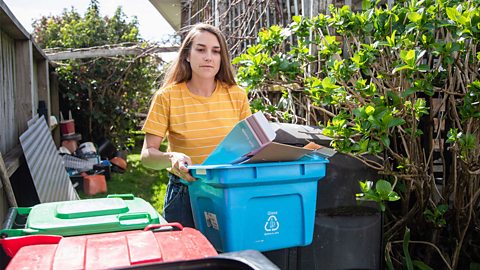
Il faut réduire les déchets dans la mer. – We have to reduce rubbish in the sea.
On doit recycler les boîtes et le papier. – We must recycle tins and paper.
On peut améliorer les transports électriques. – We can improve electric transport.
Nous devons réutiliser les sacs plastiques. – We must re-use plastic bags.
Je vais essayer des produits verts. – I’m going to use green products.
Grammar - How to use modal verbs
Modal verbs in English include 'can', 'should' and 'must'. They express the speaker’s feeling towards an action, such as ‘to be able to’/’can’ or to have to/must.
Modal verbs indicate modality, ability, necessity, possibility, obligation or permission.
They can work on their own, or with another verb that is always in the The basic form of the verb. In French, all infinitives end in '-er', '-ir' or '-re'.. For example:
Je peux utiliser moins d’énergie. - I can use less energy.
Nous pouvons protéger l’environnement. – We can protect the environment.
Useful modal verbs in French include:
Devoir - to have to, must
Pouvoir - to be able to, can
Vouloir - to want
Savoir - to know (how)
Click or tap on Show more to see how each of these four verbs is conjugated.
Check your connection, refresh the page and try again. - to have to, must
| French | English |
|---|---|
| Check your connection, refresh the page and try again. | I have to/I must |
| Check your connection, refresh the page and try again. | you (singular, informal) have to/you must |
| Check your connection, refresh the page and try again. | he has to / he must |
| Check your connection, refresh the page and try again. | she has to / she must |
| Check your connection, refresh the page and try again. | one/it has to / one/it must |
For example:
Nous devons faire plus pour préserver la nature. - We must do more to preserve nature.
Check your connection, refresh the page and try again. - to be able to, can
| French | English |
|---|---|
| Check your connection, refresh the page and try again. | I can |
| Check your connection, refresh the page and try again. | you (singular, informal) can |
| Check your connection, refresh the page and try again. | he can |
| Check your connection, refresh the page and try again. | she can |
| Check your connection, refresh the page and try again. | it/one can |
For example:
Qu'est ce que je peux faire pour aider ? - What can I do to help?
Check your connection, refresh the page and try again. - to want
| French | English |
|---|---|
| Check your connection, refresh the page and try again. | I want |
| Check your connection, refresh the page and try again. | you (singular, informal) want |
| Check your connection, refresh the page and try again. | he wants |
| Check your connection, refresh the page and try again. | she wants |
| Check your connection, refresh the page and try again. | it/one wants |
For example:
Je veux conduire une voiture électrique à l’avenir. – I want to drive an electric car in the future.
Check your connection, refresh the page and try again. - to know (how to)
| French | English |
|---|---|
| Check your connection, refresh the page and try again. | I know |
| Check your connection, refresh the page and try again. | you (singular, informal) know |
| Check your connection, refresh the page and try again. | he knows |
| Check your connection, refresh the page and try again. | she knows |
| Check your connection, refresh the page and try again. | it/one knows |
For example:
Tu sais qu’il y a beaucoup de choses que tu peux faire ? – Do you know there are lots of things you can do?
How to use the 'on' form with modal verbs
Modal verbs are often used with the on form to mean ‘you’ or ‘we’ do something.
For example:
On peut réduire la pollution en ville. – We can reduce pollution in the town.
On ne doit pas jeter les déchets dans la mer. – We must not throw rubbish in the sea.
Modal verbs - Mini quiz
Complete the following sentences with the correct modal verb:
________ sauver les animaux en danger.
I want to save the animals in danger.
Je veux sauver les animaux en danger.
Je veux means ‘I want’.
______ aider notre planète.
One (we) must help our planet.
On doit aider notre planète.
On doit means ‘one (we) must’.
________ recycler plus.
We can recycle more.
Nous pouvons / on peut recycler plus.
Nous pouvons / on peut means ‘we can’.
_______ comment protéger l’environnement ?
Do you (singular informal) know how to protect the environment?
Tu sais / Sais-tu comment protéger l’environnement ?
Tu sais means ‘you know’ or ‘do you know’. To ask a question in French you can either say tu sais or invert the verb and say sais-tu.
Find out more about using modal verbs in the Infinitives in French guide.
Listening practice
You are listening to a programme about sustainability.
Listen to what each of the four speakers says and answer the questions.
Click or tap on Start to begin the activity.
Vocabulary - Talking about environmental issues
Useful vocabulary to use when describing environmental issues includes:
| French | English | French | English |
|---|---|---|---|
| Check your connection, refresh the page and try again. | pollution | Check your connection, refresh the page and try again. | health |
| Check your connection, refresh the page and try again. | planet | Check your connection, refresh the page and try again. | risk |
| Check your connection, refresh the page and try again. | catastrophe | Check your connection, refresh the page and try again. | forest |
| Check your connection, refresh the page and try again. (f) | industry | Check your connection, refresh the page and try again. | noise |
| Check your connection, refresh the page and try again. (m) | environment | Check your connection, refresh the page and try again. | fire |
| Check your connection, refresh the page and try again. | danger | Check your connection, refresh the page and try again. (m) (pl) | public transport |
Useful verbs include:
| French | English |
|---|---|
| Check your connection, refresh the page and try again. | to stop |
| Check your connection, refresh the page and try again. | to help |
| Check your connection, refresh the page and try again. | to change |
| Check your connection, refresh the page and try again. | to cause |
| Check your connection, refresh the page and try again. | to drive |
| Check your connection, refresh the page and try again. | to fight, struggle |
| Check your connection, refresh the page and try again. | to protect |
For example:
La pollution cause des problèmes de santé. - Pollution causes health issues.
Il faut lutter pour protéger les forêts. - We have to fight to protect forests.
All Foundation Tier vocabulary listed in this guide can be found on the vocabulary sheet below.
Grammar - How to use impersonal verbs
Impersonal verbs have only one conjugation - the third person singular indefinite, or il.
Useful examples include:
Check your connection, refresh the page and try again. - there is/are
Check your connection, refresh the page and try again. - there was/ were, there used to be
Check your connection, refresh the page and try again. - there will be, there is going to be
Check your connection, refresh the page and try again. followed by the infinitive - it is/it’s necessary followed by a verb, must followed by a verb
For example:
Sur la photo, il y a une plage avec beaucoup de déchets. - In the photo, there is a beach with lots of rubbish.
Dans le passé il y avait plus de pollution à Manchester - In the past there used to be more pollution in Manchester.
À l’avenir il y aura plus de voitures électriques. - In the future there will be more electric cars.
Il faut jeter moins d’eau sale dans les rivières. - It’s necessary to throw less dirty water into rivers.
Mini quiz - Impersonal verbs
Complete the following sentences with the correct impersonal verb:
_____ beaucoup de problèmes pour l’environnement.
There are lots of problems for the environment.
Il y a beaucoup de problèmes pour l’environnement.
Il y a is the impersonal verb meaning ‘there is/are’.
______ réduire le gaspillage alimentaire.
It’s necessary to reduce food waste.
Il faut réduire le gaspillage alimentaire.
Il faut followed by an infinitive is the impersonal verb meaning ‘it’s necessary to’.
Dans le passé _____ trop de pollution industrielle.
In the past there was too much industrial pollution.
Dans le passé il y avait trop de pollution industrielle.
Il y avait is the impersonal verb meaning ‘there was/were’.
Reading practice
Read the comments on a forum about the environment and decide which environmental issue each person is talking about. Choose from the list below. There is one answer too many.
| A | Air pollution |
| B | Packaging |
| C | Deforestation |
| D | Energy |
On détruit les arbres et ça m’inquète. Il faut absolument arrêter cette destruction.
The answer is C
On détruit les arbres et ça m’inquète. Il faut absolument arrêter cette destruction.
We are destroying the trees and that worries me. We absolutely must stop destruction.
Il y a trop de circulation dans ma ville et l’air n’est pas propre. Malheureusement beaucoup d’enfants ont des problèmes respiratoires en conséquence.
The answer is A
Il y a trop de circulation dans ma ville et l’air n’est pas propre. Malheureusement beaucoup d’enfants ont des problèmes respiratoires en conséquence.
There is too much traffic in my town and the air isn’t very clean. Unfortunately many children have respiratory problems as a result.
En ce moment nous sommes en train de changer la production d’électricité. Au lieu d’utiliser le charbon et le pétrole, on commence à utiliser le soleil et le vent pour notre énergie.
The answer is D
En ce moment nous sommes en train de changer la production d’électricité. Au lieu d’utiliser le charbon et le pétrole, on commence à utiliser le soleil et le vent pour notre énergie.
We are in the process of changing electricity production at the moment. Instead of using coal and oil, we are starting to use the sun and wind for our energy.
Vocabulary sheet
Click or tap on the image below for a list of useful vocabulary to use when talking about the environment and possible solutions in French.

Vocabulary - Higher Tier
Useful Higher Tier nouns include:
| French | English | French | English |
|---|---|---|---|
| Check your connection, refresh the page and try again. | bottle | Check your connection, refresh the page and try again. | demonstration, event |
| Check your connection, refresh the page and try again. | traffic | Check your connection, refresh the page and try again. | threat |
| Check your connection, refresh the page and try again.(m) (pl) | rubbish, garbage | Check your connection, refresh the page and try again. | landscape, scenery, countryside |
| Check your connection, refresh the page and try again.(f) | renewable energy | Check your connection, refresh the page and try again. (f) (pl) | sustainable resources |
| Check your connection, refresh the page and try again. | flood | Check your connection, refresh the page and try again. | glass |
Useful Higher Tier verbs include:
| French | English |
|---|---|
| Check your connection, refresh the page and try again. | to increase |
| Check your connection, refresh the page and try again. | to burn |
| Check your connection, refresh the page and try again. | to build |
| Check your connection, refresh the page and try again. | to destroy, ruin |
| Check your connection, refresh the page and try again. | to avoid |
| Check your connection, refresh the page and try again., Check your connection, refresh the page and try again. (followed by de and a noun) | to bother, disturb, be worried (about followed by a noun) |
| Check your connection, refresh the page and try again. | to protest, show |
| Check your connection, refresh the page and try again. | to replace, swap |
| Check your connection, refresh the page and try again. | to reuse |
All vocabulary listed in this guide can be found on the vocabulary sheet below.
Higher Tier - Grammar - How to use impersonal verbs
Higher Tier impersonal verbs include:
| French | English |
|---|---|
| Il manque… | …is missing |
| Il vaut la peine de followed by the infinitive | It is/it's worth followed by a verb |
| Il vaut mieux followed by the infinitive | It is/it's better followed by a verb |
For example:
Il manque la biodiversité. - It needs biodiversity.
Il vaut la peine de recycler le papier et le verre. - It’s worth recycling paper and glass.
Il vaut mieux prendre les transports en commun que conduire. - It is better to take public transport than to drive.
Complete the sentence with the correct impersonal verb:
_____ de se doucher au lieu de prendre un bain. – It’s worth taking a shower instead of a bath.
Il vaut la peine de prendre une douche au lieu d’un bain.
Il vaut la peine de + infinitive is the impersonal verb meaning ‘it’s worth + verb’.
Find out more about using impersonal verbs in the Infinitives in French guide.
Higher Tier - Vocabulary sheet
Click or tap on the image below for a list of useful Foundation and Higher Tier vocabulary to use when talking about the environment and possible solutions in French.
Now you have learned about describing environmental issues and possible solutions why not look at the Talking about the local area in French guide.
Careers advice and tips from BBC Bitesize
Future careers, further studies and the world of work - we're here to help with advice from experts and from young people who've found their path.

More on Life in my local area
Find out more by working through a topic
- count4 of 5

- count5 of 5