Key points about describing your local area
Use the A preposition is a word such as 'at', 'for', 'with', 'into' or 'from' which is usually followed by a noun or pronoun. They are used to show where something is in place or time. en and à to talk about being in a place or going to a place.
Higher Tier - The Words that replace nouns, ie. he, she, it, they. y can either mean ‘there’ to replace a place or it can replace an object.
This guide contains a video as well as reading and listening practice.
Video - Describing my local area
Watch the video of Detchen exploring the suburb of Sceaux in Paris.
Use impersonal verbs and adjectives to describe the local area
Bienvenue au parc de Sceaux.
C’est un parc qui se trouve au sud de Paris, en banlieue.
Autour du parc de Seaux, il y a plusieurs villes.
La ville de Sceaux est à 20 minutes de Paris en train.
Et le parc est l'endroit idéal pour échapper au stress de la vie parisienne.
Dans le centre-ville de Sceaux, il y a beaucoup de touristes parce qu'il y a de très beaux bâtiments anciens.
Ici, c’est la rue Houdan où il n’y a pas de voitures.
Elle est très célèbre, parce que c’est une rue commerciale interdite aux voitures depuis 40 ans !
Moi, j’aime la Rue Houdan parce que j’y retrouve mes amis dans un super endroit qui s’appelle Plaisir des Thés.
Il y a un grand choix de thés et il faut absolument goûter leur thé des légendes. Il est trop bon !
J’y vais aussi pour acheter mon pain à la boulangerie, à gauche.
Dans ma famille, on trouve qu'ils font les meilleures baguettes de la ville.
On peut aussi y acheter un déjeuner à emporter.
D’ailleurs, j’ai un peu faim.
Je vais prendre un sandwich au fromage.
À Paris, en général, il fait beau de mai jusqu'au mois d'octobre.
Et le parc de Sceaux est un endroit idéal pour pique-niquer.
Par contre, il vaut mieux y aller quand il fait encore beau.
On ne va pas au Parc de Sceaux seulement pour manger, on peut aussi y aller pour faire une promenade ou pour courir.
Certaines personnes viennent de loin pour profiter du parc, et c'est vrai, il vaut vraiment la visite !
Moi je vais rester un peu ici pour lire au soleil !
Translation
Welcome to Parc de Sceaux.
It's a park that finds itself in the southern suburbs of Paris.
There are several towns around the park.
The town of Sceaux is 20 minutes by train from Paris.
And the park is the perfect place to escape the stress of Parisian life.
In the city centre of Sceaux, there are a lot of tourists because there are some very beautiful old buildings.
Here is Houdan street, where there are no cars.
It is very well known, because it is a commercial street that has been closed to cars for 40 years!
I like Rue Houdan because I meet my friends there in a great place called Plaisir des Thés.
There is a large selection of teas and you absolutely have to try their ‘thé des légendes’. It’s so good!
I also come to buy my bread, in the bakery on the left.
In my family, we think they have the best baguettes of the city.
You can also buy a lunch to takeaway.
Actually, I'm a bit hungry…
I'll take a cheese sandwich.
In Paris, in general, the weather is nice from May until the month October.
And the Parc de Sceaux is the ideal place for a picnic.
However, it’s better to go when the weather is still nice.
People don't just go to Parc de Sceaux to eat, they also go there to take a walk or run.
Some people come from far to enjoy the park, and it's true, it's definitely worth the visit!
I'm going to stay here for a while to read in the sun!
Vocabulary - Describing the local area
Useful vocabulary to talk about where people live includes:
| French | English |
|---|---|
| en ville | in a town |
| dans un village | in a village |
| dans un grand ville | in a city |
| à la campagne | in the countryside |
| à la montagne | in the mountains |
| dans le bois | in the woods |
| au bord de la mer | by the seaside/coast |
Useful nouns to talk about the local area include:
| French | English |
|---|---|
| Check your connection, refresh the page and try again. | noise |
| Check your connection, refresh the page and try again. | forest |
| Check your connection, refresh the page and try again. | building |
| Check your connection, refresh the page and try again. | lake |
| Check your connection, refresh the page and try again. | pollution |
| Check your connection, refresh the page and try again. | street |
| Check your connection, refresh the page and try again. | beach |
| Check your connection, refresh the page and try again. | view |
Useful adjectives to describe places include:
| French | English | French | English |
|---|---|---|---|
| ancien(ne) | former (when before the noun) | historique | historic |
| ancien(ne) | ancient (when after the noun) | idéal(e) | ideal |
| beau / beaux / belle / bels / bel | beautiful | moderne | modern |
| calme | quiet/calm | pauvre | poor |
| célèbre | famous | populaire | popular |
| culturel(le) | cultural | propre | clean |
| dangereux/euse | dangerous | riche | rich |
For example:
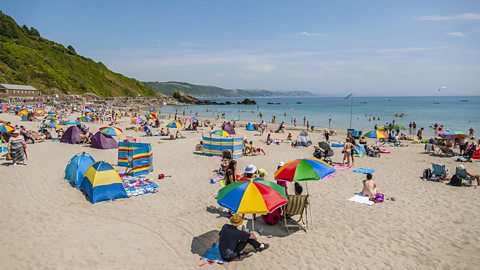
J’habite dans un petit village à la campagne et c’est très calme. - I live in a little village in the countryside and it’s very quiet.
Nous habitons en ville et ce n’est pas propre - il y a trop de pollution. - We live in town and it isn’t clean - there is too much pollution.
Grammar - How to use the prepositions 'en' and 'à'
En and à are prepositions that mean both ‘to’ and ‘in’. They are used with:
cities or towns
countries
continents
When to use 'en'
- Use en with ville to mean ‘in’ or ‘to’. For example:
J'habite en ville. – I live in town.
Je vais en ville. – I go to town.
- Use en (without an 'A', 'an' and 'the'.) to mean ‘to’ and ‘in’ feminine countries, such as France, and continents such as Europe. For example:
Nous habitons en France. - We live in France.
Elle va voyager en Europe. - She is going to travel to Europe.
When to use 'à'
- Use à without an article to mean ‘to’ or ‘in’ a city, town or village.
For example:
Nous allons à Paris. - We are going to Paris.
Ils habitent à Manchester. - They live in Manchester.
- Use à with the definite article (le, la or les) to mean ‘to’ when going to a place, such as the market, bank or beach.
For example:
Je vais au supermarché. - I’m going to the supermarket.
Nous allons à la plage. - We’re going to the beach.
Je vais aux montagnes. - I’m going to the mountains.

Remember
When using à with le, it is contracted to au.
When using à with les, it is contracted to aux.
- Use au with masculine countries and aux with plural countries to mean ‘to’ and ‘in’.
For example:
Je vais aux États Unis. - I’m going to the USA.
Ils habitent au Canada. - They live in Canada.
Using 'en' and 'à' - Mini quiz
Complete the following sentences with the correct prepositions:
J’habite ___ Angleterre.
I live in England.
J’habite en Angleterre.
With a feminine country, such as l’Angleterre, use en to mean ‘in’.
Nous aimons aller ______ ville.
We’re like going to town.
Nous aimons aller en ville.
With ville, meaning 'town', use en to mean ‘in’ or ‘to’.
Il va ____ marché cet après-midi.
He’s going to the market this afternoon.
Il va au marché cet après-midi.
When talking about a place, use à plus the article.
Le marché (market) is masculine, and à followed by le contract to au.
L’année prochaine je vais _____ Paris.
Next year I’m going to Paris.
L’année prochaine je vais à Paris.
When talking about towns and cities, use à before the name of the town, village or city.
Find out more about using prepositions in the Prepositions of place in French guide.
Reading practice - my local area
You are looking at a school blog on which some French students have written about where they live. Read the three texts to find out where each person lives and choose the correct answers from the options below.
There is one option that is not needed.
| A | In the countryside |
| B | In a city |
| C | On the coast |
| D | In the mountains |
Question 1
J’habite dans une ferme à quinze kilomètres d’une petite ville. Il y a beaucoup de champs et des bois près de chez nous. J’adore là où j’habite parce que c’est très beau.
The answer is A.
I live on a farm 15km from a small town. There are lots of fields and some woods near our house. I love it where I live because it is very beautiful.
Question 2
J’ai de la chance parce que je peux faire du ski tous les jours en hiver et je fais des randonnées* deux ou trois fois par semaine en été. J’habite dans un chalet et ma chambre a une vue extraordinaire.
*des randonnées – hikes, walks
The answer is D.
I’m lucky because I can go skiing every day in the winter and I go hiking two or three times a week in the summer. I live in a chalet and my bedroom has a spectacular view.
Question 3
Bonjour, je m’appelle Antoine et j’habite dans un appartement assez petit dans un bâtiment moderne. Il y a beaucoup de voitures dans ma rue et il y a un grand centre commercial à deux minutes de mon appartement. J’aime bien habiter ici car il y a beaucoup de choses à faire.
The answer is B
Hi, my name is Antoine and I live in a fairly small apartment in a modern building. There are a lot of cars on my street and there is a big shopping centre two minutes from my flat. I like living here because there are lots of things to do.
Vocabulary - Describing my town
Useful phrases when talking about your local area.
In town
| French | English |
|---|---|
| J’habite dans une grande ville en Angleterre. | I live in a big town in England. |
| Mon village se trouve près de Plymouth. | My village is located near Plymouth. |
| Il y a beaucoup de magasins dans ma ville. | There are lots of shops in my town. |
| Ma ville est moderne. | My town is modern. |
| On peut aller au cinéma le soir. | You can go to the cinema in the evening. |
| Pour améliorer ma ville, il faut construire un grand centre commercial. | To improve my town, one must build a big shopping centre. |
| Je préfère habiter en ville. | I prefer to live in town. |
| Il y a trop de bruit aussi. | There is too much noise as well. |
| Les touristes peuvent visiter le château ou le musée. | Tourists can visit the castle or the museum. |
| Pour les jeunes, il y a une piscine et un centre sportif. | For young people, there is a swimming pool and a sports centre. |
In the countryside:
| French | English |
|---|---|
| Nous habitons à la campagne. | We live in the countryside. |
| J’aime mon petit village parce que c’est beau. | I like my little village because it’s beautiful. |
| Notre village se situe près d’une forêt. | Our village is situated near a forest. |
| On peut faire du vélo ou aller au parc. | You can go cycling or go to the park. |
| Malheureusement, il n’y a pas de bons magasins. | Unfortunately, there aren’t any good shops. |
| Les transports publics sont nuls aussi. | The public transport is rubbish as well. |
All Foundation Tier vocabulary listed in this guide can be found on the vocabulary sheet below.
Listening practice
You listen to a radio phone-in, during which some people talk about where they live. Listen to each person and answer the questions.
Louis
Why does Louis find his town boring?
There is nothing to do there.
Diane
What does Diane dislike about her town?
There is too much noise.
Enzo
What three things are there in Enzo’s village?
A little supermarket, a church and a post office.
Click or tap on Show more to read the transcripts and translations.
Louis
Dans ma ville, il n’y a rien à faire, ça peut être ennuyeux ici. De plus, comme c’est une ville industrielle, il y a trop de pollution.
In my town there is nothing to do, it can be boring here. In addition, as it is an industrial town, there is too much pollution.
Diane
Il y a un grand centre commercial dans ma ville, avec beaucoup de magasins de vêtements, une librairie, des cafés et des restaurants. Je pense que c’est bon. Par contre, il y a trop de bruit dans ma ville et ça, je n’aime pas du tout.
There is a big shopping centre in my town, with lots of clothes shops, a bookshop, some cafés and restaurants, and I think that’s good. On the other hand, there is too much noise in my town and I don’t like that at all.
Enzo
J’habite dans un village que j’adore, même s’il n’y a pas beaucoup de choses à faire, parce que c’est calme et historique. Il n’y a qu’un petit supermarché, une église et une poste mais ça suffit.
I live in a village which I love, even though there isn’t much to do because it’s quiet and historic. There is only a little supermarket, a church and a post office, but that’s enough.
Vocabulary sheet
Click or tap on the image below for a list of useful vocabulary to use when describing the local area.

Higher Tier - Vocabulary
Useful Higher Tier vocabulary includes:
| French | English |
|---|---|
| Check your connection, refresh the page and try again. | field |
| Check your connection, refresh the page and try again. | the best |
| Check your connection, refresh the page and try again. | the worst |
Useful Higher Tier phrases include:
| French | English |
|---|---|
| L’avantage, c’est qu’il y a beaucoup de choses à faire pour les jeunes. | The advantage is that there are lots of things to do for young people. |
| L’inconvénient, c’est qu’il y a trop de voitures, qui causent la pollution. | The disadvantage is that there are too many cars, which cause pollution. |
| L’avantage, c’est que c’est très calme et on est près de la nature. | The advantage is that it’s very quiet and you are close to nature. |
| L’inconvénient, c’est que c’est trop loin de la ville et de mes amis. | The disadvantage is that it’s too far from town and from my friends. |
All vocabulary listed in this guide can be found on the vocabulary sheet below.
Higher Tier - Grammar - The pronoun 'y'
The pronoun y can either mean ‘there’ to replace a place or it can replace an object (not a person) that is introduced by the preposition à, to mean ‘it’ or ‘them’.
How to use the pronoun ‘y’ to mean ‘there’

When using the pronoun y to mean ‘there’, the y comes between the The person or thing in the sentence that is doing the action. or Words to replace the subject of a sentence, eg 'He read the book' instead of 'James read the book'. and the A word used to describe an action or state of being.. For example:
Il va au marché. Il y va pour acheter des fruits. – He goes to the market. He goes there to buy some fruit.
Je suis allé(e) en ville le week-end dernier avec mes amis. Nous y sommes allé(e)s en autobus. – I went to town last weekend with my friends. We went there by bus.
How to use the pronoun ‘y’ to mean ‘it' or 'them’

The pronoun y is also used to replace a previously mentioned or implied place or location. It usually translates to 'there' in English.
However, the concept of y is broader, and it can also be used to replace any phrase that begins with à, en, dans, or other prepositions indicating location.
It can mean ‘it’ or ‘them’ depending on the context.
For example:
Il s’intéresse à l’histoire de sa ville. Il s’y intéresse depuis longtemps. – He’s interested in the history of his town. He’s been interested in it for a long time.
J’aime jouer au foot. J’y joue deux fois par semaine. – I like playing football. I play it twice a week.
When y is used with a verb and followed by à, it typically replaces the object of the preposition à, referring back to something previously mentioned.
The object can be a thing, a place, or a concept/idea. The pronoun y replaces the à + noun phrase to avoid repetition.
Examples of how to use verbs followed by the pronoun y include:
Il faut faire attention en allant à vélo. Il faut y faire attention. – You should pay attention when going on your bike. You should pay attention to it.
Je pense aux vacances. J’y pense tous les jours. - I’m thinking about the holidays. I think about them every day.
Click or tap on Show more to see some useful verbs that are followed by à and can use y as a pronoun.
Check your connection, refresh the page and try again. - to believe in
Check your connection, refresh the page and try again. - to pay attention to/be careful of
Check your connection, refresh the page and try again. - to be interested in
Check your connection, refresh the page and try again. (+ sport) - to play (sport)
Check your connection, refresh the page and try again. - to think of/about (not opinion)
Check your connection, refresh the page and try again. - to think about/reflect on

Higher Tier - Using the pronoun 'y' - Mini quiz
Complete the following sentences:
___ _____ tous les jours.
I go there every day.
J’y vais tous les jours.
Y means there and is positioned between the pronoun, je, and the verb, vais.
As je ends in a vowel, e, remove the e and add an apostrophe before y to form j’y.
____ _____ ______ pendant une semaine.
We are there for a week.
Nous y sommes pendant une semaine.
Y means there and is positioned between the pronoun, nous and the verb, sommes.
Elle aime jouer au foot. ____ ____ _____ le week-end.
She likes playing football. She plays it at the week-end.
Elle aime jouer au foot. Elle y joue le week-end.
Jouer à is a verb that takes y as a preposition to replace what is being played.
Y is positioned between the pronoun, elle and the verb, joue.
J’aime faire le shopping pour les vêtements. _____ ______ depuis longtemps.
I like going shopping for clothes. I’ve been interested in it for a long time.
J’aime faire le shopping pour les vêtements. Je m'y intéresse depuis longtemps.
S’intéresser à is a verb that takes y as a preposition to replace what the person is interested in.
Y is positioned between the pronoun, je me and the verb, intéresse.
As me ends in a vowel, e, remove the e and add an apostrophe before y, to form j’y.
Find out more about using the pronoun y in the Higher Tier - Adverbial pronouns 'y' and 'en' in French guide.
Higher Tier - Vocabulary sheet
Click or tap on the image below for a list of useful vocabulary to use when describing the local area.
Now you have learned about describing the local area, why not have a look at the Talking about future opportunities guide?
Careers advice and tips from BBC Bitesize
Future careers, further studies and the world of work - we're here to help with advice from experts and from young people who've found their path.

More on Life in my local area
Find out more by working through a topic
- count4 of 5

- count5 of 5