Key points about future education and employment
Use the Used to describe actions that are going to take place in the immediate future. to talk about what you are going to do.
The Describes what someone would, should or could do or what could happen in the future. expresses what would, could or should happen.
Higher Tier - Use the Used to talk about actions that will take place in the future. tense to talk about things that will happen.
This guide contains a video as well as listening and reading practice.
Video - Describing future plans
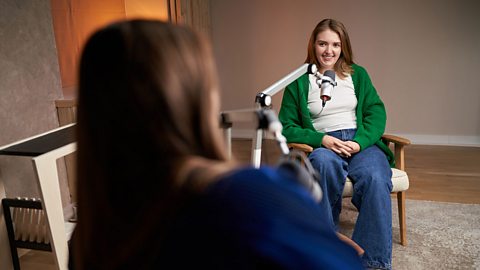
Watch the video where Adnane chats to a couple of friends, who discuss their future plans.
Use the future tense and the conditional to describe what is going to happen or what you would like to happen
Quels sont tes projets pour les vacances d'été ?
Je vais aller à la mer, avec ma famille.
On fait ça chaque année.
Et toi ?
Moi, je vais aller voir ma famille en Italie, pour les voir.
Qu’est-ce que tu vas faire après tes études secondaires ?
Moi je veux étudier le théâtre. Je vais passer l'examen pour rentrer, donc j'espère que je vais réussir.
Et toi ?
Je pense que j'aimerai bien faire une formation de cirque, à Bruxelles.
Je veux bien étudier de l'italien, parce que je veux bien parler avec Olga dans sa langue maternelle.
Veux-tu étudier à l'avenir ? Et si oui, que veux-tu faire ?
Je veux bien travailler, mais pour faire un bon travail, on doit aussi étudier un peu, je pense.
Imaginons, que tu ne passes pas les examens, tu ferais quoi après ?
Hmm, peut-être je vais devenir pâtissière.
Pâtissière ?
Pâtissière, ouais !
C'est toi qui as fait ça ?
Non.
De quoi aimerais-tu être fière ?
J'aimerai bien être fière de moi, comme personnage artistique reconnu.
Et pourquoi ?
Pour être connue dans le monde.
On mange un petit morceau ?
Oui, oui !
Translation
What are your plans for the summer holidays?
I’m going to go to the sea, with my family.
We go every year.
And you?
I’m going to go and see my family in Italy. To see them.
What are you going to do after your studies?
I want to study theatre. I’m going to sit an exam, so I hope I’ll do well.
And you?
I think I’d like to do a course on circus in Brussels.
I’d like to study italian, because I’d like to speak with Olga in her mother tongue.
Do you want to study in the future? And if so, what do you want to do?
I’d like to work, but to get a good job, I think you have to study.
Let’s say you don’t pass your exams, what would you do after?
Hmm, maybe I’d become a baker.
A baker?
A baker, yes!
Did you make these?
No.
What would you like to be proud of?
I’d like to be proud of myself, as a recognised artist.
And why?
To be known throughout the world.
Shall we have a bite to eat?
Yes, yes!
Useful vocabulary - Starting sixth form or college
Useful phrases for talking about starting sixth form or college include:
| French | English |
|---|---|
| Je vais continuer au lycée. | I am going to carry on to sixth form/college. |
| Nous pouvons choisir de nouvelles matières. | We can choose new subjects. |
| Je ne veux pas étudier les sciences. | I don’t want to study science. |
| L’année prochaine, je voudrais quitter le collège. | Next year, I would like to leave school. |
| Je veux faire une formation pratique. | I want to do a practical apprenticeship. |
| Moi, je veux vraiment aller à l’université. | Personally, I really want to go to university. |
| J’espère aller en France pour améliorer mon français. | I hope to go to France to improve my French. |
| Je voudrais apprendre à conduire. | I want to learn to drive. |
Grammar - How to form the near future tense
The near future tense is the most common way of talking about future plans.
How to form the near future tense
It is formed by using the correct part of the A verb that describes an action that is happening now or that happens regularly, eg I eat breakfast every day. of aller (to go), followed by the The basic form of the verb. In French, all infinitives end in '-er', '-ir' or '-re'..
Look at the table to check you know how to conjugate the verb aller.
| French | English |
|---|---|
| Check your connection, refresh the page and try again. | I go, am going |
| Check your connection, refresh the page and try again. | you (singular informal) go, are going |
| Check your connection, refresh the page and try again. | he goes, is going |
| Check your connection, refresh the page and try again. | she goes, is going |
| Check your connection, refresh the page and try again. | one goes/is going/we go, are going |
| Check your connection, refresh the page and try again. | we go, are going |
| Check your connection, refresh the page and try again. | you (plural, singular formal) go, are going |
| Check your connection, refresh the page and try again. | they go, are going |
| Check your connection, refresh the page and try again. | they (feminine) go, are going |

For example:
Je vais faire mes devoirs. - I’m going to do my homework.
Il va trouver un emploi. - He’s going to find employment.
Je vais étudier le théâtre l’année prochaine. - I’m going to study drama next year.
Nous allons passer nos examens en mai. - We are going to take our exams in May.
Tu vas aller en France ? - Are you going to go to France?
The near future - Mini quiz
Translate the following sentences into French:
I’m going to study.
Je vais étudier.
Je vais means ‘I’m going’ and this is followed by the infinitive étudier, to study.
We’re going to go to sixth form college.
Nous allons aller au lycée or On va aller au lycée.
Nous allons / on va means ‘we’re going’ and this is followed by the infinitive aller, to go.
Find out more about how to use and form the near future tense in the Future phrases in French guide.
Listening practice
Listen to the two callers on a French radio phone-in about plans for the future and answer the questions.
- What does Samira want to do?
| A | Go to university |
| B | Voluntary work |
| C | An apprenticeship |
The answer is C.
TranscriptC’est mon rêve d’être propriétaire de ma propre entreprise.
Comme je n’ai pas assez d’argent pour aller à l’université, car ça coûte trop cher, je vais aller en apprentissage comme électricienne. Comme ça je pourrai apprendre tout pour devenir patronne.
Translation
It's my dream to be the owner of my own business.
As I do not have enough money to go to university because it costs too much, I will do an apprenticeship as an electrician. That way I can learn everything to become a boss.
- What does Fatima want to do?
| A | Live abroad |
| B | Earn lots of money |
| C | Retake her exams |
The answer is A.
Transcript
J’adore étudier et pour cette raison, j’espère que j’aurai des bonnes notes et que je pourrai aller à l’université.
Je rêve de faire une licence de français et d’aller habiter à l’étranger.
Je ne sais pas ce que je vais faire après l’université, mais gagner beaucoup d’argent n’est pas vraiment important pour moi.
Comme je n’ai pas assez d’argent pour aller à l’université, car ça coûte trop cher, je vais aller en apprentissage comme électricienne. Comme ça je pourrai apprendre tout pour devenir patronne.
Translation
I love studying and for that reason, I hope that I will get good grades and I will be able to go to university.
I dream of doing a degree in French and to live abroad.
I don’t know what I will do after university, but earning a lot of money isn’t really important.
Vocabulary - Talking about the world of work
Useful nouns for talking about the world of work include:
| French | English |
|---|---|
| Check your connection, refresh the page and try again. | career |
| Check your connection, refresh the page and try again. | job, position |
| Check your connection, refresh the page and try again. | role |
| Check your connection, refresh the page and try again. | work |
| Check your connection, refresh the page and try again. | salary |
For example:
Avoir un bon salaire est très important pour moi. - Having a good salary is very important for me.
Je voudrais un rôle dans l’industrie. - I would like a role in industry.
Useful phrases for talking about possible future careers include:
| French | English |
|---|---|
| Je rêve de devenir chanteur/chanteuse. | I dream of becoming a singer. |
| Je voudrais être joueur/joueuse de foot. | I would like to be a football player. |
| J’ai décidé d’être médecin. | I have decided to be a doctor. |
| Je vais travailler à l’étranger. | I am going to travel in Europe with my friends. |
| Mon but c’est d’avoir une carrière bien payée. | My goal is to have a well-paid career. |
| Il faut apprendre de nouvelles compétences. | You have to learn new skills. |
| Je cherche mon premier poste. | I’m looking for my first job. |
| Je veux gagner beaucoup d’argent. | I want to earn a lot of money. |
Remember
The verb travailler means ‘to work’, not ‘to travel’.
The French for 'to travel' is voyager.
All Foundation Tier vocabulary listed in this guide can be found on the vocabulary sheet below.
Grammar - How to use the conditional

Use the conditional tense to express what you would like.
The most common form of the conditional uses the verb vouloir (to want to):
Je voudrais - I would like
Tu voudrais -you sing. informal would like
Il/elle/on voudrait - he/she/one, we would like
**Using vouloir with an infinitive
The conditional with vouloir is often used with an infinitive verb to say what someone would like to do. For example:
Je voudrais faire une formation à l’avenir. - I would like to do an apprenticeship in the future.
Tu voudrais aller à l’université ? - Would you like to go to university?
Using the conditional tense with an 'if' clause
The conditional tense if often used with an ‘if’ clause. For example:
Si possible, on voudrait trouver un bon métier. - If possible, we would like to find good jobs.
An ‘if’ clauses with the imperfect tense can be combined with a conditional clause to describe what would happen if things were different.
For example:
Si j’étais riche, je voudrais aider les autres. - If I were rich, I would like to help others.
Translate the following sentences into French:
I would like to study.
Je voudrais étudier.
There are two parts to this verb. You need je voudrais (I would like) followed by the infinitive of the verb to study, étudier.
She would like to work.
Elle voudrait travailler.
There are two parts to this verb. You need elle voudrait (she would like) followed by the infinitive of the verb to do, travailler.
Have a look at the Conditional in French guide for more on how to form and use the conditional.
Reading practice
You are researching universities in France and come across an article in which two students in terminale , the final year of school, describe their intentions.
Read what Marco and Lola say and answer the questions below.
Marco
Choisir une carrière, ce n’est pas facile. Je n’aimerais pas demander à ma famille de payer beaucoup d’argent pour l’université. C’était différent pour mes parents car il y avait des bourses pour y aller donc c’était gratuit pour eux.
Ce qui m’intéresse, c’est les médias. Je voudrais être apprenti chez mon journal local d’abord parce que je gagnerais de l’argent en même temps que d’avoir une formation. J’adorerais faire des entretiens et écrire des articles.
Lola
Pour moi, aller à l’université est un but important. Je voudrais devenir professeur et pour réussir dans ce métier, il faut étudier. Mes parents ont quitté le collège à la fin de la seconde pour travailler mais ils m’encouragent à suivre mon rêve.
J’espère trouver un emploi d’été pour pouvoir payer mon logement puisque je vais étudier à Lille, loin de chez moi. Je travaillerais comme serveuse ou vendeuse, par exemple.
- Who intends to go to university?
- The answer is Lola.
She says: Pour moi, aller à la fac est un but important. - For me, going to university is an important goal.
Marco intends to do an apprenticeship at his local newspaper.
He says: Je voudrais être apprenti chez mon journal local. - I’d like to do an apprenticeship at my local newspaper.
- Who has parents who went to university?
- The answer is Marco.
The text says: C’était différent pour mes parents car il y avait des bourses pour y aller donc c’était gratuit pour eux. - It was different for my parents because there were grants to go there (ie to university) so it was free for them.
Lola’s parents left school after second grade (equivalent to year 11) to work.
The text says: Mes parents ont quitté le collège à la fin de la seconde pour travailler. - My parents left after year 11 to go to work.
- Who has already decided on their career?
- The answer is Marco and Lola.
Marco wants to work in the media and become a journalist.
He says: J’adorerais faire des entretiens et écrire des articles. - I would love to do interviews and write articles.
Lola wants to be a teacher.
She says: Je voudrais devenir professeur. - I would like to become a teacher.
- Who will need to get a summer job?
- The answer is Lola.
Lola says: J’espère trouver un emploi d’été. - I hope to find a summer job.
Click or tap on Show more to read the translations of what Marco and Lola have written.
Marco
Choosing a career is not easy. I would not want to ask my family to pay a lot of money for university. It was different for my parents because there were grants to go there (ie to university) so it was free for them.
What interests me is media. I would like to do an apprenticeship first at my local newspaper because I'd earn money at the same time as being trained. I would love to do interview and write articles.
Lola
For me, going to university is an important goal. I would like to become a teacher and to achieve in that job you need to study. My parents left school after year 11 to work but they are encouraging me to follow my dream.
I hope to find a summer job to be able to pay my accommodation as I am going to study in Lille, a long way from home. I'll work as a waitress or sales person for example.
Vocabulary sheet
Click or tap on the image below for a list of useful vocabulary to use when describing future education and work.

Higher Tier - Useful vocabulary
Useful nouns related to the world of work include:
| French | English |
|---|---|
| l’emploi | employment |
| le métier | job |
| l’employé | employee |
Useful phrases to use when talking about future opportunities include:
| French | English |
|---|---|
| J’ai l’intention d’étudier les maths. | I intend to study maths. |
| Si j’étais apprenti(e), je gagnerais de l’argent. | If I were an apprentice, I would earn money. |
| J’aimerais étudier à l’étranger. | I would like to study abroad. |
| J’ai besoin d’une bourse. | I need a scholarship/grant. |
| J’espère trouver un métier intéressant. | I hope to find an interesting job. |
| Mon emploi idéal serait influenceur/influenceuse. | My ideal job would be an influencer. |
| Un jour, j’aurai ma propre entreprise. | One day I will have my own company. |
| Je m’intéresse à l’enseignement. | I’m interested in teaching. |
All vocabulary listed in this guide can be found on the vocabulary sheet below.
Higher Tier - Grammar - The simple future tense
The simple future describes what will happen in terms of predictions and future plans.
To form the simple future of Something that follows the usual or ‘regular’ pattern. er verbs, take the infinitive and add the following endings:
| Subject pronouns | Future ending | Example er verbs | English |
|---|---|---|---|
| je | ai | Check your connection, refresh the page and try again. | I will study |
| tu | as | Check your connection, refresh the page and try again. | you (informal singular) will work |
| il | a | Check your connection, refresh the page and try again. | he will look for |
| elle | a | Check your connection, refresh the page and try again. | she will speak |
| on | a | Check your connection, refresh the page and try again. | one/we will arrive |
| nous | ons | Check your connection, refresh the page and try again. | we will win/earn |
| vous | ez | Check your connection, refresh the page and try again. | you (formal singular, plural) will ask for |
| ils | ont | Check your connection, refresh the page and try again. | they (masculine or mixed) will accept |
| elles | ont | Check your connection, refresh the page and try again. | they (feminine) will prepare |
For example:
Nous gagnerons plus d’argent à l’avenir. - We will earn more money in the future.
Elle travaillera avant les examens. - She will work before the exams.
Irregular verbs
Some very common verbs are irregular in the simple future. This means that they are not formed using the infinitive, but the endings added are the same as for regular verbs.
High frequency irregular verbs include:
être - to be
avoir - to have
aller - to go
Click or tap on the Show more button to find out how to conjugate these key verbs in the simple future tense.
The simple future form of être (to be)
These are the simple future forms of être. The future endings are added to the stem ser.
| Conjugated verb form | English |
|---|---|
| Check your connection, refresh the page and try again. | I will be |
| Check your connection, refresh the page and try again. | you will be |
| Check your connection, refresh the page and try again. | he will be |
| Check your connection, refresh the page and try again. | she will be |
| Check your connection, refresh the page and try again. | one/we will be |
For example:
Je serai célèbre. – I will be famous.
L’examen sera difficile. – The exam will be difficult.
The simple future of avoir (to have)
These are the simple future forms of avoir. The future endings are added to the stem aur.
| Conjugated verb form | English |
|---|---|
| Check your connection, refresh the page and try again. | I will have |
| Check your connection, refresh the page and try again. | you will have |
| Check your connection, refresh the page and try again. | he will have |
| Check your connection, refresh the page and try again. | she will have |
| Check your connection, refresh the page and try again. | one/we will have |
For example:
Tu auras assez d’argent ? – Will you have enough money?
L’organisation aura beaucoup de clients. – The organisation will have many clients.
The simple future of aller (to go)
These are the simple future forms of aller. The future endings are added to the stem ir.
| Conjugated verb form | English |
|---|---|
| Check your connection, refresh the page and try again. | I will go |
| Check your connection, refresh the page and try again. | you will go |
| Check your connection, refresh the page and try again. | he will go |
| Check your connection, refresh the page and try again. | she will go |
| Check your connection, refresh the page and try again. | one/we will go |
For example:
J’irai au lycée l’année prochaine. – I will go to sixth form college next year.
On ira en Thaïlande pendant notre année sabbatique. – We will go to Thailand during our gap year.
The simple future - Mini quiz
Translate the following sentences into French:
I will study.
J’étudierai.
To form the simple future tense in the ‘I’ form of an er verb, take the infinitive verb, étudier, and add the ai ending.
She will go.
Elle ira.
To form the simple future tense in the ‘she’ form of the irregular verb aller, take the stem ir and add the ending a.
The simple future is only used at Higher Tier. Find out more about how to form and use this tense in the Simple future in French guide.
Higher Tier - How to form the conditional
Forming the conditional of regular er verbs
The conditional is formed by adding the Used to describe things in the past, actions that used to happen regularly or an incomplete action. tense ending to the infinitive for regular er verbs.
| subject pronoun | stem | conditional tense ending | example | English |
|---|---|---|---|---|
| je/j' | étudier | ais | Check your connection, refresh the page and try again. | I would study |
| tu | voyager | ais | Check your connection, refresh the page and try again. | you would travel |
| il/elle/on | gagner | ait | Check your connection, refresh the page and try again. | he would earn |
| nous | travailler | ions | Check your connection, refresh the page and try again. | we would work |
| vous | trouver | iez | Check your connection, refresh the page and try again. | you would find |
| ils/elles | continuer | aient | Check your connection, refresh the page and try again. | they would continue |
Forming the conditional of irregular verbs
The following four common irregular verbs all have An irregular verb does not follow a set pattern.The part of the verb after the conjugated ending has been taken off. in the conditional, but the same endings:
avoir - to have
être -to be
aller - to go
faire - to do/make
Only the singular forms (je, tu, il / elle / on) are needed at Higher Tier.
| Infinitive | English | stem | example | English |
|---|---|---|---|---|
| avoir | to have | aur | Check your connection, refresh the page and try again. | I would have |
| aller | to go | ir | Check your connection, refresh the page and try again. | You would go |
| être | to be | ser | Check your connection, refresh the page and try again. | She would be |
| faire | to do/make | fer | Check your connection, refresh the page and try again. | She would do/make |
The conditional is often used with ‘if’ clauses and the imperfect to say what you would do if the circumstances were different.
For example:
S’il avait plus d’argent, il irait en Asie. - If he had more money, he would go to Asia.
Si c’était plus facile, je ferais plus de travail. - If it was easier, I would do more work.
Higher Tier - The conditional - Mini quiz
Translate the following phrases into French.
I would go
J’irais.
Aller, to go, is an irregular verb and is formed with the stem ir- followed by the ending for the ‘I’ form -ais.
She would do.
Elle ferait.
Faire, to do, is an irregular verb and is formed with the stem fer- followed by the ending for the ‘she’ form -ait.
Find out more about forming the conditional with regular and irregular verbs (Higher Tier) in the Conditional in French guide.
Higher Tier - Vocabulary sheet
Click or tap on the image below for a list of Higher Tier useful vocabulary to use when describing future education and work.
Now you have revised the important vocabulary and key grammar points for talking about future opportunities why not have a look at the Describing tourist attractions guide?
Careers advice and tips from BBC Bitesize
Future careers, further studies and the world of work - we're here to help with advice from experts and from young people who've found their path.

More on Future opportunities
Find out more by working through a topic
- count2 of 2