Key points about describing my home and neighbourhood

Describing your house
Useful vocabulary to describe your house and the different rooms in it includes:
| French | English | French | English |
|---|---|---|---|
| Check your connection, refresh the page and try again. | office, desk | Check your connection, refresh the page and try again. | window |
| Check your connection, refresh the page and try again. | my bedroom | Check your connection, refresh the page and try again. | garden |
| Check your connection, refresh the page and try again. | my parents’ bedroom | Check your connection, refresh the page and try again. | door |
| Check your connection, refresh the page and try again. | my brother’s bedroom | Check your connection, refresh the page and try again. | wall |
| Check your connection, refresh the page and try again. | kitchen | Check your connection, refresh the page and try again. | dining room |
| Check your connection, refresh the page and try again. | entrance, starter | Check your connection, refresh the page and try again. | bathroom |
| Check your connection, refresh the page and try again. (m) | stairs | Check your connection, refresh the page and try again. | lounge, living room |
For example:
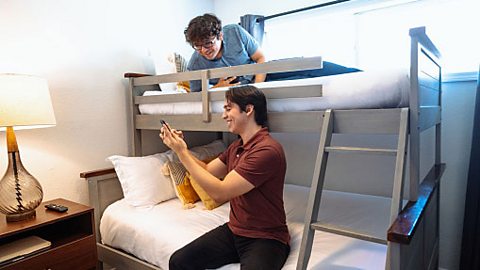
Dans ma maison, il y a huit pièces. - In my house, there are eight rooms.
La chambre de ma mère est au deuxième étage. - My mum’s bedroom is on the second floor.
Nous avons un bureau au sous-sol. - We have an office in the basement.
Remember that to show possession in French use the A preposition is a word such as 'at', 'for', 'with', 'into' or 'from' which is usually followed by a noun or pronoun. They are used to show where something is in place or time. de.
For example:
La chambre de ma sœur - My sister’s room.
Grammar - Possessive adjectives
Possessive adjectives show who something or someone belongs to.
Use a possessive adjective to show who something belongs to eg, my, your, our.
In French, the possessive adjective agrees with the All French nouns are either masculine or feminine. In French, objects such as a table or car, as well as people, have a grammatical gender. of the thing owned, not the owner.
| English | Masculine | Feminine | Plural (masculine and feminine) |
|---|---|---|---|
| my | Check your connection, refresh the page and try again. | Check your connection, refresh the page and try again. | Check your connection, refresh the page and try again. |
| your (familiar singular) | Check your connection, refresh the page and try again. | Check your connection, refresh the page and try again. | Check your connection, refresh the page and try again. |
| his/her/its | Check your connection, refresh the page and try again. | Check your connection, refresh the page and try again. | Check your connection, refresh the page and try again. |
| our | Check your connection, refresh the page and try again. | Check your connection, refresh the page and try again. | Check your connection, refresh the page and try again. |
| your (formal/plural) | Check your connection, refresh the page and try again. | Check your connection, refresh the page and try again. | Check your connection, refresh the page and try again. |
| their | Check your connection, refresh the page and try again. | Check your connection, refresh the page and try again. | Check your connection, refresh the page and try again. |
For example:
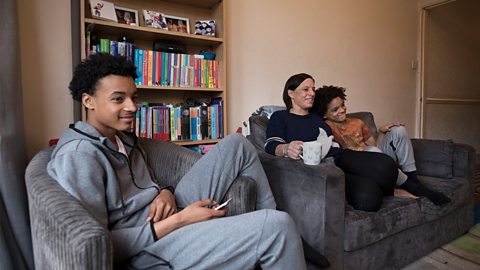
Je dois partager ma chambre. – I have to share my bedroom.
On a mangé dans notre jardin. – We ate in our garden.
Nous allons visiter leur maison demain. – We’re going to visit their house tomorrow.

Remember
Mon, ton and son are used instead of ma, ta and sa before a feminine word starting with a vowel or silent 'h'. This makes pronunciation easier.
For example:
C’est ton adresse ? – Is that your address?
Using possessive adjectives - Mini quiz
Choose the correct possessive adjective to complete the following sentences.
Press Start to begin the activity.
Find out more about using possessive adjectives in the Possessive adjectives in French guide.
Listening practice
Listen to these students talking about where they live. Decide whether each person has a positive or negative opinion about where they live and note at least one reason why.
Student 1
Negative.
Shares room with sister .
Ce que je n’aime pas, c’est que je dois partager ma chambre avec ma sœur.
What I don’t like is that I have to share a room with my sister.
Student 2
Negative.
Room is very small, has a lot of books, so there isn’t much space.
Ma chambre est très petite et j’ai beaucoup de livres alors il n’y a pas beaucoup de place.
My room is very small and I have a lot of books so there’s not much room.
Student 3
Positive.
Own room, comfortable bed, walls are favourite colour, perfect.
J’ai ma propre chambre avec un lit confortable. Les murs sont bleus - ma couleur préférée. C’est parfait !
I have my own bedroom with a comfortable bed. The walls are blue – my favourite colour. It’s perfect!
Student 4
Negative.
Liked old flat better, house too far from friends.
J’aimais mieux notre ancien appartement. Notre nouvelle maison est trop loin de mes amis.
I liked our old flat better. Our new house is too far from my friends.
Vocabulary – Describing where you live
Useful phrases to help describe where you live include:
| French | English | French | English |
|---|---|---|---|
| Mon adresse, c’est … | My address, is … | C’est un appartement moderne en ville. | It’s a modern flat in town. |
| Ma maison se trouve près de … | My house is situated near … | C’est une vieille maison. | It’s an old house. |
| Ma maison est dans un village à la campagne. | My house is in a village in the countryside. | Nous avons des voisins sympas. | We have nice neighbours. |
| Nous habitons dans la capitale. | We live in the capital city. | Nous sommes dans une rue calme. | We are on a quiet street. |
| Elle habite chez ses grands-parents. | She lives at her grand-parents’ place. | Notre maison est sur la grande route. | Our house is on the main road. |

For example
À l’avenir, je voudrais habiter à la campagne parce que c’est plus calme. - In the future, I would like to live in the countryside because it’s quieter.
Est-ce que tu as rencontré nos nouveaux voisins? - Have you met our new neighbours?
All Foundation Tier vocabulary listed in this guide can be found on the vocabulary sheet below.
Reading practice
You receive an email from your friend who has just been to stay in a house that she loved. Read the text and answer the questions that follow.
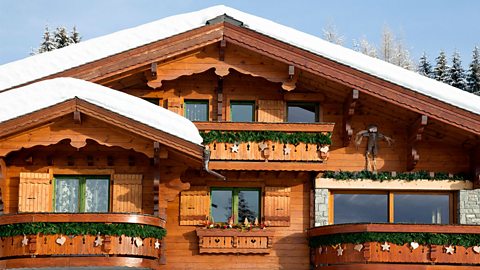
Le weekend dernier, je suis restée à la campagne, dans le sud-est de la France, chez une copine française. Sa maison est ma maison idéale. Elle est énorme. Il y a six chambres et chaque chambre a une salle de bains. Chez moi, il y a seulement deux salles de bains pour toute la famille.
De plus, la plupart des chambres ont une vue étonnante sur les montagnes. Au premier étage, il y a une grande cuisine moderne et un petit bureau. Au sous-sol*, il y a un cinéma privé où nous avons regardé un film et mangé des snacks, puisqu’il y a aussi une machine à popcorn.
Dehors, dans le jardin, il y a une piscine. Nous n’avons pas fait de la natation car il faisait trop froid, mais nous avons pu profiter du jacuzzi. C’était vraiment génial !
J’espère que je vais pouvoir retourner chez ma copine bientôt.
Élodie
*au sous-sol = basement
- Whose house did Élodie go to last weekend?
Her French friend’s house.
She says: …chez une copine française – …at my French friend’s house.
- How many bedrooms are there in the house?
Six.
She says: Il y a six chambres… – There are six bedrooms…
- How many bathrooms are there in Élodie’s own house?
Two.
She says: Chez moi, il y a seulement deux salles de bains… – At my house, there are only two bathrooms…
- What can you see from most of the bedrooms?
The mountains.
She says they have: …une vue étonnante sur les montagnes. – …an incredible view of the mountains.
- What is in the basement?
A cinema.
She says: Au sous-sol, il y a un cinéma privé… – In the basement, there is a private cinema…
- Why didn’t they swim in the pool?
It was too cold.
She says: Nous n’avons pas fait de la natation, car il faisait trop froid… – We didn’t go swimming because it was too cold…
Click or tap on Show more to read a translation.
Last weekend, I stayed in the countryside in the south-east of France at French friend's house. Her house is my ideal house. It's huge. There are six bedrooms and each room has a bathroom. In my house there are only two bathrooms for the whole family.
What's more, most of the bedrooms have an incredible view of the mountains. On the first floor, there is a big, modern kitchen and a small office. In the basement, there is a private cinema where we watched a film and ate snacks as there was also a popcorn machine.
Outside, in the garden, there is a swimming pool. We didn't go swimming as it was too cold but we were able to make the most of the jacuzzi. It was really great!
I hope to be able to go back to my friend's house soon.
Élodie
Vocabulary sheet
Click or tap on the image below for a list of useful vocabulary to use when describing your home and neighbourhood.

Higher Tier – Vocabulary – Describing where you live
Useful vocabulary to talk about where you live includes:
| French | English |
|---|---|
| au premier étage | on the first floor |
| au deuxième étage | on the second floor |
| la pièce | room |
J’habite dans la banlieue de … - I live in the suburbs of …
For example:
Ma maison se trouve dans la banlieue de Manchester. - My house is situated in the suburbs of Manchester.
All vocabulary listed in this guide can be found on the vocabulary sheet below.
Higher Tier - Vocabulary sheet
Click or tap on the image below for a list of useful vocabulary to use when describing your home and neighbourhood.
Now you have revised the important vocabulary and key grammar points describing your home and neighbourhood why not have a look at the Describing tourist attractions guide.
Careers advice and tips from BBC Bitesize
Future careers, further studies and the world of work - we're here to help with advice from experts and from young people who've found their path.

More on Life in my local area
Find out more by working through a topic
- count4 of 5

- count5 of 5