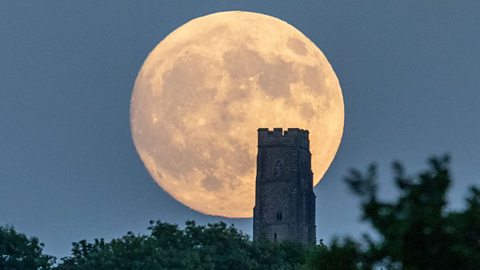
We have an extra reason to appreciate the Moon's beauty this week.
On Thursday 4 December we get our last full moon of the year. Known as a cold supermoon, it is the second-biggest of the year and the third of four supermoons that will appear close together.
Astronomers say we can enjoy it from around 6.15pm, but that also depends on which part of the UK you live in.
Why is a supermoon 'super'?
The distance between the Moon and the Earth varies each year as the Moon's orbit is not a perfect circle. When the Moon is closest to the Earth, and is full, it can be called a supermoon - as it looks bigger and brighter than usual. Compared to other full moons, it can look up to 14% bigger and 30% brighter.
Not all astronomers agree on the definition of a supermoon. Another way of describing it is when the Moon is within 360,000km of the centre of the Earth.
It's not just a supermoon that gets people talking about the moon. On socials, there are a massive 48 million posts on Instagram and 5 million posts on TikTok.
But not all the chat on social media can be believed…
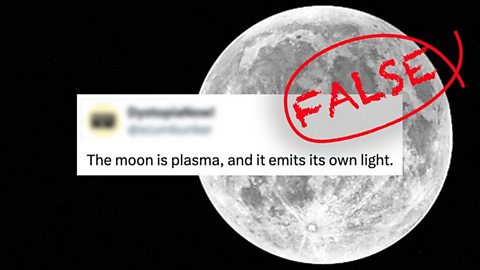
The Moon doesn't make its own light. We can see the Moon so clearly because it reflects sunlight. Half of the Moon is brightly lit by the Sun, the other half is in darkness. The Moon is made up of rock and metals, not plasma, which is a hot, ionized gas composed of positively charged ions and free electrons. The Sun is made from plasma. The way the moon looks has led to other conspiracy theories - including the time humans landed there for the first time.
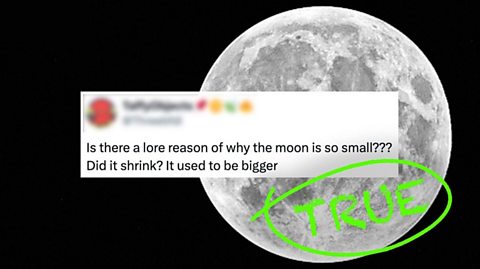
The Moon is actually shrinking but very gradually. A huge amount of heat was generated when the Moon was formed in what scientists think was a collision event around 4.5 billion years ago. The interior of the Moon has been cooling down ever since, which has caused the Moon to shrink by around 50 metres over the last several hundred million years!
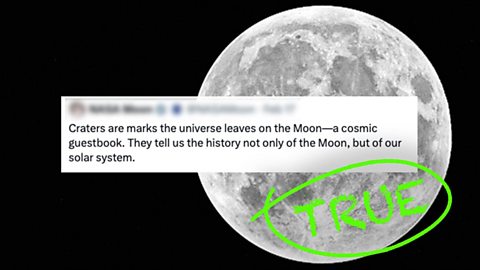
Lunar craters are created when an asteroid, meteoroid, or a comet, plunges into the Moon’s surface. Some craters on the moon are more than 186 miles in diameter, that's about the distance it would take to drive from London to Wakefield in Yorkshire! There’s no liquid water or wind on the moon, so evidence of the impacts has been preserved for billions of years. Scientists use a technique called crater-counting to identify the age of the Moon's surface.
Moon misinformation
With so much curiosity and intrigue about the Moon, it could be quite easy for misinformation to be spread and shared online. When you read and watch content on your socials, think before you share. Don't believe everything you see, hear or read, including conspiracy theories. Do your own research and check that the information comes from trusted sources and experts.
This article was updated in December 2025.

Not sure if the news you’re seeing on social media is true or false? Can you always tell if the things you see online are real or fake?
Learn how to get the other side of the story with our quizzes, videos and explainers about media skills and viral trends including popular food myths.
Do leaves on tracks cause train delays?
Thousands of leaves are falling - but will they affect your journey?
Super Bowl half-time show: Headliner rumours and Bad Bunny backlash
Adele and Taylor Swift were rumoured - but it's not them