All about the EU
Previously known as the European Economic Community (EEC), the EU has been a huge part of life, economics and politics for decades. It became known as the EU in 1992 and today, there are currently nearly 30 European countries who are part of it.
For nearly 50 years, the UK was one of them, until the 2016 referendum, when the UK voted to leave. But what is the EU and what does it stand for?
Here, BBC Bitesize takes a closer look at the history of the EU, why it was created and the UK’s relationship with it. You can find out more below.
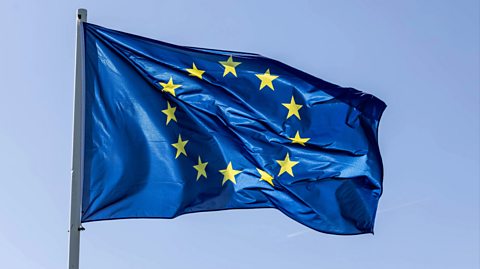
What is the EU and what does it stand for?
The EU stands for The European Union. The EU is a group of countries from across Europe whose governments work together, and they have agreements in place for political and economic purposes.
It is what is known as a single market, meaning the agreement allows the free movement of goods, services, capital and labour. The EU has its own parliament, rules and benefits and the European Union also played a big role in the development of the euro.
Introduced in 2002, several countries began using the coins and notes instead of their own currency over 20 years ago. Called the eurozone, there are now over 20 countries who use the euro.
When was the EU created and why?
After World War II ended, the EU as it would later be known was created to prevent further conflict and build international relationships, following the devastation of the war. First came the Treaty of Paris of 1951, which established the European Coal and Steel Community (ECSC) and was joined by France, Germany, Italy, the Netherlands, Belgium and Luxembourg.
In 1958, under the Treaty of Rome, these same six countries were behind the European Economic Community and European Atomic Energy Community, which worked alongside the ECSC. By the following decade, in 1967, the three communities as they were known merged and became known as the European Communities (EC).
By 1991, the Treaty on European Union was signed at Maastricht, The Netherlands and established the European Union (EU) as the successor to the EC. As a result, EU citizenship was created, allowing people from member countries to move freely between member states.
When did the United Kingdom join the EU?
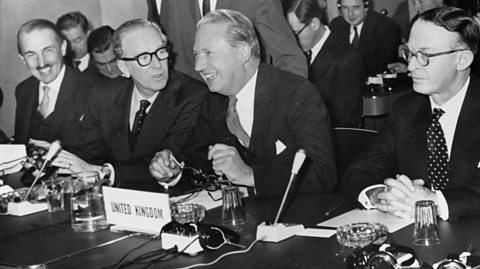
It was first in 1961 – four years after the EEC was established – that the UK applied to join. Unsuccessful, the UK would apply again in 1963 and 1967 before officially joining in 1973 – which marked the UK’s membership in the EEC, which later evolved into the EU.
However, the following year in 1974, Labour came to power under Prime Minister Harold Wilson, who promised to renegotiate the deal and as a result, hold a referendum. In 1975, the country’s first nationwide referendum was held, which asked if the UK should continue its membership in the European Community.
At the time, 67.2% voted in favour to remain. This is something the UK did for many decades that followed.
Can you name the following European countries?
Why isn’t the United Kingdom in the EU now and what is Brexit?
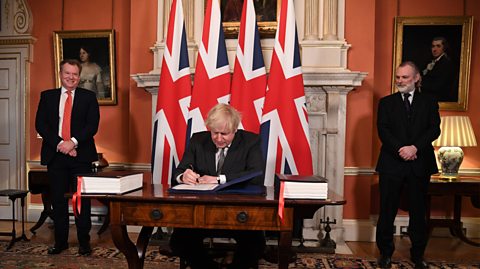
It was a public vote – called a referendum – that was held on 23 June 2016 that saw the UK vote to leave the European Union. At the time, voters were asked the question of whether the UK should leave or remain in the EU, with the leave side winning by nearly 52% to 48%.
Nicknamed Brexit, short for ‘British Exit,’ the change did not happen straight away. It wasn’t until 31 January 2020 that the UK left the EU, with its transition period finishing on 31 December that year.
When it comes to the nations within the UK, Northern Ireland has a separate agreement. The Brexit negotiation was complex and there were a number of implications as a result of leaving the EU – you can read more about them here.
What countries are in the EU?
There are currently 27 countries in the European Union. These are Austria, Belgium, Bulgaria, Croatia, Republic of Cyprus, Czechia, Denmark, Estonia, Finland, France, Germany, Greece, Hungary, Ireland, Italy, Latvia, Lithuania, Luxembourg, Malta, Netherlands, Poland, Portugal, Romania, Slovakia, Slovenia, Spain and Sweden.
The most recent country to join the European Union is Croatia, who became a member in 2013. However, an agreement called the EEA (European Economic Area) extends the European Union’s single market to Iceland, Liechtenstein and Norway.
This article was written in December 2025
