What are percentages?
Percent or % means 'out of one hundred'.
In this diagram, \({30}\) out of \({100}\) squares have been shaded. So 30% has been shaded.
Examples of percentages
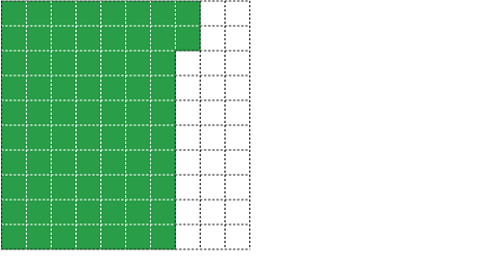
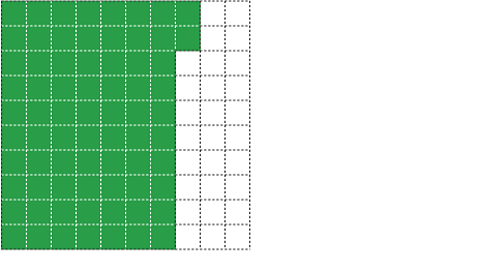
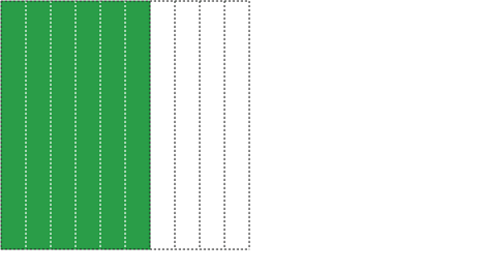
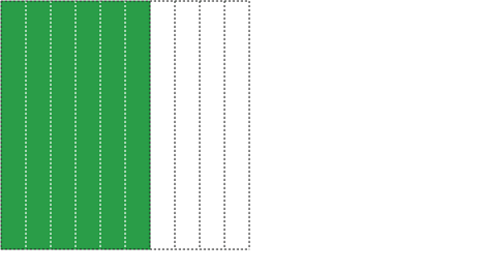
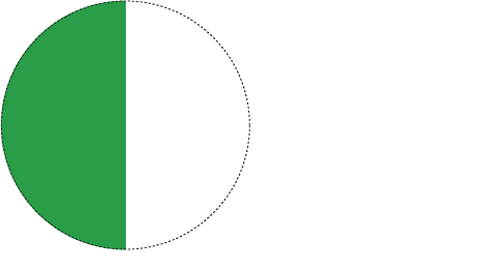
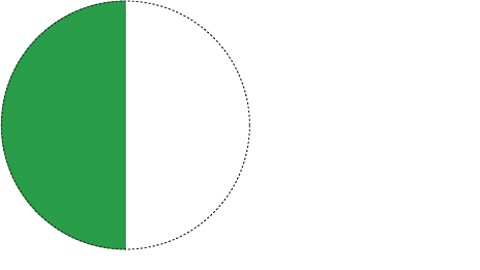
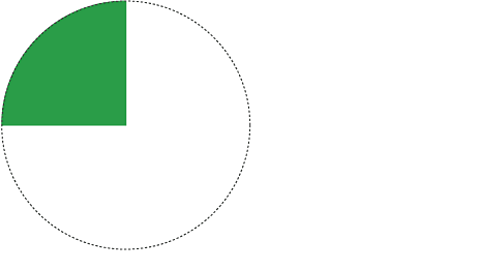
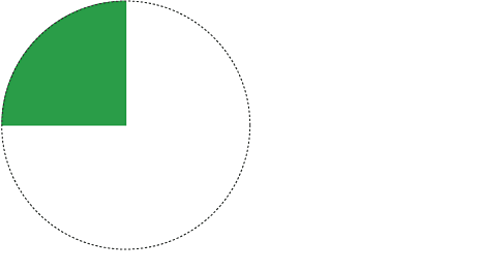
Image caption, What percentage has been shaded?
1 of 8
Writing one number as a percentage of another
Key point
To write one number as a percentage of another, divide the first number by the second number, then multiply by 100.
Question
a) A dress which originally cost \(\pounds{80}\) is reduced by \(\pounds{10}\) in the sale. What percentage reduction is this?
b) A swimming team has \({20}\) members and \({12}\) of these are boys.What percentage of the swimming team are boys?
Answer
a) \(10 \div 80 = 0.125\)
\(0.125 \times 100\% = 12.5\%\)
So the dress has been reduced by \(12.5\%\).
b) \(\frac{12}{20} \times 100 = 60\)
So \(60\%\) of the team are boys.
Finding the percentage of a quantity
It's often useful to be able to find a percentage of a quantity.
For example, you might be told that bus fares are going up by \(5\%\) and you need to know how much more you will need to pay each week.
Here are a couple of ways you could do it:
Method 1
Find \(1\%\) of the quantity by dividing it by \({100}\).
Find \(5\%\) of a quantity by multiplying \(1\%\) of the quantity by \(5\).
To find \(x\%\) of a quantity you need to multiply \(1\%\) of the quantity by \(x\).
Question
Rakesh has a box containing \({60}\) pens. \(20\%\) of the pens are red.
How many red pens does the box contain?
Answer
You need to find \(20\%\) of \({60}\).
\(1\%\) of \({60}\) is \(60 \div 100 = 0.6\)
So \(20\%\) of \({60}\) is \(0.6 \times 20 = 12\)
Method 2
Find the percentage of a quantity by multiplying that quantity by the percentage expressed as a fraction.
This combines the division and multiplication of Method 1 into one sum.
Questions
Q1. In a class of \({25}\) pupils, \(24\%\) live in a flat. How many pupils live in a flat?
Q2. Last year Sam earned \(\pounds{20,000}\). This year her pay has increased by \(8\%\).
a) By how much money has Sam's pay increased?
b) What is her new salary?
Answers
A1. \(24\%\) is equivalent to \(\frac{24}{100}\)
\(24\%\) of \(25 = \frac{24}{100} \times 25 = 6\)
Therefore \(6\) pupils live in a flat.
A2.
a) Method 1:
\(1\%\) of \(20,000 = 20,000 \div 100 = 200\)
\(8\%\) of \(20,000 = 8 \times 200 = 1,600\)
b) Method 2:
\(\frac{8}{100} \times 20,000 = 1,600\)
So Sam's new salary is:
\(\pounds{20,000} + \pounds{1,600} = \pounds{21,600}\)
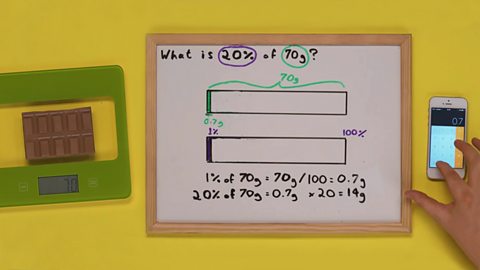
A one-minute video showing you how to work out a percentage of an amount using bar models.
How to work out the percentage of an amount
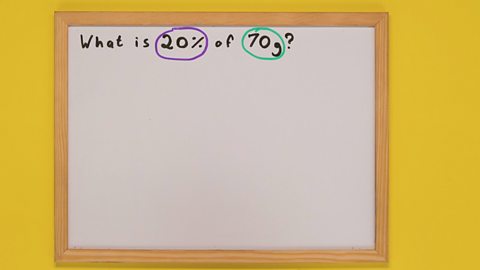
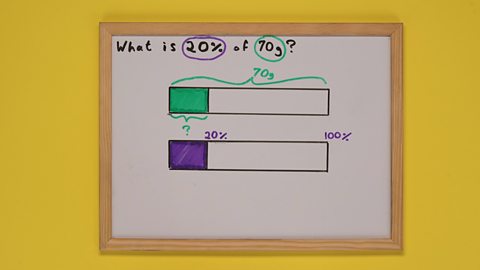
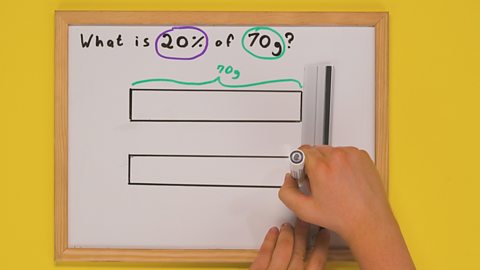
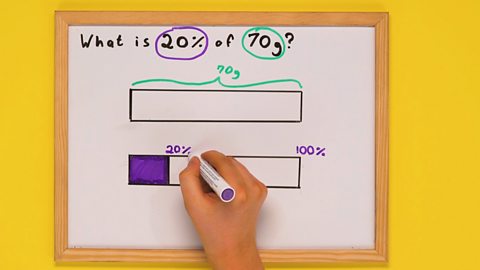
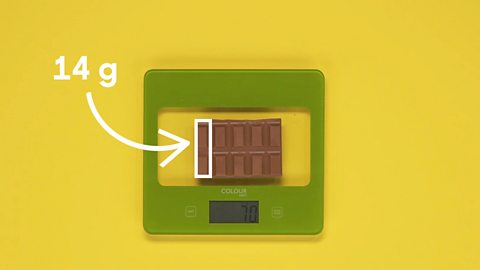
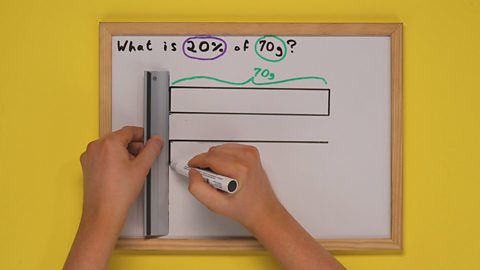
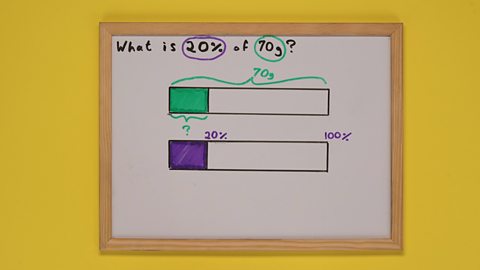
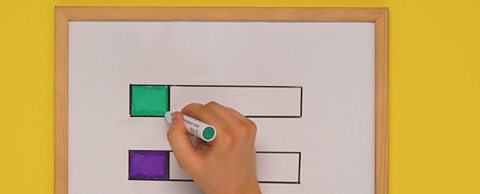
Image caption, STEP 1 - DRAW TWO BARS: Write out the problem and circle the key information. Here it is the percentage you want to find, 20%, and the weight of the chocolate, 70 g...
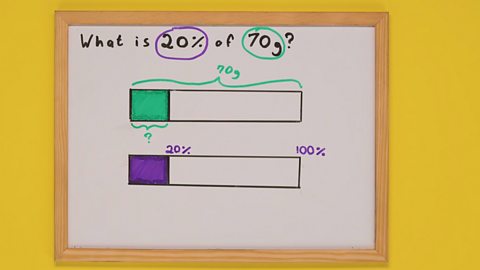
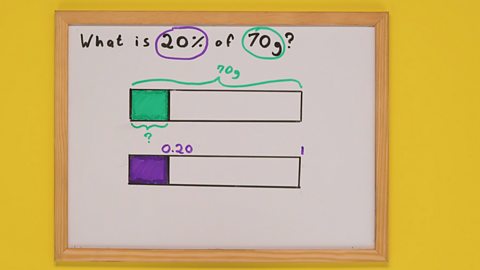
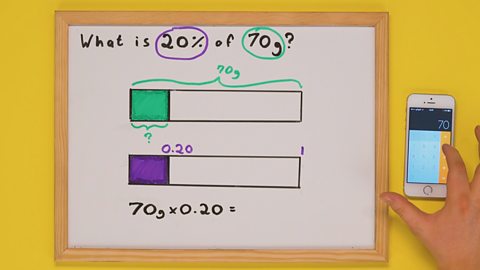
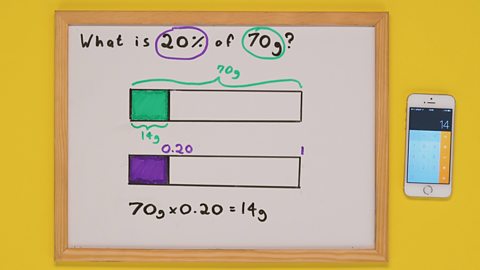
1 of 8
A short video showing you how to work out a percentage of an amount using the 1% method.
What is 20% of 70g?
70g
100%
20%
0.2
1
70g x 0.20 = 14g
14g
Work out percentages slideshow
Image caption, Click to see a step-by-step slideshow.
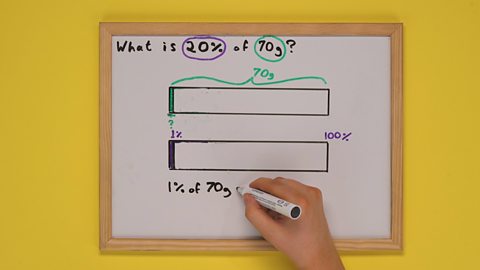
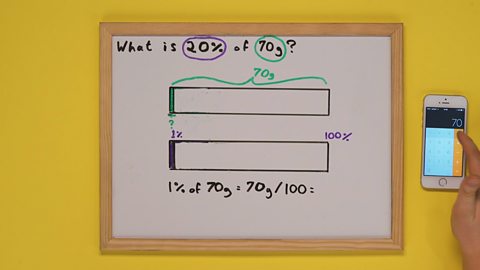
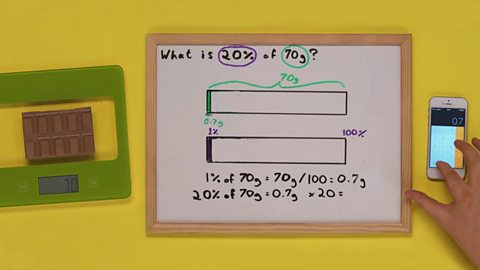
1 of 8
A bargain for Gran: Calculating percentages
A hunt for a bargain birthday gift turns into a challenge as one shopper works out how to calculate percentages.
Ben What can I get for Gran?
This looks like the sort of place.
Not what you’d call overcrowded.
No, I don’t know about those.
What do old people like?
Shop assistant We will be closing in five minutes.
Ben Better be quick.
What about these?
No, no… ooh that! £52.
£10, £20, OK so £37.
Oh there must be something.
Aha! Bargains!
But they haven’t done the maths.
Oh no, what can I write on?
Hmm…no, hmm oh cool!
So I need to work out 35% of £48.
Well, let’s break it down.
To get 10% of 48 you move the number one place to the right of the decimal point so £4.80.
So 10% three times takes us to 30% and that leaves 5%.
5% is half of 4.80 which is 2.40.
So adding them up, right hand column, zero, zero, zero, zero.
Three eights are 24 plus four is 28.
Carry the two to the left of the decimal point.
Then three fours are 12 plus two, plus two, is £16.80 off.
So £48 minus £16.80.
Let’s take the 16 off first.
48 minus 16 is 32 and take off the 80p that’s £31.20.
A bargain and gives me money to spare!
You’re gonna love this Gran!
Hey there’s another one!
That one looks nicer though and it’s reduced to £32 which is £18 off but which one is better value?
I just need to compare the percentage discounts.
The pink one was 35% off and on the right they’ve knocked £18 off a £50 cardigan.
I can think of the discount as a fraction.
£18 out of £50, 18 over 50.
So how do I make 18 over 50 into a percentage?
To change a fraction into a percentage I need to multiply by a 100.
I need to multiply by 100.
Hmm, that’ll take a bit of working out…
But luckily, in this case, because the denominator is 50, I can use a simpler method.
Because percentages are out of 100 if I multiply the bottom 50 by two I get 100.
Multiply the top 18 by two, I get 36.
So that’s 36 out of 100 which is 36% discount.
Wow! A whole percentage point better value.
(MUSIC)
You deserve it Nan.
(MUSIC)
And I get the banana.
Test section
Question 1
\({40}\) squares are shaded in a \({100}\)-square grid.
What percentage of the grid is shaded?
Answer
\(\frac{40}{100}\), which is \({40}\%\).
Question 2
There are \({35}\) squares shaded in a \({50}\)-square grid.
What percentage of the grid is shaded?
Answer
\(\frac{35}{50}=\frac{70}{100}\), which is \({70}\%\).
Question 3
What is \({40}\%\) of \({90}\) people?
Answer
The method of calculating a percentage of a quantity is to find \({1}\%\) then multiply it to get the percentage you need.
\({90}\div{100}={0.9}\)
\({0.9}\times{40}={36}\).
So the answer is \({36}\) people.
Question 4
What is \({35}\%\) of \({210}~{g}\)?
Answer
The method of calculating a percentage of a quantity is to find \({1}\%\) then multiply it to get the percentage you need.
\({210}~{g}\div{100}={2.1}~{g}\)
\({2.1}~{g}\times{35}={73.5}~{g}\).
Question 5
There is \({15}\%\) off the price of clothes in a shop.
A sweater's original price is \(\pounds{36}\).
What is its price after the reduction?
Answer
Remember that one way of calculating this answer is to find \({1}\%\), then multiplying it to get the percentage you need.
Then, you need to subtract this number from the original sum.
\(\pounds{36}\div{100}=\pounds{0.36}\)
\(\pounds{0.36}\times{15}=\pounds{5.40}\)
\(\pounds{36}-\pounds{5.40}=\pounds{30.60}\)
Question 6
The number of participants in a cycling competition has increased by \({20}\%\) since last year.
If there were \({1,240}\) competitors last year, how many are competing this year?
Answer
Remember that one way of calculating the answer is to find \({1}\%\), then multiply it to get the percentage you need.
Then, you need to add this number to the original sum.
\({1,240}\div{100}={12.4}\)
\({12.4}\times{20}={248}\)
\({1,240}+{248}={1,488}\)
Question 7
Ben gets \(\frac{14}{20}\) in his Geography test.
What percentage is this?
Answer
Remember that one way of calculating a percentage is to convert the fraction into an equivalent fraction over \({100}\).
\(\frac{14}{20}=\frac{70}{100}={70}\%\)
Question 8
In a class of \({30}\) pupils, \({12}\) are boys.
What percentage of the class are boys?
Answer
Remember that one way of calculating a percentage is to convert the fraction into an equivalent fraction over \({100}\).
\(\frac{12}{30}=\frac{4}{10}=\frac{40}{100}={40}\%\)
Question 9
Diane eats \({4}\) pieces of a \({16}\) piece chocolate bar.
What percentage of the bar has she eaten?
Answer
Remember that you have to divide to get the decimal, then multiply by \({100}\) to get the percentage.
\({4}\div{16}={0.25}={25}\%\)
Question 10
If \({27}\) out of \({60}\) cars are red, what is the percentage of non-red cars?
Answer
After calculating how many cars are not red, remember to divide to get the decimal, then multiply by \({100}\) to get the percentage.
\({60}-{27}={33}\)
\({33}\div{60}={0.55}={55}\%\)
More on Percentages
Find out more by working through a topic
- count2 of 9
- count3 of 9
- count4 of 9