What is percentage change?
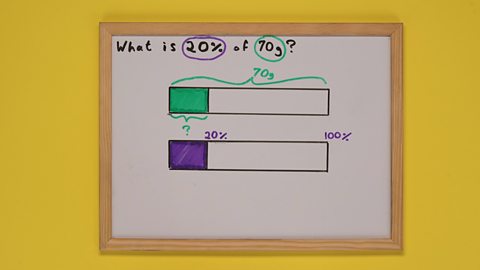
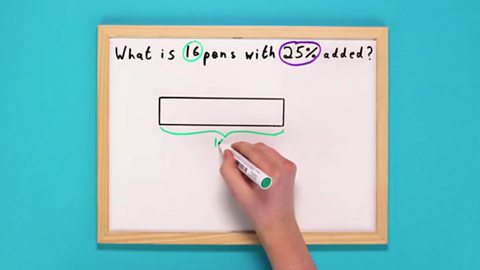
In everyday life, quantities are often changed by a percentage of the original amount.
Percentage Increase/Decrease
In a sale, prices might be decreased by a certain percentage or electricity might have to be increased by a percentage of the present cost.
This is referred to as percentage decrease and percentage increase respectively.

A set of towels normally costs £45.
What will the set cost after the price is reduced in the sale?
\(£45\) is reduced by \(15\%\)
\(15\%~of~45\) = \({45}\times{15}\div{100}\)
\(= £6.75\)
The price has been reduced by \(£6.75\)
The new price is \(£45 - £6.75 = £38.25\)
OR
\(£45\) is reduced by \(15\%\)
The full price is taken to be \(100\%\)
\(100\% - 15\% = 85\%\)
The sale price is \(85\%\) of the full price.
\(85\%~of~45 =\)
\({45}\times{85}\div{100}\)
\(= £38.25\)
The new price is \(£38.25\)
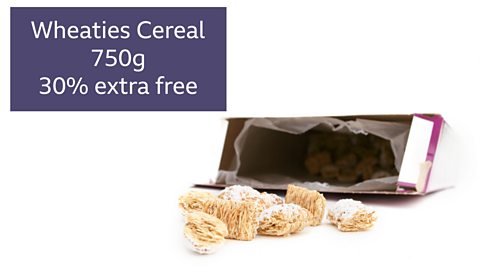
How much cereal will be in the Wheaties packet after the extra is added?
\(750g\) is increased by \(30\%\)
\(30\%\) of \(750\) =
\({750}\times{30}\div{100}\)
\(= 225\)
There will be \(225g\) more in the packet.
\(750g + 225g = 975g\)
The new packet will contain \(975g\) of cereal.
OR
\(750g\) is increased by \(30\%\)
The original pack contains \(100\%\).
The new pack will contain \(100\% + 30\% = 130\%\)
\(130\%~of~750g = 975g\)
The new packet will contain \(975g\) of cereal.
Calculating Percentage Change
Percentage change is the amount that a quantity has changed, expressed as a percentage of the original value.
This can be either an increase or a decrease.
Percentage change can be calculated using the appropriate formula:
\(\%\) increase = \(\frac{(actual~increase)}{(original~value)}\times{100}\)
OR
\(\%\) decrease = \(\frac{(actual~decrease)}{(original~value)}\times{100}\)
Example
A laptop that normally costs \(£550\) is reduced to \(£484\) in a sale.
What is the \(\%\) reduction in the price?
Use the formula:
\(\%\) decrease = \(\frac{(actual~decrease)}{(original~value)}\times{100}\)
Actual decrease \(= £550 – £484 = £66\)
% decrease =\(\frac{66}{550}\times{100} = 12\%\)
Key point
Percentage increase/decrease is always a % of the original quantity.
Question
A family’s gas bill for one year was \(£654\).
The gas company increases the price and the next year their bill is \(£709.59\).
What was the % increase?
Answer
Use the formula:
\(\%\) increase = \(\frac{(actual~increase)}{(original~value)}\times{100}\)
Actual increase:
\(= £709.59 – £654\)
\(= £55.59\)
% increase =\(\frac{55.59}{654}\times{100}\)
\(= 8.5\%\)
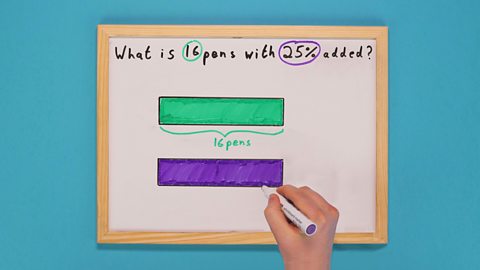
A short video showing how to work out percentage increase.
How to work out percentage increase slideshow

Image caption, Click to see a step-by-step slideshow.

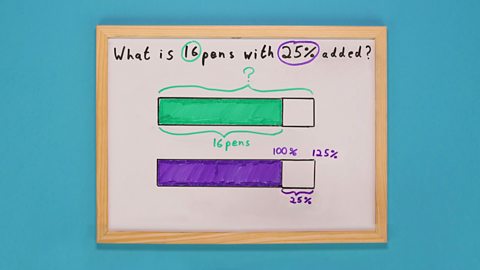
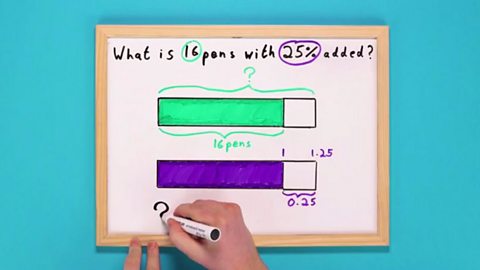
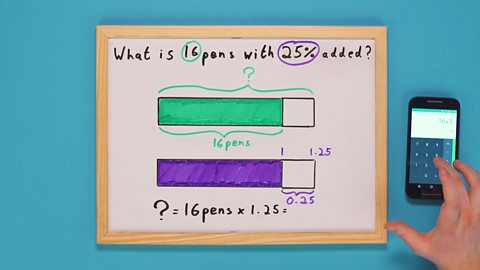
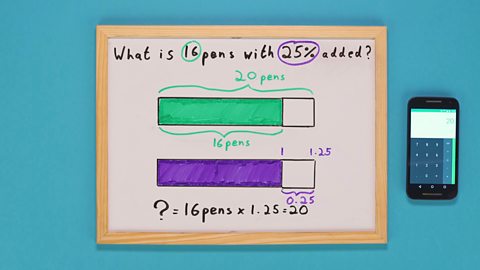

1 of 8
A one-minute video showing how to work out a percentage decrease.
How to work out percentage decrease

Image caption, Click to see a step-by-step slideshow.

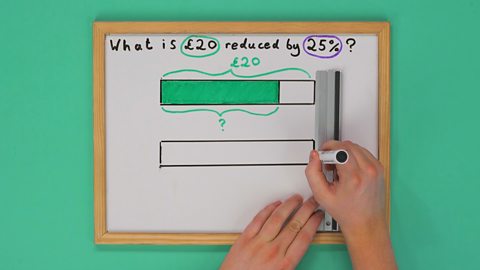
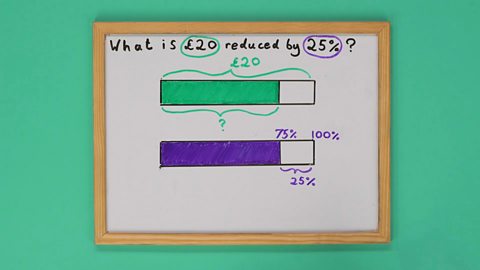
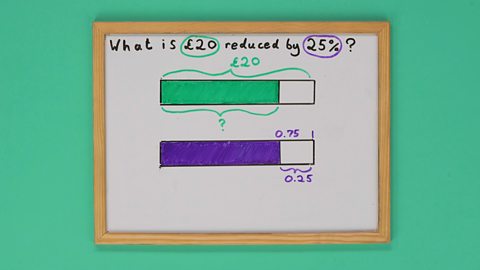
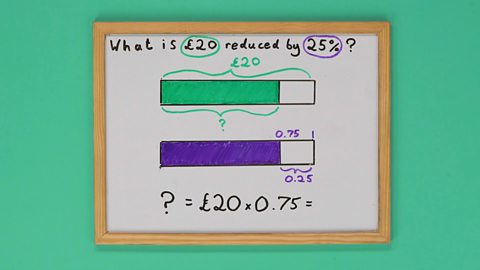
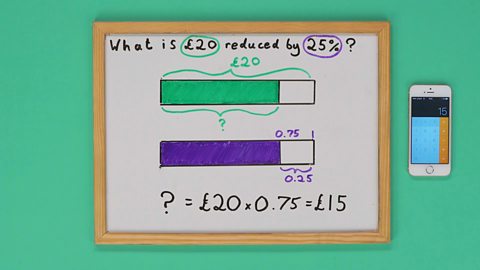

1 of 8
Reverse Percentages (finding original value before percentage change)

Naydia spends \(£52\) on a pair of trainers in the sale.
What would they have cost before the sale?
Let the original price = \(100\%\)
The reduction is \(20\%\) so sale price = \(80\%\) of the original.
The trainers cost \(£65\) before the sale.
Question
A car salesperson sold \(378\) cars in 2019.
This was an increase of \(8\%\) on the year before.
How many cars did she sell in 2018?
Answer
Let the original amount = \(100\%\)
The increase is \(8\%\) so sales for 2018 = \(108\%\)
\(108\% = 378\)
\(1\%\) \(= 378 ÷ 108 = 3.5\)
\(100\%\) = \({3.5}\times{100}\)
\(= 350\)
The salesperson sold \(350\) cars in 2018.
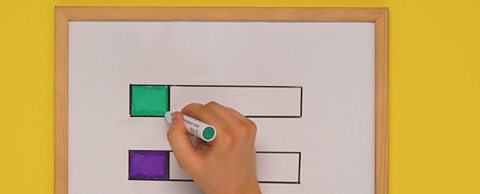
A one-minute video showing how to work out the original value before a percentage change.
Work out original value slideshow
Image caption, Click to see a step-by-step guide.

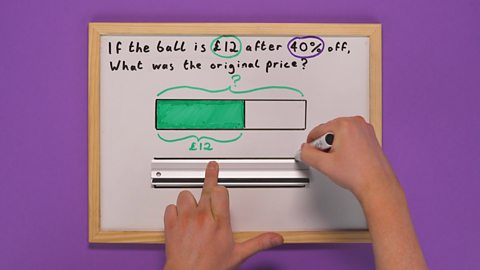
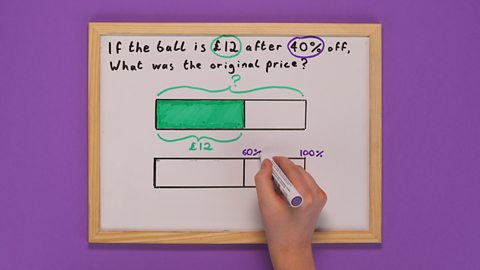
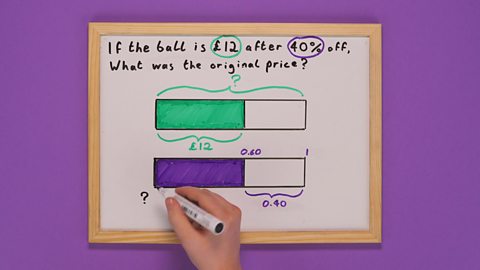
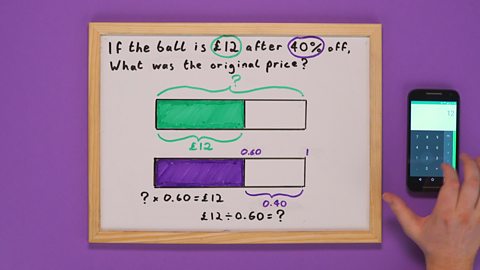
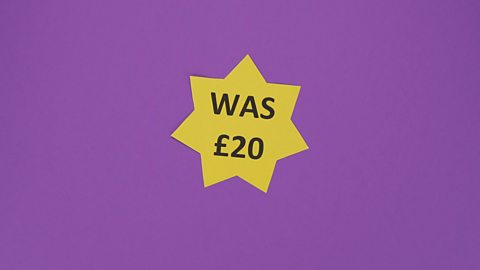
1 of 7
Repeated Percentage Change
Repeated Percentage Change is when an amount changes a number of times by a given %.
Example
Amy buys a nearly new car costing \(£10500\).
The dealer tells her that the value of the car will depreciate (decrease) by \(8\%\) each year.
How much will the car be worth after 3 years?
Decrease in first year:
\(8\%\) of \(£10500\) = \(£840\).
Value at the end of first year = \(£10500 - 840 = £9660\)
Decrease in second year:
\(8\%\) of \(£9660 = £772.80\).
Value at the end of second year \(= £9660 - £772.80 = £8887.20\)
Decrease in third year:
\(8\%\) of \(£8887.20 = £71.10\) (nearest penny)
Value at the end of third year \(= £8887.20 - £710.98 = £8176.22\)
Amy’s car will be worth \(£8176.22\) after 3 years
Alternative method
There is an alternative and much quicker method.
The value of the car decreases by \(8\%\) each year.
This is \(92\%\) of the value for the previous year.
\(92\% = 0.92\)
After one year the value will be:
\({10500}\times{0.92}\)
After two years the value will be:
\({10500}\times{0.92}\times{0.92}\)
After three years the value will be:
\({10500}\times{0.92}\times{0.92}\times{0.92} = {10500}\times{0.92}^3\)
\({10500}\times{0.92}^3 = {£8176.22}\) (nearest penny)
Question
The population of a town is \(42000\).
Planners estimate that it will increase by \(0.7\%\) every year.
Calculate the estimated population in two years’ time.
Answer
Increase in first year:
\(0.7\%~of~42000 = 294\)
At the end of first year the population will be:
\(42000 + 294 = 42294\)
Increase in second year:
\(0.7\%~of~42294\)
\(= 296\) (nearest whole number)
At the end of second year the population will be:
\(42294 + 296 = 42590\)
OR
\(100\% + 0.7\% = 100.7\% = 1.007\)
Population after 2 years:
= \({42000}\times{1.007}^2\)
\( = 42590\)
Test section
Question 1
A calculator normally costs \(£18\) but the price is reduced by \(12\%\) in a promotion.
What is the reduced price?
Answer
\(£15.84\)
Question 2
The population of a town increases from \(67500\) to \(72600\).
What is the percentage increase?
Answer
\(7.6\%\)
Question 3
Zak runs a \(10k\) race in \(40\) minutes.
The next week he runs it in \(38\) minutes.
What is the percentage reduction in his time?
Answer
\(5\%\)
Question 4
After a reduction of \(15\%\), a sofa is priced at \(£680\).
What was the price before the reduction?
Answer
\(£800\)
Question 5
Daisy’s annual salary has been increased by \(4\%\) to \(£26000\).
What was her salary before the increase?
Answer
\(£25000\)
Question 6
In 2020, it was estimated that house prices in Northern Ireland were increasing by \(2.4\%\) every year.
In January 2020, the average house price \(£143000\).
What will the average house price be in January 2022?
Give your answer to the nearest \(£\).
Answer
\(£149946\)
More on Percentages
Find out more by working through a topic
- count3 of 9
- count4 of 9