Key points

Used to describe nouns and must agree with the nouns they are describing. are useful for giving more information on your opinion of different types of food and drink.
Adjectives must agree with the The name of a thing such as an object, a place or a person. Nouns are often described as naming words. they describe.
Add the A letter or group of letters, which is added to the end of a word in order to form a different word, often of a different word class.ísimo to an adjective to make it more intense.
This guide contains a video comprehension and reading practice.
Vocabulary - Food and drink
Useful vocabulary to use when talking about meals includes:
| Spanish | English |
|---|---|
| Check your connection, refresh the page and try again. | lunch |
| Check your connection, refresh the page and try again. | drink |
| Check your connection, refresh the page and try again. | evening meal |
| Check your connection, refresh the page and try again. | meal/lunch |
| Check your connection, refresh the page and try again. | breakfast |
| Check your connection, refresh the page and try again. | snack |

Useful nouns for food and drink include:
| Spanish | English | Spanish | English |
|---|---|---|---|
| Check your connection, refresh the page and try again. (f) | water | Check your connection, refresh the page and try again. | rice |
| Check your connection, refresh the page and try again. | apple | Check your connection, refresh the page and try again. | sandwich |
| Check your connection, refresh the page and try again. | bread | Check your connection, refresh the page and try again. | sugar |
| Check your connection, refresh the page and try again. | paella (dish usually of rice and seafood) | Check your connection, refresh the page and try again. | meat |
| Check your connection, refresh the page and try again. | salad | Check your connection, refresh the page and try again. | fish |
| Check your connection, refresh the page and try again. | fruit | Check your connection, refresh the page and try again. | chicken |
| Check your connection, refresh the page and try again. | prawns | Check your connection, refresh the page and try again. | dessert |
| Check your connection, refresh the page and try again. | burger | Check your connection, refresh the page and try again. | sauce |
| Check your connection, refresh the page and try again. | egg | Check your connection, refresh the page and try again. | ham |
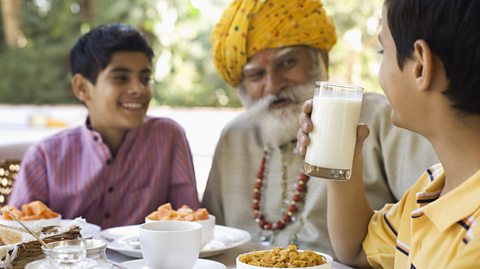
For example:
Para el desayuno tomo huevos y pan y bebo café. – For breakfast I have eggs and bread and I drink coffee.
Mi bebida favorita es la limonada pero sé que el agua es más sana. – My favourite drink is lemonade but I know that water is healthier.
Para la cena normalmente tomo el pescado o la carne con verduras. – For the evening meal I normally have fish or meat with vegetables.
En España se come tradicionalemente las tapas en los bares – el jamón, las patatas bravas y las gambas son populares. – In Spain one traditionally eats tapas in bars – ham, Spanish-style potatoes and prawns are popular.
Grammar - Making adjectives agree
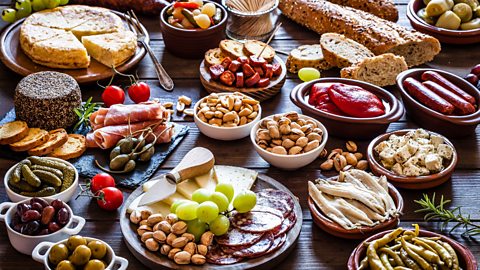
To describe food or someone’s food preferences, such as saying you are vegetarian, use adjectives.
In Spanish, adjectives usually go after the noun.
For example:
La paella es muy rica. - Paella is very tasty.
Las tapas son tradicionales. - Tapas are traditional.
In Spanish, adjectives must agree with the noun. For regular adjectives, change the o to a when using it with a feminine noun, and add s with a plural noun.
| Masculine | Feminine | English | |
|---|---|---|---|
| Singular | Check your connection, refresh the page and try again. | Check your connection, refresh the page and try again. | tasty |
| Plural | Check your connection, refresh the page and try again. | Check your connection, refresh the page and try again. | tasty |
For example:
Elena es vegetariana. – Elena is vegetarian.
Las patatas bravas son deliciosas. – Patatas bravas (Spanish-style potatoes) are delicious.
Adjectives that end in e or a consonant do not change if the noun is masculine or feminine.
Add es to the end of the adjective when used with a plural noun.
| Masculine | Feminine | English | |
|---|---|---|---|
| Singular | Check your connection, refresh the page and try again. | Check your connection, refresh the page and try again. | traditional |
| Plural | Check your connection, refresh the page and try again. | Check your connection, refresh the page and try again. | traditional |

For example:
La carne es bastante caliente. – The meat is quite hot.
El azúcar es muy dulce. – Sugar is very sweet.
Adjectives and agreements - Mini quiz
Complete the following sentences with the correct adjective.
La hamburguesa es _______.
The burger is tasty.
La hamburguesa es rica.
Rico means tasty and la hamburguesa is feminine singular, so the adjective ending is a.
Las patatas bravas son _________ .
Patatas bravas are traditional.
Las patatas bravas son tradicionales.
The adjective tradicional means ‘traditional’. Add es to make it plural, to match with patatas bravas.
Los huevos son __________.
The eggs are delicious.
Los huevos son deliciosos.
Los huevos is a masculine plural noun, so the adjective ending is os.
Me gusta la leche ______.
I like warm milk.
warm = caliente
Me gusta la leche caliente.
The adjective caliente ends in e and does not change in the singular form.
Find out more about making adjectives agree in the Adjectives in Spanish guide.
Video comprehension
Watch the video then answer the questions below.
Maria talks about Spanish food
Question
According to María, what time is it at the start of the video?
Answer
Ten o'clock in the morning.
She says: 'Bueno, son las diez de la mañana y tengo mucha hambre.' (Well, it's ten o'clock in the morning and I'm very hungry.)
Question
Why does María not have 'pan con tomate' for breakfast at weekends?
Answer
She stays in bed/ she skips breakfast.
She says: 'Para desayunar, tomo pan con tomate. Aparte de los fines de semana porque me quedo en la cama y me salto el desayuno.' (For breakfast I have 'pan con tomate'. Apart from weekends because I sleep in and skip breakfast.)
Question
María says that 'pan con tomate' is …
| A | very popular with young people |
| B | quite a recent invention |
| C | a typical breakfast dish all over Spain |
Answer
c) 'Es un plato de desayuno típico en toda España.' (It's a typical breakfast dish all over Spain.)
Question
María says she doesn't like adding oregano because 'tiene un sabor muy fuerte'. What does this mean?
Answer
It has a strong taste/ flavour. 'Hay gente que añade orégano, pero no es la receta tradicional y a mí no me gusta porque tiene un sabor muy fuerte.' (Some people add oregano, but it's not the traditional recipe and I don't like it because it has a really strong taste/ flavour.)
Question
Which member of María's family is from Catalonia?
Answer
Her dad.
She says: 'Mi padre es de Cataluña en el noreste de España, y para él este plato se llama 'pan tumaca'. (My dad is from Catalonia in the northeast of Spain, and to him this dish is called 'pan tumaca'.)
Click or tap on Show more to read the transcript and translation.
¡Hola! ¿Qué tal? Yo soy Maria.
Bueno, son las 10 de la mañana y tengo mucha hambre.
Entonces, hoy vais a aprender a preparar un desayuno español típico.
Y luego ¡vamos a desayunar!
¡Vámos!
Para el desayuno, tomo pan con tomate.
Aparte de los fines de semana, que me quedo en la cama y me salto el desayuno.
¿Habéis probado pan con tomate?
¡Está buenísimo!
Además, es super fácil de preparar.
Se hace con pan y tomate. ¡Claro!
Pero tiene dos ingredients principales más.
El aceite de oliva y el ajo.
Es un plato de desayuno típico en toda España.
Primero, rallamos los tomates.
Añadimos un poco de aceite de oliva.
Una pizca de sal…
Y lo mezclamos bien.
Hay gente que añade orégano, pero no es la receta tradicional y a mí no me gusta tanto porque tiene un sabor muy fuerte.
Luego, tostamos el pan.
Frotamos un poco de ajo sobre la tostada.
Y finalmente echamos el tomate por encima.
¡Y ya está!
Ya tenemos nuestro pan con tomate. ¡Muy fácil!
Mi padre es de Cataluña en el noreste de España, y para él este plato se llama ‘pan tumaca’.
Esta variación se puede servir con lonchas de jamón serrano.
Vamos a probarlo.
¡Qué rico!
El pan con tomate se sirve con café.
Con o sin leche…
Y con zumo de naranja natural.
¡Me encanta!
Pues ya sabéis, cuando quieres un desayuno típico español, tenéis que pedir pan con tomate.
Yo quiero pan con tomate por favor.
Con café y zumo.
Bueno, ahora se falta una cosa …
¡Una foto para mi blog!
Siempre saco fotos de mi comida.
A mis seguidores les encanta.
Bueno, pues. Hasta la próxima.
Translation
Hi! How are you? I’m Maria.
Well, it’s 10am and I’m very hungry.
So, today you’re going to learn to make a typical Spanish breakfast. And then we’re going to have breakfast.
Let’s go!
For breakfast I have pan con tomate, apart from on weekends because I sleep in and skip breakfast.
Have you tried pan con tomate? It’s delicious! And furthermore, it’s very easy to prepare.
It’s made with bread and tomato, of course!
But it has two more main ingredients; olive oil and garlic.
It’s a typical breakfast dish all over Spain.
First, we grate the tomatoes.
We add a little olive oil.
A pinch of salt.
And we mix it well.
There are people who add oregano, but it’s not the traditional recipe and I don’t like it so much because it has a really strong taste.
Then we toast the bread.
We rub a bit of garlic on the toast.
And finally we put the tomato on top.
And that’s it! Now we have our pan con tomate. Very easy!
My dad is from Catalonia in the northeast of Spain, and for him this dish is called ‘pan tumaca’.
This version can also be served with slices of jamon serrano.
Let’s try it. Delicious!
Food
Pan con tomate is served with coffee, with or without milk, and fresh orange juice.
I love it.
Well, now you know – when you want a typical Spanish breakfast, you have to order pan con tomate.
I’d like pan con tomate, please, with coffee and juice.
And, well, there’s only one thing left to do…
A photo for my blog! I always take photos of my food. My followers love them.
Well, then. Until next time!
Vocabulary - Describing food
Useful verbs for talking about food and meals include:
| Spanish | English |
|---|---|
| Check your connection, refresh the page and try again. | to drink |
| Check your connection, refresh the page and try again. | to have dinner |
| Check your connection, refresh the page and try again. | to eat |
| Check your connection, refresh the page and try again. | to have breakfast |
| Check your connection, refresh the page and try again. | to taste/try |
| Check your connection, refresh the page and try again. / Check your connection, refresh the page and try again. | to be hungry/thirsty |
| Check your connection, refresh the page and try again. | to take/have |
| Check your connection, refresh the page and try again. | to bring |

For example:
Cuando tengo sed bebo un vaso de agua. - When I’m thirsty I drink a glass of water.
Ayer probé un plato de pollo piquante. Fue muy rico. - Yesterday I tried a dish of spicy chicken. It was very tasty.
Useful adjectives for describing food include:
| Spanish | English | Spanish | English |
|---|---|---|---|
| asqueroso/a | disgusting | picante | spicy |
| bueno/a | good | rico/a | tasty, rich, wealthy |
| caliente | hot, warm | saludable | healthy |
| sano/a | healthy, wholesome | delicioso/a | delicious |
| tradicional | traditional | vegano/a | vegan |
| fresco/a | fresh, cold | vegetarian/a | vegetarian |
For example:
Me gusta comer verduras y fruta porque soy vegana. - I like eating fruit and vegetables because I’m vegan.
La ensalada fresca es deliciosa y sana. - Fresh salad is delicious and healthy.
All Foundation Tier vocabulary listed in this guide can be found on the vocabulary sheet below.
Grammar - How to use the suffix 'ísimo'
The suffix ísimo can be added to an adjective to make that adjective more intense.
For example:
bueno (good) → buenísimo (very good)
If the adjective ends with o or a remove the final letter and add ísimo or ísima.
For example:
sano (healthy) → sanísimo (very healthy)
mucho (much) → muchísimo (a lot of, very much)
For adjectives the end in a consonant, add ísimo directly to the end of the adjective.
For example:
mal (bad) → malísimo (very bad)
One exception that is important in the context of describing food is rico (tasty).
For example:
rico (tasty) → riquísimo (very tasty)
The c becomes qu.

Remember
As with all adjectives, the ending of ísimo must change to agree with the noun they describe:
o for masculine singular nouns
a for feminine singular nouns
os for masculine plural nouns
as for feminine plural nouns
Suffixes - Mini quiz
Complete the following sentences with an adjective and the correct form of the suffix ísimo.
La comida es ___________.
The food is very bad.
La comida es malísima.
Add ísima to the adjective mal to agree with the feminine noun comida.
Las tapas son ___________.
The tapas are very good.
Las tapas son buenísimas.
Remove the o from the adjective bueno and add ísimas to agree with the feminine, plural noun tapas.
Las tapas son ___________.
The tapas are very good.
Las tapas son buenísimas.
Remove the o from the adjective bueno and add ísimas to agree with the feminine, plural noun tapas.
El pescado es ___________.
The fish is very tasty.
El pescado es riquísimo.
Remove the o from rico and add ísimo to agree with the noun pescado, which is masculine and singular.
When using the adjective rico you also have to replace the c with qu.
Find out more about using suffixes in the Suffixes in Spanish guide.
Reading practice
Read the two restaurant reviews and answer the questions below.
Review 1
Un restaurante agradable, el camarero fue muy bueno y la comida es riquísima.
Tomé el pescado, que recomendó el camarero y estaba fresco y delicioso.
Calidad y precio muy buenos en mi opinión. Sin duda volveré.
- What two things does the reviewer say?
| A | The restaurant was very expensive. |
| B | The reviewer ordered what the waiter suggested. |
| C | The reviewer did not like the waiter’s suggestion. |
| D | The reviewer was too full for dessert. |
| E | The reviewer intends to go back to the restaurant. |
The correct answers are B and E.
Review 2
Los camareros son simpáticos pero muy lentos y tardaron en traer las bebidas.
En general la comida no estaba mala pero la verdad es que el restaurante se tiene que modernizar.
Las mesas y las sillas no son muy buenas.
- What was wrong with the waiters?
| A | They were rude. |
| B | They were slow. |
| C | They brought the wrong drinks. |
The answer is B.
- What didn’t the reviewer like about the restaurant?
| A | The location. |
| B | The food. |
| C | The furniture. |
The answer is C.
Click or tap on Show more to read a translation of the two reviews.
Review 1 translation
A pleasant restaurant, the waiter was very good and the food was very tasty.
I had the fish, which the waiter recommended, and it was fresh and delicious.
Very good quality and price in my opinion.
Without doubt I will return.
Review 2 translation
The waiters were nice/friendly but very slow and took a long time to bring the drinks.
In general the food wasn’t bad but the truth is the restaurant needs modernising.
The tables and chairs aren’t good.
Vocabulary sheet
Click or tap on the image below for a list of useful Foundation Tier vocabulary to use when talking about eating out.

Higher Tier - Vocabulary - Food and drink
Useful vocabulary includes:
| Spanish | English |
|---|---|
| Check your connection, refresh the page and try again. | milk |
| Check your connection, refresh the page and try again. | sweet |
All vocabulary listed in this guide can be found on the vocabulary sheet below.
Higher Tier - Vocabulary sheet
Click or tap on the image below for a list of useful Higher Tier vocabulary to use when talking about eating out.
Now you have revised the important vocabulary and key grammar points for talking about eating out, why not have a look at the Describing free time activities in Spanish guide?
Careers advice and tips from BBC Bitesize
Future careers, further studies and the world of work - we're here to help with advice from experts and from young people who've found their path.

More on Free time activities
Find out more by working through a topic
- count5 of 5

- count1 of 5

- count2 of 5

- count3 of 5