Key points about TV, film and music

Vocabulary - Types of TV shows and films
TV genres
| Spanish | English | Spanish | English |
|---|---|---|---|
| Check your connection, refresh the page and try again. | comedy | Check your connection, refresh the page and try again. | sports programme |
| Check your connection, refresh the page and try again. | quiz show, competition | Check your connection, refresh the page and try again. | music programme |
| Check your connection, refresh the page and try again. | cartoons | Check your connection, refresh the page and try again. | children's programmes |
| Check your connection, refresh the page and try again. | series | Check your connection, refresh the page and try again. | news |
| Check your connection, refresh the page and try again. | reality show | Check your connection, refresh the page and try again. | soap opera |

Film genres
| Spanish | English |
|---|---|
| Check your connection, refresh the page and try again. | action film |
| Check your connection, refresh the page and try again. / Check your connection, refresh the page and try again. | romance film |
| Check your connection, refresh the page and try again. | comedy |
| Check your connection, refresh the page and try again. | science-fiction film |
| Check your connection, refresh the page and try again. | horror film |
| Check your connection, refresh the page and try again. | war film |
Useful additional vocabulary includes:
| Spanish | English |
|---|---|
| Check your connection, refresh the page and try again. | song |
| Check your connection, refresh the page and try again. | lyrics, letter |
| Check your connection, refresh the page and try again. | concert |
| Check your connection, refresh the page and try again. | message |
| Check your connection, refresh the page and try again. | music |
| Check your connection, refresh the page and try again. | entrance, admission ticket |
| Check your connection, refresh the page and try again. | scene (of film), stage |
| Check your connection, refresh the page and try again. | character |
| Check your connection, refresh the page and try again. | show, spectacle |

For example:
Me encanta la telerrealidad porque es genial. – I love reality TV because it’s great.
Es mi canción preferida porque me gusta la letra – me hace bailar. – It’s my favourite song because I like the lyrics – they make me dance.
Fue una escena fantástica porque fue tan emocionante. – It was a fantastic scene because it was so exciting.
Normalmente las entradas para los conciertos de música cuestan demasiado pero la semana pasada tuve un descuento para jóvenes. – Normally tickets for music concerts cost too much but last week I had a discount for young people.
El mensaje de la película que vi ayer fue muy triste. – The message of the film I saw yesterday was very sad.
Grammar - Using adjectives

Adjectives are useful to use when giving opinions.
Remember that adjectives need to In Spanish, an adjective must agree with the noun or nouns they are describing, which means that they have to show if they are masculine or feminine and singular or plural to match the noun. with the The name of a thing such as an object, a place or a person. Nouns are often described as naming words. they describe in Spanish.
For example:
un programa gracioso - a funny programme
una película aburrida - a boring film
The endings of the adjectives gracioso and aburrida have changed to match the Nouns in Spanish are classified into two groups: masculine or feminine. Each noun therefore has a gender. of the nouns before them.
The adjective also changes when the noun is More than one of an item..
For example:
los programas divertidos – the fun programmes
las entradas caras – the expensive tickets
Divertidos is masculine and plural to agree with los programas. Note that el programa is a masculine noun, although it ends in -a.
Caras is feminine and plural to agree with las entrada.
Adjectives which do not end in o, do not change according to gender, but have an s added on the end, when the noun they describe is plural.
For example:
Vi una serie emocionante. – I saw an exciting series.
Los personajes fueron fascinantes. – The characters were fascinating.
Adjectives - Mini quiz

Complete the following phrases in Spanish.
las películas _________
romantic films
las películas románticas
The noun películas is feminine plural. romántico (romantic) must agrees with it and end in as.
La telerrealidad es __________.
Reality TV is exciting.
La telerrealidad es emocionante.
Emocionante means exciting and its ending does not change according to whether the noun it describes is masculine or feminine.
Las comedias son __________.
Comedies are funny.
Las comedias son graciosas.
The adjective graciosas needs to agree with the noun comedias, which is feminine plural, and so ends in as.
La escena es __________.
The scenery is interesting.
La escena interesante.
Interesante is an adjective which ends in e and does not change according to whether it is masculine or feminine.
Find out more about adjectival agreements in the Adjectives in Spanish guide.
Reading practice
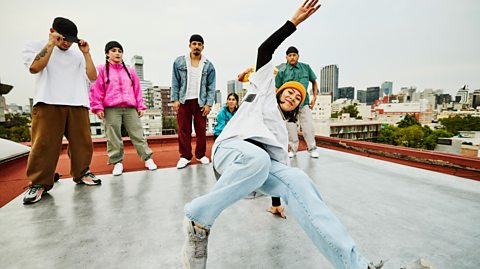
Read the article about reggaetón, a popular type of music in Spanish and Latin America, and complete the activity below.
El reggaetón es una expresión musical reciente de las comunidades latinas. Se puede decir que es la versión latina del hip-hop.
Tuvo su origen en Panamá en los años ochenta y la palabra 'reggaetón' se inventó en Puerto Rico en los años noventa cuando se estableció como un sonido diferente al reggae en español.
Las canciones incluyen *rimas tradicionales pero la letra suele utilizar lenguaje gráfico.
*rimas - rhymes
Choose the three correct statements from the article.
| A | Reggaetón is the Latin equivalent of hip-hop |
| B | The music was invented in Puerto Rico in the '80s |
| C | The word reggaetón was invented in Puerto Rico |
| D | The songs use traditional lyrics |
| E | The lyrics often use bad language |
The correct statements are A, C and E.
A is correct because the text says es la versión latina del hip-hop (it's the Latin version of hip-hop).
C is correct because the text tells us la palabra 'reggaetón' se inventó en Puerto Rico (the word reggaetón was invented in Puerto Rico).
E is correct because the text says la letra suele utilizar lenguaje gráfico (the lyrics usually use graphic language).
B is incorrect because the music originated from Panama in the '80s. The text says tiene su origen en Panamá en los años ochenta (it originates from Panama in the eighties).
D is incorrect because the music uses traditional rhythms, not lyrics. The text says las canciones incluyen rimas tradicionales (the songs include traditional rhythms).
Click or tap on Show more to read a translation.
Reggaetón is a recent musical expression in Latin American communities. It could be said that it is the Latin version of hip-hop.
It had its origins in Panama in the 1980s and the word 'reggaetón' was invented in Puerto Rico in the 1990s when it established itself as a different sound to Spanish reggae.
Songs include traditional rhymes but the lyrics often include graphic words.
Vocabulary – Giving opinions
Useful adjectives to use when giving your opinion include:
| Spanish | English | Spanish | English |
|---|---|---|---|
| aburrido/a | boring | entretenido/a | entertaining |
| cómico/a | funny | estúpido/a | stupid |
| divertido/a | fun | fascinante | fascinating |
| educativo/a | educational | informativo/a | informative |
| emocionante | emotional/exciting | repetitivo/a | repetitive |

Useful verbs
The following verbs can be followed by the Form of the verb that has not been conjugated. Usually translated with 'to' in English, eg to play. of a verb or a noun.
| Spanish | English | Spanish | English |
|---|---|---|---|
| Me gusta(n) | I like | Me gustan las comedias. | I like comedies. |
| Odio | I hate | Odio las películas de terror. | I hate horror films. |
| Me encanta(n) | I love | Me encanta ver programas de deporte. | I love watching sports programmes. |
| Prefiero | I prefer | Prefiero escuchar la música de los años ochenta. | I prefer listening to music from the 80s. |
| Me interesa(n) | …interest(s) me | Los programas sobre los animales me interesan. | Programmes about animals interest me. |
| Me parece | seems to me | Me parece que los dibujos animados son graciosos. | It seems to me that cartoons are funny. |
| Soñar | to dream | Sueño con estar en un programa de telerrealidad. | I dream of being on a reality TV programme. |
All Foundation Tier vocabulary listed in this guide can be found on the vocabulary sheet below.
Grammar - How to form negative sentences in Spanish
To make a sentence negative in Spanish, put no in front of the Word used to describe an action, state of being or an occurrence..
For example:
No me gustan las telenovelas - I don't like soap operas.
Other useful negative words include:
| Spanish | English |
|---|---|
| nada | nothing |
| nadie | nobody/no one |
| nunca | never |
| tampoco | neither/not either |
| ni…ni | neither … nor |
| ninguno/a/os/as | no/not any |

For example:
No hay nada interesante en este programa. - There is nothing interesting in this programme.
En mi casa nadie ve la televisión juntos. - Nobody watches television together in my house.
Nunca he visto una telenovela. – I’ve never watched a soap opera.
A mí tampoco me gusta esta canción. - I don't like this song either.
No he escuchado ni descargado esta canción. - I haven't heard or downloaded this song.
Ninguno
Note that ninguno changes to agree with the noun it is describing.
For example:
No me gusta ninguna de sus canciones. – I don’t like any of his songs.
The form ningún is used in front of a masculine singular noun.
For example:
No he visto ningún vídeo. - I haven’t seen a single video.
Ningún reverts to ninguno when it is used on its own to refer to a masculine singular noun.
For example:
No he oído ninguno. - I haven’t heard anything.
Ningún also reverts to ninguno when it is used before the verb.
For example:
Ninguno de mis actores favoritos está en la película. - None of my favourite actors are in the film.
Negatives - Mini quiz
Complete the following sentences in Spanish.
_____ he visto ese programa.
I have never seen that programme.
Nunca he visto ese programa.
Nunca, meaning 'never', needs to go at the start of the sentence.
A _____ le gusta esa canción.
Nobody likes that song.
A nadie le gusta esa canción (Nobody likes that song.)
Nadie means nobody and needs to go after ‘a’ in this sentence.
No me gustan ____ las películas románticas ___ las películas de terror.
I like neither romantic films nor horror films.
No me gustan ni las películas románticas ni las películas de terror.
Ni … ni means 'neither … nor'.
No he escuchado _______ canción.
I haven’t listened to a single song.
No he escuchado ninguna canción.
The negative word in this sentence, ninguno, must agree with the feminine noun, canción, and becomes ninguna.
Find out more about using negative forms in the Negative forms in Spanish guide.
Listening practice
Listen to Amina talk about watching TV and films and answer the questions in English.
- What two things do Amina's parents like watching?
News and documentaries.
- What does her sister like watching?
Reality programmes.
- Why doesn't Amina watch TV?
She prefers watching films on her computer.
Click or tap on Show more to read the transcript and a translation.
Transcript
A mis padres siempre les gusta ver las noticias y los documentales, pero mi hermana prefiere los programas de realidad porque piensa que son divertidos. Yo nunca veo la tele porque prefiero ver las películas en mi ordenador. Me gustan las películas de terror porque me dan miedo.
Translation
My parents always like watching the news and documentaries, but my sister prefers reality TV programmes because she thinks they are fun. I never watch TV because I prefer watching films on my computer. I like horror films because they scare me.
Now listen to Joel and answer the questions in English.
- What does Joel say about cartoons?
He used to watch/love them when he was younger.
- What does he like watching now? Why?
He likes watching soaps because they are entertaining.
- Does he like detective series? Why? Why not?
No, because they are long and repetitive.
Click or tap on Show more to read the transcript and a translation.
Transcript
Cuando era más joven, me encantaban los dibujos animados, pero ahora las telenovelas son los programas que más me gustan porque son entretenidas. Las series policíacas no me interesan nada porque son largas y repetitivas. Tampoco me gustan las películas de acción.
Translation
When I was younger, I used to love cartoons. But now soaps are the programmes that I like the most because the stories are entertaining. Detective series don't interest me at all because they are long and repetitive. I don't like action films either.
Vocabulary sheet
Click or tap on the image below for a list of useful Foundation Tier vocabulary to use when talking about music, TV and film.

Higher Tier - Vocabulary
| Spanish | English |
|---|---|
| Check your connection, refresh the page and try again. | documentary |
| Check your connection, refresh the page and try again. | discount |
| Check your connection, refresh the page and try again. | screen, monitor |
| Check your connection, refresh the page and try again. | sound |
| Spanish | English | Spanish | English |
|---|---|---|---|
| Temer | to fear | Temo la violencia en las películas de terror. | I fear the violence in horror films. |
All Higher Tier vocabulary listed in this guide can be found on the vocabulary sheet below.
Higher Tier - Vocabulary sheet
Click or tap on the image below for a list of useful Higher Tier vocabulary to use when talking about music, TV and film.
Now you have revised the important vocabulary and key grammar points for talking about music, TV and film, why not have a look at the Describing family celebrations in Spanish guide?
Careers advice and tips from BBC Bitesize
Future careers, further studies and the world of work - we're here to help with advice from experts and from young people who've found their path.

More on Free time activities
Find out more by working through a topic
- count3 of 5

- count4 of 5

- count5 of 5

- count1 of 5