Welcome to The Regenerators.
A classroom activity for 11-14s studying English
Green Scenes is an activity for the classroom which lets you express your feelings and opinions about climate change and the environment.
Use the videos for inspiration and work in groups to give a performance on this theme. It could be a rap, an improvised story or an adaptation of a text such as Shakespeare’s The Tempest.
The student and teacher worksheets provide ideas on how to create sustainable performances using recycled objects as props.
Green Scenes - inspiration videos
These fun videos feature an improv troupe putting on different types of performance with a green theme and using upcycled objects.
Use the videos to inspire your own performances.
How to rhyme and rap with a green theme
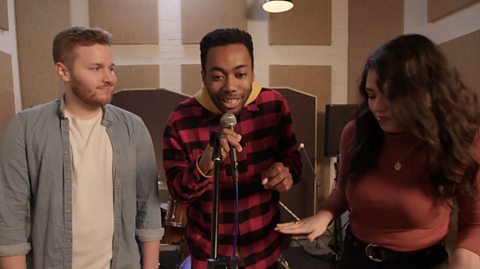
Tai: Today we're gonna do a rap about climate change. That's right. We're going to use the green theme. Rapping is when you recite or rhyme words to a beat. So let's warm up. We're going to try and rhyme using the term 'I like' and then go from there.
Let's see how we do.
(WARM UP CAPTION)
Charlotte: Okay.
Tai: Yeah.
Tai: We got it.
Kelsey: I like trees that are tall and thin.
Charlotte: I like trees that you can sit in.
Tai: I like trees that give my head a spin.
Kelsey: I like trees that don't scratch my skin.
Charlotte: I like trees where the birds are sat.
Tai: I like trees that are nice for my cat.
Kelsey: I like trees that are full of bats.
Joshua: Oh, whoa, whoa. Whoa, whoa, whoa, whoa, whoa.
Kelsey: What?
Joshua: Bats?
Kelsey: What? They're cute.
Joshua: Bats? No no no, cute?! Beady little eyes and fangs. And there's the whole vampire thing.
Kelsey: No, they're actually really really important. They pollinate plants and stuff so that people and animals can eat them. Flowers.
Joshua: So you're telling me those scary things are an essential part of our ecosystem?
Kelsey: Yes! They're like bees of the night.
Joshua: Don't be scared. Don't have a fright. They are just the-
All: Bees of the night!
Tai: I like these things. They're so tight. Bats are like bees of the night.
Charlotte: And bats are good for you and me because they're really important in biodiversity. Whoo!
Kelsey: I cannot top that…
Charlotte: That was a big word to get into a rap guys.
Joshua: That's like… Bi-o-di-ver-si-ty. Woo!
Tai: Let's start our main challenge. We're going to write a rap about a climate change theme of our choosing. It could be anything from fossil fuels to rising sea levels. If you're struggling to find a structure, you can take your favourite song or rap and change the lyrics for your own.
So what do people care about?
Kelsey: Uh …Solar panels!
Charlotte: Ooh. Yeah…
Tai: I love it.
Charlotte: That's good.
Tai: I love it.
Joshua: Could be a little tough to get solar panels into the rap bars.
Tai: True.
Charlotte: Yeah, it's difficult to rhyme.
Tai: True.
Charlotte: Let's go broader. Let's do, like, renewable energy. And so maybe we could have, like, a bit of a chant in the middle that's like um, sun, wind, tidal waves…
Joshua: Switch to green in lots of ways.
Charlotte: Okay, that's really cool. Yeah.
Joshua: In between the verses could be different types of green energy.
Kelsey: Yeah, yeah, yeah. And we'll repeat the chorus and-
Charlotte: Yeah.
Kelsey: Yeah and go like that. Yeah.
Charlotte: Okay, awesome.
Kelsey: Ready to give it a go.
Joshua: I'm really excited.
Charlotte: One, two, three, four.
All: Sun, wind, tidal waves. Switch to green in lots of ways. Sun, wind, tidal waves. Switch to green in lots of ways.
Joshua: The sun is hot and full of power. So use that heat to heat your shower.
All: Sun, wind, tidal waves. Switch to green in lots of ways.
Tai: The wind, it blows all day and night. Those turning turbines. They keep on those lights.
All: Sun, wind, tidal waves. Switch to green in lots of ways.
Kelsey: The moon pulls the sea to and fro. So use its power to light your home.
All: Sun, wind, tidal waves. Switch to green in lots of ways. Woo!
(CONCLUSION CAPTION)
Tai: Rhyme is a great tool to remember information and share it with others. Just think about all the song lyrics you know, without even trying. You can do it too, decide on a topic and your key word.
Then see what words you can rhyme it with. And share your green message with the world.
How to create a new sustainable story
Joshua: Hey, this challenge is about how stories are created and how they can be used to explore the natural world. Let's start by getting these rusty brains of ours warmed up. I'm going to say the first word I think of when I think of the environment.
Then we're going to go around as a group and say a word that links the last word we heard.
(WARM UP CAPTION)
Joshua: So when I think about the environment, I think about trees.
Charlotte: Green.
Kelsey: Leaves.
Tai: Wind.
Joshua: Echo.
Charlotte: Caves.
Kelsey: Mountain.
Charlotte: Volcanoes.
Joshua: Erupt.
Kelsey: Fire.
Tai: Hot.
Charlotte: Lava.
Joshua: Melting.
Kelsey: Ice.
Tai: Cream.
Joshua: Great guys, that was great. Great. What were some of the fun words that we remember from that?
Kelsey: Uh, I guess I like green.
Joshua: Is that because it's the only one you can remember?
Kelsey: No!
(ALL LAUGH)
Joshua: It's time for our main challenge. We are now going to connect our words about the environment to our imaginations, Using props made from everyday items, we're going to act out a scene.
Think about how you can use your body to make different shapes and convey different emotions and atmospheres. This piece of paper and this pencil remind me of saving a tree from being cut down. Let's give that a go.
Charlotte: Lots of good stuff here.
Tai: Uh huh.
(UPCYCLED PROPS CAPTION)
Kelsey: I found some pen caps, and I really liked the word melting, so I think I'm going to use these to do that.
Joshua: I've got your normal, run of the mill plastic bag.
Charlotte: I scrunched up some Post-it notes, and we will see where that goes.
Tai: I got these super cool bits of green card, that I will use to turn into…something.
(PERFORMANCE CAPTION)
Kelsey: Drip.
Tai: I am so hot.
Kelsey: Drip.
Joshua: Oh. Pretty cool well we've got here huh?
Charlotte: Are you talking about me?
Joshua: (GASP) Was that the well?
Tai: Are you stuck down there?
Charlotte: No, I am the well. You are hearing the voice of the well.
Joshua: Dude, we just found a magic well.
Tai: What do we do?
Charlotte: You may ask me, the magic well, one question.
Tai: What kind of question?
Charlotte: That counts as a question, but, believe it or not, I've been stuck with this before. So I will allow you one further question. But do be careful.
Joshua: We want to know why it's so hot and why this giant glacier is melting at such an alarmingly fast rate.
**Charlotte:**A very good question indeed. You've noticed it's hot. The glaciers are dripping. I imagine your brow is dripping.
Joshua: Yes.
Charlotte: And that's because our planet is warming up at an alarming rate because of all the things you humans have been doing up there.
Tai: I would like one more question. I promise I won't mess this one up.
Charlotte: Okay, well I shouldn't really be doing this, but I'll allow you one extra question as I haven't had many visitors and I've been a bit lonely.
Tai: What can we do to help?
Charlotte: Well, that is the question. What do you think you could do to help?
Tai: I guess I could recycle.
Charlotte: Very good. Recycling, reusing. Amazing.
Joshua: I guess we could take shorter showers.
Charlotte: Great idea. Shorter, quicker showers instead of bath - saving water.
Tai: My family and I can all ride bikes instead of using the car.
Charlotte: Yes, exactly.
Joshua: It's all doing something to the mountain. She's become glorious again.
Charlotte: And scene!
Joshua: And scene. Nice work guys.
(CONCLUSION CAPTION)
Joshua: Storytelling is a great way to communicate your thoughts and feelings. If you've got a story to tell, don't be afraid to use your imagination. You can start with the simplest ideas and build on them with the help of the objects around you.
What stories about the environment do you want to share? It could be about plastic, pollution, food waste, or even green tech.
How to use a text like Shakespeare's The Tempest for inspiration
Charlotte: Good morrow to thee fellow bards. We're going to explore climate change through the theme of The Tempest by Shakespeare. First, let's get ourselves warmed up with a bit of word association.
(WARM UP CAPTION)
Kelsey: I'm going to point at something and you're going to say what that thing could represent. So just any ideas of in your imagination what we might be able to use our object for or what it could represent.
Charlotte: Got it.
Tai: Sounds good.
Kelsey: Ready?
Charlotte: Yep.
Kelsey: Okay.
Group (one at a time): Giant raindrops. Tortoises. Flotation devices. The wind. A river. Clouds. Bricks. Big boulders falling down a hill. Knowledge. Nice.
Kelsey: Great.
Charlotte: We've got our brains thinking creatively. This is perfect for our next task, which uses part of Caliban's speech from The Tempest. Caliban is a native to the island where The Tempest is set. Here he is talking to his master, Prospero, a magician and ruler of the island.
(MONOLOGUE CAPTION)
Kelsey as Caliban: This island's mine, by Sycorax my mother, which thou takest from me. When thou camest first, Thou strokedst me and madest much of me, Thou wouldst give Water and berries in't, and teach me how, To name the bigger light, and how the less, That burn by day and night: and then I loved thee.
And show'd thee all the qualities o' the isle, The fresh springs, brine-pits, barren place and fertile: Cursed be that I did so! All the charms Of Sycorax, toads, beetles, bats, light on you!
For I am all the subjects that you have, Which first was mine own king: and here you sty me In this hard rock, whiles you do keep me from The rest o' the island.
Charlotte: Using this extract as inspiration, we're going to create a scene about climate change.
Kelsey: So what were some themes?
Joshua: I really liked the way Caliban talks about nature in those and the wildness of nature and how that really inspires him to talk so beautifully about it.
Charlotte: Yeah, I really like that as well. And the idea of like letting nature be. So like, allowing things to grow in the way that they want to. I think it's really awesome that we could definitely use that.
Kelsey: Sounds great. Shall we try a scene?
Charlotte: Yeah, let's try a scene.
Kelsey: Okay.
Charlotte: Okay.
(PERFORMANCE CAPTION)
Charlotte: We're just so pleased that you are our first visitor and, well, we thought we'd show you the best bit first. Right?
Joshua: You're the first person we've shown this to. OK?
Tai: Umm. All I see is an overgrown garden, is it hidden?
Charlotte: This is it! Overgrown, wild.
Joshua: Overgrown is what it's meant to be.
Charlotte: Yeah. We took all the gardening books and all that stuff, we threw it out the window, and we just let nature take over.
Tai: Umm, why?
Joshua: Why don't you have a look and tell me why?
Kelsey: The golden sun glints lovingly off of the pond filled with bright, yellow, luscious algae.
Charlotte: I mean, some people get rid of the algae in their pond, but look at this. It's beautiful. It makes shapes. It's patterns. It does smell a bit but we love that, don't we honey?
Tai: Can I touch it?
Joshua: Yeah, yeah go ahead. Touch the algae.
Charlotte: Yeah.
Joshua: Can you see the little fish underneath it feeding off the algae, too?
Tai: Yeah. It's so gooey.
Joshua: It's gooey and beautiful.
Charlotte: It's gooey!
Joshua: You can't pay for that goo.
Charlotte: Okay, be really still.
Joshua: Okay.
Charlotte: This is like, you only get this in, like, rewilded gardens.
Joshua: I can't believe we're getting this.
Charlotte: I can't believe it. It's like. It's like a documentary.
Tai: What is it?
Joshua: Well, this is a…
Charlotte: It's a…
**TOGETHER:**three…armed…Huluuu. A three armed Huluuu.
Charlotte: And you wouldn't get that in another garden, if it had, you know, paving stones and a swing.
Tai: So what would you even call this… place?
Charlotte: Well, it's our…
Joshua: We call it home, but others call it rewilding.
Kelsey: And scene.
Charlotte: Yay! Great use of props there. So good. All those different animals that you were. So we were giving you lots of things to be and you were amazing. That was great.
Kelsey: Beautiful world we've created here.
(CONCLUSION CAPTION)
Charlotte: You can see that even in Shakespeare's time, people were concerned about natural resources and who the Earth belongs to. By making the performance fresh and interesting, that message still comes through.
Try putting your own twist on an older play like The Tempest. You can set it in the present day or even tell the story from the perspective of the island.
Tips for improvising
Charlotte: So here are our top tips for great improv.
Tai: Improv is 90% listening.
Kelsey: Agree with what your partner has given you and add something on.
Joshua: Always be present. Be in the moment. You can't plan ahead.
Charlotte: And finally, always work together with your team. Because working together, you come up with the best stories, the best worlds and the best characters.
Student worksheets
Use these worksheets alongside the videos to create a performance of your choice on the theme of climate change, the environment or being more sustainable. They include tips and inspiration, plus a self-assessment checklist and reflection task.
Download or view the worksheets online.
Green Scenes - student worksheet. document
THE REGENERATORS
The worksheets are designed to be used electronically but if printing is needed this greyscale version will use less ink.
Teacher notes
A set of teacher notes are available. They include English curricula links and suggestions on how to run the activity in the classroom, with ways to stimulate creativity around climate themes.
Download or view the briefing notes online.
Green Scenes - teacher notes. document
THE REGENERATORS

The teacher notes are designed to be used electronically but if printing is needed this greyscale version will use less ink.
Related study guides
A collection of study guides from BBC Bitesize that can help to craft performances.

How to use rhyme effectively
ENGLISH
Audience, purpose and form
ENGLISH
There's more to learn
More from The Regenerators
BBC BITESIZE