Five fun facts about television
Television is coming up to its hundredth birthday, so we've put together this article to celebrate!
From grainy black-and-white to crystal clear 4K, TV has been on quite the journey over the last century, but how did it all come about? Here at BBC Bitesize, we've collected some of the most common questions floating around the web, to give you the lowdown on all things TV!
Who invented television?
The invention of TV was a complicated affair, with a number of people from across the globe laying claim to the imaging invention.
In America, received wisdom would crown Philo Farnsworth as the father of the television, while German researcher Paul Nipkow could lay a very fair claim, with Scotsman John Logie Baird serving as the UK's chosen champion.
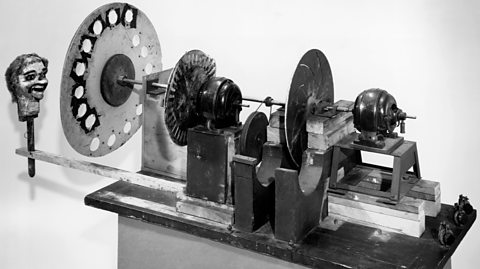
In 1884, Nipkow came up with a system for sending images along wires using a spinning disk, which became known as a 'Nipkow disk'. While he referred to his invention as an electric telescope, it was - in function - an early variation of mechanical television.
Nipkow never built a working mechanical set, however, with this honour going to Scottish inventor John Logie Baird.
Logie Baird built on Nipkow's work, as well as research done by fellow Scotsman Alan Archibald Campbell-Swinton, to produce the first demonstration of the transmission of a moving image.
Farnsworth's claim to the throne lies in the fact that Logie Baird's invention was mechanical, while the TV we know and love today is electronic - an innovation first pioneered by Farnsworth in the late 1920s.
When was television invented?
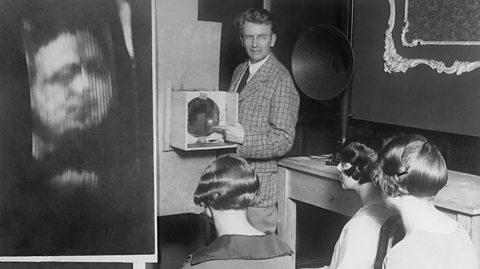
John Logie Baird gave the first demonstration of a moving image transmitted by television in Soho, London on 26 January 1926.
Having successfully completed a trial run on 2 October 1925, Baird took his invention public, exhibiting the first television images to around 40 members of The Royal Institution. The invention, then known as the 'televisor', first transmitted an image of a ventriloquist dummy, before moving onto an image of a human face.
The dummy in question was called Stooky Bill, who cemented his place in the legacy of British TV, as the source of untold terror in Doctor Who anniversary special 'The Giggle'.
What was the first ever TV broadcast?
The first images to be transmitted by television were of a dark-haired ventriloquist's dummy known as Stooky Bill, who made his debut on 2 October 1925.
The world's first ever regular television service was launched by the BBC, on 2 November 1936. Only initially available to those in the London area, those early transmissions reached around 100 people on first broadcast.
What is the most viewed television programme of all time?
In the UK, the most viewed television broadcast is England's victory over Germany in the 1966 Men's World Cup final, which brought in a whopping 32.3 million viewers.
Princess Diana's funeral comes in as the runner up, with 32.1 million viewers, while a Royals documentary, the Apollo 13 splashdown and the Euro 2020 final round out the top five.
In terms of more traditional programming, the 1986 EastEnders Christmas special takes the cake, with over 30 million people tuning in to watch Dirty Den serve Angie Watts with divorce papers on 25 December 1986.
The most viewed programme of 2024 was the Gavin and Stacey Christmas special, pulling in over 19 million viewers on BBC One and iPlayer, marking the second time the sitcom has reigned supreme as the country's most watched TV treat.
How has television changed over the years?
Television has come a long way since the days of spinning disks and Stooky Bill, but what are some of the biggest advances?
Well, the most obvious advancement in TV technology would be the advent of colour TV. And once again, who's at the scene of the crime? That Scottish savant, John Logie Baird. Logie Baird first demonstrated colour TV in 1928, with his system going on to inspire the techniques used by NASA to broadcast images live from the moon!
BBC Two became the first regular colour TV channel in Europe, kicking off in 1967 with the Wimbledon Tennis championships.
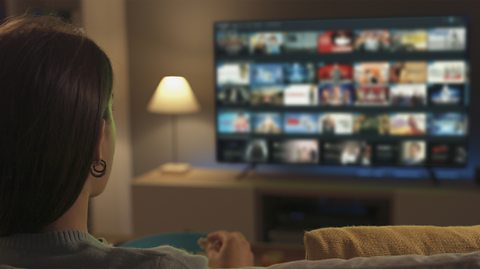
More recently, it'd be hard to argue against the advent of streaming as the most important innovation in modern television. Streaming TV first originated in 2003, but the boom really began in 2007, when Netflix shifted from a DVD-rental service to an online streaming empire.
2007 also saw the official launch of BBC iPlayer, which allowed users to catch up on shows for up to seven days after they first aired.