Famous saints and the UK patrons
Religious and spiritual figures known throughout history, saints have been recognised and honoured for their faith, work and teachings. Often designated as a patron on a particular cause, group of people or profession, there are saints associated with so many different things - from athletes to bookkeepers, guards, midwives, postal workers and more.
Many have their own named day in which they are still celebrated today. But traditionally, people see them and what they represented as symbols of how to live a better life.
But what is a saint and how do you become one? Here, BBC Bitesize takes a closer look what it means to be a saint and who the patrons saints of the UK are.
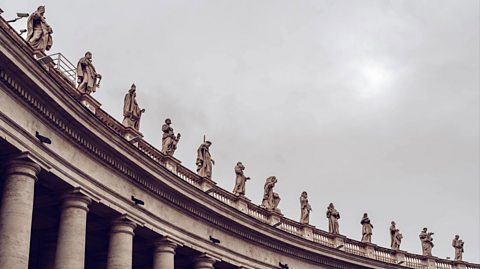
What is a saint?
Saints are people who led holy lives or are believed to be especially close to God, being declared a saint after death is seen as a religious honour. In some religions, this is an official status, while others simply honour saints, whether in life they were for example messengers of God, prophets, doers of good deeds and more.
Some are more well-known than others, with a number having their own special, dedicated day in which they are celebrated. So many continue to play an important role in people’s day to day lives, but you may also celebrate them without realising.
For example, 14 February every year marks Valentine’s Day. A day to celebrate with the one you love; St. Valentine is most famously known as the patron saint of love.
How do you become a saint?
Different religions honour or recognise saints and in that can have different formal or informal processes to lead to figures being officially recognised as saints. For example, in the Roman Catholic Church, the process cannot begin until at least five years after their death – however, the waiting period can be waived by the Pope.
Taking a closer look at evidence of the candidate’s holiness and work, the individual is declared a ‘servant of God’ and if the Pope decides that the person lived a life of "heroic virtue", they can then be called "venerable." To reach the next stage, which is called beatification, a miracle needs to be attributed to prayers made to the individual after their death.
Canonisation is the final step and to reach this, a second miracle normally needs to be attributed to prayers made to the candidate after they have been beatified. Many saints are very historic figures who died centuries ago; however, people can still be made saints today.
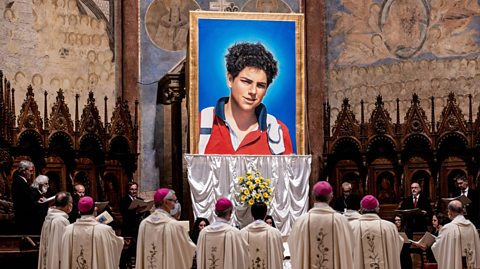
For example, in 2025, London-born Carlo Acutis became the first millennial saint. Carlo died at the age of 15 of leukaemia in 2006, but in his life created websites documenting "miracles" as a means of spreading Catholic teaching, leading some to nickname him God's influencer.
In September 2025, Pope Leo XIV presided over the canonisation of Carlo Acutis, who became the first millennial saint.
Who are the four patron saints in the UK?
Patron saints are chosen as special protectors or guardians over all areas of life. There are thousands recognised across the globe that represent all kinds of things, from jobs to animals and more.
But many nations also have patron saints too. In the UK, there are four patron saints that represent each of the nations.
These are St David in Wales, St Patrick in Northern Ireland, St George in England and St Andrew in Scotland. They all have annual days dedicated to them, celebrated across the UK and beyond.
Who is St David?
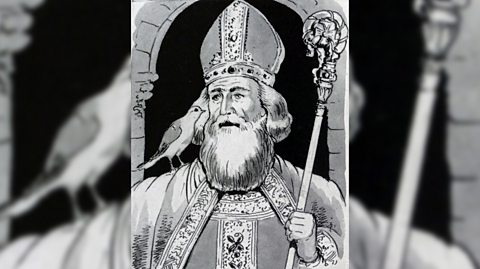
Saint David - or Dewi Sant in Welsh – is the patron saint of Wales. According to legend, he was born on a cliff-top in Pembrokeshire during a fierce storm and he is the only native-born patron saint of Britain and Ireland.
The date of his birth isn't certain, but it is generally accepted that he died on the 1 March c. 589 and some claim he lived to be more than 100-years-old. A devout monk, David and his brothers led a very simple life, living off the likes of bread, vegetables, herbs and only drinking water.
There are many stories of the miracles of St David, from raising the ground under him to form a hill, so that all his congregation could see him to bringing a child back to life. Although one of the most famous stories is David restoring the sight of his teacher, Paulinus.
The leek, and later the daffodil, are both national symbols of Wales and are often worn on St David’s Day. Legend has it that St David suggested Welsh soldiers wear a leek on their helmets to distinguish them from the invading Saxon soldiers who wore similar uniforms - and the leek features in the uniforms of Welsh regiments to this day.
Who is St Patrick?
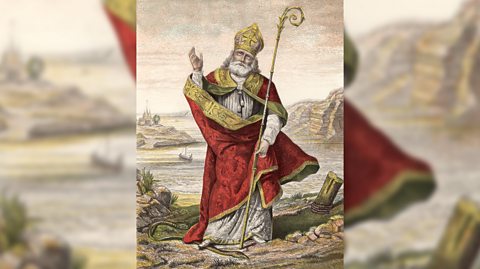
St Patrick is the patron saint of Ireland, and his named day is a national holiday in the Republic of Ireland and Northern Ireland. Credited with bringing Christianity to Ireland, it is believed Patrick was born around 373AD.
As a teenager, he was captured by Irish pirates, enslaved and taken to Ireland. Escaping after six years, he returned to Britain and became a priest but felt called in a dream to return to Ireland and preach the message of Christianity.
He did this and later was appointed as successor to St Palladius, the first bishop of Ireland. There are a number of legends associated with St Patrick, perhaps the most famous being that he drove the snakes from Ireland.
To explain the nature of the Trinity, St Patrick also famously used a shamrock leaf – which is one leaf with three parts – to represent the father, the son and the holy spirit. To this day, the shamrock is still a symbol synonymous with St Patrick.
Who is St George?
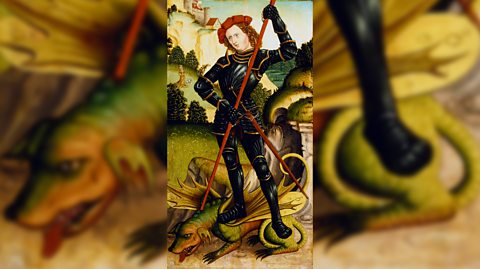
St George isn’t just the patron saint for England – he also holds the position around the globe in countries like Portugal, Germany, Greece and more. Believed to have lived in Cappadocia, a region of modern-day Turkey, there are many myths and legends surrounding St George.
Although he was a Roman soldier, George was also a Christian. He who spoke out against the persecution of Christians by the Emperor Diocletian, which led to his execution.
Through history, he has been the subject of many popular stories – the most famous perhaps being the tale of when he rescued a princess from a dragon. It was King Edward III of England who adopted St George as the patron saint of The Noble Order of the Garter in 1350.
As the patron of this Order, its badge depicts George slaying the dragon and this remains an important symbol of knighthood. England’s flag, which has a white background and a red cross, is also known as the Cross of St George
Who is St Andrew?
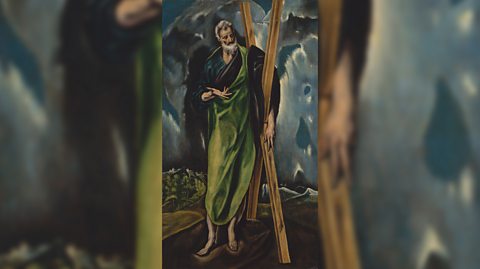
In the UK, we best know St Andrew as the patron saint of Scotland. Born between 5AD and 10AD, according to Christianity, he went on to become an Apostle of Jesus and is also recognised as the patron saint of fishermen, due to his profession.
One of the 12 disciples, St Andrew is said to have travelled to Greece to preach Christianity but was crucified at Patras on an X-shaped cross – which is represented on Scotland's flag, the saltire, also known as St Andrew’s Cross. However, there are different beliefs surrounding his connection to Scotland.
St Andrew never visited Scotland, but centuries after his death legends say that his bones were brought to Scotland to Kilrymont (later renamed St Andrews) in Fife. Another story is that in the in the 9th century, King Óengus II (Angus) was preparing for battle against the Saxons when, according to legend, St Andrew appeared to him in a dream.
The legend goes that St Andrew promised victory and on the day of battle, his symbol, an X, appeared in the sky. St Andrew was officially named the patron saint of Scotland in 1320, when Scotland’s independence was declared with the signing of The Declaration of Arbroath.
When are the patron saint days celebrated in the UK?

Annually in the UK, there are named days celebrating the four patron saints.
St David’s Day is on 1 March and is a day for celebrating Welsh heritage and culture, no matter where in the world you are. To mark the occasion, Welsh people traditionally wear one or both of Wales' national emblems - a daffodil and a leek.
St Patrick’s Day is on 17 March and has long been a hugely popular holiday celebrated around the globe. To celebrate, many cities, towns and villages turn into a sea of green, holding events and parties with traditional music, shamrock decorations and more.
St George's Day is celebrated throughout England, usually on 23 April. However, in 2025, the date was changed by the Church of England to 28 April, as no saint's day can take place in the week before or after Easter.
St Andrew's Day is on 30 November, and the day is marked with a celebration of Scottish culture, traditional food, music and more. But St Andrew isn't just the patron saint for Scotland and holds the position in several other countries too.
This article was written in November 2025
