Astronomy and astrology: what's the difference?
It shouldn’t be too surprising that astronomy and astrology are often confused, given how similar their names sound.
But they actually have vastly different meanings, so getting them mixed up could land you in quite the pickle. Here at BBC Bitesize, we've put together this handy guide to clear up some of the biggest questions:
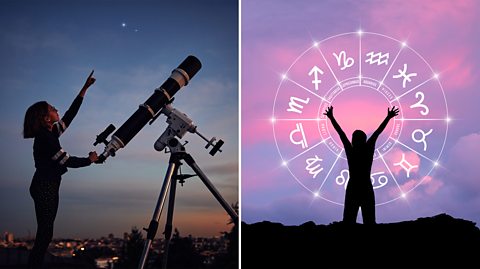
What is astronomy?
Astronomy is the scientific study of objects and phenomena that exist outside the Earth's atmosphere. This includes the Sun, the Moon, other planets and stars.
Astronomy is an almost boundless science, studying everything from what we can see with the naked eye, to objects visible only through telescopes and other instruments. Over the centuries, the scope of astronomy has expanded to encompass other scientific fields, such as astrophysics, within its cosmically broad horizons.
Famous astronomers and astrophysicists include Stephen Hawking, Carl Sagan, Jill Tarter and - perhaps surprisingly - Queen guitarist Brian May. You might have also heard of Professor Brian Cox, a physicist who has created a whole series of Space Science videos just for BBC Bitesize!
So, now we know what astronomy is, let's look at some of the coolest stuff that astronomers get to study…
How can I see an eclipse?
There are two main types of eclipse we see on Earth: a lunar eclipse and a solar eclipse.
A lunar eclipse occurs when the Earth passes in between the Sun and Moon, casting its shadow over the moon's surface, and giving it a deep red appearance.
Lunar eclipses can occur in total or partial form. A total lunar eclipse happens when the Moon, Sun and Earth are perfectly aligned, meaning the Moon is caught in the darkest part of the Earth's shadow. This darkest region is called the umbra, while the lighter outer region is called the penumbra. During a partial lunar eclipse, only part of the Moon passes through the umbra, while most of it remains in the penumbra.
The next lunar eclipse visible in the UK will be a partial lunar eclipse on 28 August 2026.
For more surprising facts about the Moon, check out this article.
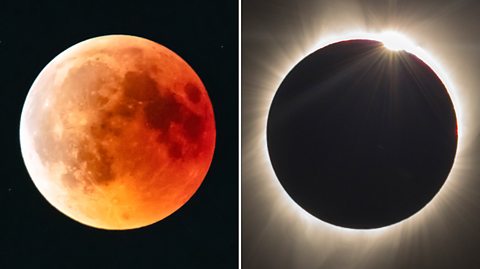
A solar eclipse, on the other hand, is when the Moon passes directly between the Earth and Sun.
There are several types of solar eclipses: total, partial, and annular. A total solar eclipse occurs when the Moon completely covers the Sun, plunging observers in the darkest part of the Moon’s shadow into near-darkness for a short time during the day.
A partial solar eclipse happens when the Moon and Sun aren't totally aligned, meaning the Moon only covers a small section of the Sun.
While an annular solar eclipse occurs when the Moon is not at its closest point to Earth, shrinking its visual appearance and leaving the outer ring of the Sun visible.
Total solar eclipses are very rare, with none expected to hit the UK until 2090! In the meantime, 12 August 2026 will bring the UK a partial solar eclipse, with another following in August 2027.
So, how can you watch an eclipse safely?
Well, it's pretty common knowledge that looking straight at the Sun is not good! The Royal Observatory recommends picking up a pair of eclipse glasses, making a pinhole projector, or checking for a local astronomical society event!
Note: When buying eclipse glasses, only go for the real deal - your retinas are worth far more than a naff knock-off!
What are constellations and how can I spot them?
Constellations are groups of stars that form a distinct pattern, such as an animal or other shape. Looking at the night sky, your eyes may have drifted to some of the more famous constellations, like Orion or the Plough.
There are 88 constellations in total, and while research suggests these patterns are largely incidental, they still serve as a useful shorthand for scientists when discussing the positions of stars.
What is astrology?
Astrology is the belief that the positions of stars and planets can affect the course of a person’s life.
While the practise of astrology is around 5000 years old, common magazine features like horoscopes have helped it maintain popularity over the years.
Let’s take a closer look at astrology, explore some of its core beliefs, and see how it differs from astronomy.
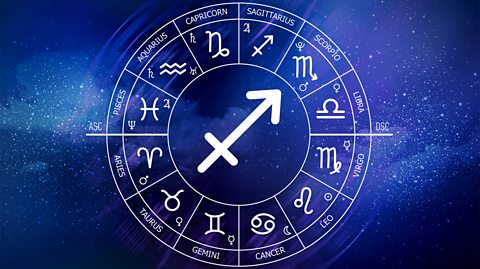
What are star signs and what star sign are you?
In Western society, when people mention their star sign, they are usually referring to the signs of the zodiac.
The zodiac is an imaginary belt in the sky that divides the Sun’s path into 12 sections, each associated with a corresponding constellation. Your star sign is determined by which section of the zodiac the Sun occupied on the day you were born.
In astrology, it's believed that your star sign can influence your personality, relationships and even your future career! Each sign corresponds to a range of dates, which can be found below:
- Aries - 21 March - 19 April
- Taurus - 20 April - 20 May
- Gemini - 21 May - 21 June
- Cancer - 22 June - 22 July
- Leo - 23 July - 22 August
- Virgo - 23 August - 22 September
- Libra - 23 September - 23 October
- Scorpio - 24 October - 21 November
- Sagittarius - 22 November - 21 December
- Capricorn - 22 December - 19 January
- Aquarius - 20 January - 18 February
- Pisces - 19 February - 20 March
Do star signs affect your personality?
To put it bluntly (typical Scorpio) - no!
Despite astrology’s widespread popularity, science has long dismissed its credibility, as star signs have no proven effect on personality or intelligence.
It can sometimes feel like your horoscope is accurate, but this is more likely a case of a self-fulfilling prophecy. If someone reads their horoscope in the morning and sees that they are supposed to be kind to others, any subsequent acts of kindness are more likely influenced by the horoscope writer than by the positions of the stars.
What is the difference between astronomy and astrology?
Despite their similar names and shared connection to stars and space, astronomy and astrology are very different fields.
Astronomy is a science whilst astrology is better described as a pseudoscience. Astronomy concerns itself with finding out about the objects that float out in space, and far less (read: not at all) with how those objects can impact our dating life.
Astrology is a system of belief, one that can't be verified by science or experimentation. Astronomy, on the other hand, uses scientific methods to learn more about the universe.
So, if you're after information about planets, stars, asteroids and comets then astronomy is the one for you!
