Key points about describing your local area

The verbs ser and estar both mean 'to be' and are used in different ways to talk about what is in the local area.
Use Used to communicate that something must be done without specifying who should do it, where there is no natural subject (I, you, he, etc.). to describe the local area and what you can do there.
Talk about the weather using impersonal verbs.
This guide contains a video as well as listening and reading practice.
Video - Describing the local area
Watch the video of Paula exploring her local area and talking to locals.
Paula describes her local area in Colombia using impersonal verbs
Hola, me llamo Paula y vivo en Honda, un pueblo en Colombia.
Es un clima tropical por lo que hace mucho calor.
Desde aquí en la plaza mayor podemos ver el parque, la iglesia y algunos restaurantes. Me encanta vivir en Honda por su historia y su cultura, y porque la gente es muy relajada.
Cuando hace mucho calor, me gusta venir al mercado a tomar un salpicón.
Hola, doña Irene, buenos días, ¿cómo está? Me gustaría tomar un salpicón, por favor.
Un salpicón está hecho de frutas y es muy refrescante.
Muchas gracias
Honda es un pueblo histórico con mucha arquitectura antigua.
Hola, buenos días, disculpa, ¿en dónde queda la calle de las Trampas?
Claro, mira. Subes por esta calle y luego giras a la izquierda.
Ok bueno. ¡Muchas gracias, adiós!
Por eso hay bastante turismo, tanto colombiano como del extranjero. Me gusta mucho venir al río Magdalena con mis amigos.
¡Hola! ¿Qué tal? ¿Vamos al río?
Sí, vale, vamos.
Nos gusta disfrutar de la naturaleza mientras hacemos pulseras juntos.
Aquí estamos en el puente Navarro, el primer puente de acero construido en América del sur. Vale mucho la pena venir a visitarlo porque puedes disfrutar de una hermosa vista, y sobre todo la puesta del sol, es espectacular.
¡Espero que un día puedas conocer Honda también!
Translation
Hello, my name is Paula. I live in Honda, a town in Colombia.
It's a tropical climate so it's very hot.
Here we are in the main square, and we can see the park, the church and some restaurants. I love living in Honda because of its history and culture, and because the people are friendly and relaxed.
When it gets really hot, I like to come to the market to eat "salpicón".
‘Hi Miss Irene, good morning, how are you? I’d like a salpicón, please.’
A salpicón is made of fruit, and it’s very refreshing.
Thanks so much.
Honda is a historic town with a lot of beautiful, old architecture.
Hi, good morning, excuse me. Which way is Calle de las Trampas?
Sure, look. You go up this street and then turn left.
Okay sure. Thanks a lot, bye!
That’s why there is a lot of tourism, both Colombians and foreigners.
I really like coming to the Magdalena river with my friends.
Hi! How are you? Shall we go to the river?
Yes sure, let’s go!
We like to enjoy nature, while making bracelets together.
Here we are at the Puente Navarro, the first iron bridge built in South America.
It’s really worth visiting because you can enjoy the beautiful view, especially at sunset, it’s spectacular.
I hope one day you can come to visit Honda too!
Vocabulary - Talking about the local area
Useful vocabulary for talking about where your city, town or village is located include:
| Spanish | English |
|---|---|
| está lejos/cerca de… | it's near to/far from… |
| está en el norte/el sur/el este/el oeste | it's in the north/south/east/west |
| está situada/se encuentra… | it's situated… |
| en el centro | in the centre |
| en el campo | in the countryside |
Useful adjectives to use when giving an opinion of where you live include:
| Spanish | English | Spanish | English |
|---|---|---|---|
| aburrido/a | boring | histórico/a | historic |
| agradable | pleasant | limpio/a | clean |
| antiguo/a | old | moderno/a | modern |
| bonito/a | pretty | pequeño/a | small |
| encantador/a | charming | ruidoso/a | noisy |
| feo/a | ugly | sucio/a | dirty |
| grande | big | tranquilo/a | quiet/peaceful |
| hermoso/a | beautiful |

Remember
Adjectives need to agree with the nouns they are describing. For example:
El pueblo es tranquilo. - The village is quiet.
La ciudad es tranquila. - The city is quiet.
Find out more about adjectival agreements in the Adjectives in Spanish guide.
Grammar - How to use the verbs 'ser' and 'estar' in Spanish
There are two Word used to describe an action, state of being or an occurrence. for 'to be' in Spanish, ser and estar, and they are used in different ways.
The two verbs are A verb that is not in the infinitive form but has been changed to match the subject of the verb, for example I go, he goes. like this:
| Check your connection, refresh the page and try again. - to be | Check your connection, refresh the page and try again. - to be |
|---|---|
| Check your connection, refresh the page and try again. - I am | Check your connection, refresh the page and try again. - I am |
| Check your connection, refresh the page and try again. - you are | Check your connection, refresh the page and try again. - you are |
| Check your connection, refresh the page and try again. - he/she is | Check your connection, refresh the page and try again. - he/she is |
| Check your connection, refresh the page and try again. - we are | Check your connection, refresh the page and try again. - we are |
| Check your connection, refresh the page and try again. - you (plural) are | Check your connection, refresh the page and try again. - you (plural) are) |
| Check your connection, refresh the page and try again. - they are | Check your connection, refresh the page and try again. - they are |
When to use 'ser' - to be

The verb ser (to be) should be used for permanent things.
- Talking about nationalities. For example:
Somos galeses. - We are Welsh.
- Saying someone’s name or who someone is in relation to you. For example:
Julia es mi hermana. - Julia is my sister.
- Talking about someone’s job. For example:
Mi madre es enfermera. - My mum is a nurse.
- Describing the physical characteristics of a person or thing. For example:
La ciudad es ruidosa. – The town is noisy.
- Describing someone’s personality. For example:
Eres muy amable. - You’re very kind.
When to use 'estar' - to be

Estar also means ‘to be’. Use it for temporary things and locations.
- Talking about things that might change in the future. For example:
Estoy enferma. - I’m ill.
Está triste hoy. - He’s sad today .
- Talking about where someone or something is. For example:
Mi casa está enfrente del cine. - My house is opposite the cinema.
Estamos en casa. - We’re at home.
Using 'ser' and 'estar' - Mini quiz
Which verb should you use to complete the following sentences:
______ en el campo.
We are in the countryside.
Estamos en el campo
We are in the countryside.
Use estar as it describes location.
Mi ciudad ____ sucia.
My town is dirty.
Mi ciudad es sucia.
Use ser as 'dirty' describes the town’s physical characteristics.
Find out more about using ser and estar in the Verb 'to be' in Spanish guide.
Listening practice
You are listening to two Spanish students, Santi and Nieves talking about where they live. Listen to each speaker and answer the questions.
Click or tap on Start when you are ready to start the activity.
Vocabulary - Describing what is in the local area
Useful nouns to talk about your area and what there is there include:
| Spanish | English | Spanish | English |
|---|---|---|---|
| Check your connection, refresh the page and try again. | neighbourhood, district | Check your connection, refresh the page and try again. | stadium |
| Check your connection, refresh the page and try again. | countryside, field, pitch | Check your connection, refresh the page and try again. | factory |
| Check your connection, refresh the page and try again. | castle | Check your connection, refresh the page and try again. | market |
| Check your connection, refresh the page and try again. | cinema | Check your connection, refresh the page and try again. | park |
| Check your connection, refresh the page and try again. | large town, city | Check your connection, refresh the page and try again. | sports centre |
| Check your connection, refresh the page and try again. | building | Check your connection, refresh the page and try again. | village, small town |
| Check your connection, refresh the page and try again. | space |
Other useful vocabulary includes:
| Spanish | English |
|---|---|
| Check your connection, refresh the page and try again. | nature |
| Check your connection, refresh the page and try again. | pollution |
| Check your connection, refresh the page and try again. | noise |
| Check your connection, refresh the page and try again. | environment |
All vocabulary listed in this guide can be found on the vocabulary sheet below.
Grammar - How to use impersonal verbs

Impersonal verbs in English include verbs such as ‘one does’ or ‘one goes’.
To turn any Spanish verb into an impersonal verb, use the Words that replace nouns such as he, she, it, they. se and the he/she form of the verb. For example:
Se puede ir al cine. - One can go to the cinema.
Las puertas se abren a las siete. - The doors open at seven.
Se necesita un polideportivo en la ciudad. - One needs a sports centre in the town.
Talking about the weather

Weather verbs are always impersonal and they are written in the he/she form of the verb. For example:
Hace buen tiempo. – It’s good weather.
Hace mal tiempo. – It’s bad weather.
The illustration shows how impersonal verbs are used to describe the weather.
Click on Show more to see a list of phrases for describing the weather in Spanish.
Hace frío. - It’s cold.
Hace calor. – It’s hot.
Hace sol. – It’s sunny.
Hace viento. – It’s windy.
Hace buen tiempo. – It’s good weather.
Hace mal tiempo. – It’s bad weather.
Llueve. - It’s raining.
Nieva. – It’s snowing.
How to use 'hay' to say 'there is' or 'there are' in Spanish
Hay is a very common word in Spanish and means 'there is' or 'there are'.
Use no hay to say 'there is not' or 'there are not'.
Hay is used for both singular and plural sentences.
For example:
Hay un restaurante nuevo. - There is a new restaurant.
Hay dos piscinas en mi ciudad. – There are two pools in my town.
Mini quiz
Complete the following sentences:
____________ a la bolera.
You (one) can go to the bowling alley.
Infinitive = poder.
Se puede ir a la bolera.
Se puede means 'you can' or 'one can'.
It is an impersonal verb in the third person singular form. It is followed by an infinitive, in this ir, 'to go'…
____ muchos parques en mi ciudad.
There are lots of parks in my city.
Hay muchos parques en mi ciudad.
Use the impersonal verb hay, meaning ‘there is/are’.
It does not change according to whether the noun that follows it is singular or plural.
Find out more about using impersonal verbs in the Impersonal verbs in Spanish guide.
Reading practice
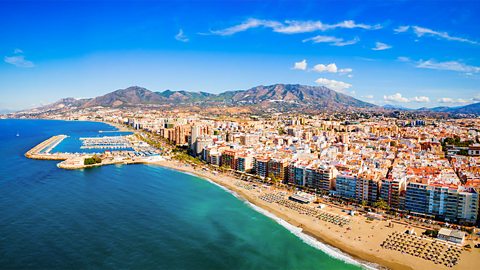
Read this information from a Spanish travel guide about Fuengirola and answer the questions that follow.
Fuengirola es famosa por sus playas grandes, su arquitectura árabe y es considerada un de los destinos más populares en toda España.
Situada en el sur de España, en la Costa de Sol en la región de Málaga, es una de las ciudades españolas con el mayor número de visitantes cada año.
No es una ciudad muy grande y se puede visitar la mayoría de la ciudad a pie en un día.
Además, vale la pena ir a los pueblos que están cerca, como Ronda o Mijas.
En el centro de la ciudad de Fuengirola hay una plaza hermosa con una iglesia bonita, el castillo Sohail, y un mercado animado donde se puede comprar recuerdos de tu visita.
Answer the questions in English.
- What is Fuengirola considered to be?
Fuengirola is considered to be one of the most popular tourist destinations in Spain.
The text says: …es considerada una de las destinaciones más populares en toda España. …considered to be one of the most popular destinations in all of Spain.
- How do we know that Fuengirola is popular with tourists?
Because it is one of the cities with the biggest number of visitors every year.
The text says: …es una de las ciudades españolas con el mayor número de visitantes cada año. - …it's one of the Spanish cities with the biggest number of visitors each year.
- What is the benefit of Fuengirola not being that big?
You can visit it on foot in one day.
The text says: …se puede visitar la mayoría de la ciudad a pie en un día. - …you can visit it on foot in one day.
- What can you do in the market?
Buy souvenirs.
The text says: …se puede comprar recuerdos de tu visita. - You can buy souvenirs of your visit.
Click or tap on Show more to read a translation of the text.
Fuengirola is famous for its big beaches, its Arabic architecture and is considered to be one of the most popular destinations in all of Spain.
Situated in the south of Spain, on the Costa del Sol, in the region of Málaga, it's one of the Spanish cities with the biggest number of visitors each year.
It is not a very big city and you can visit most of the city on foot in one day.
What's more it is worth going to nearby towns such as Ronda or Mijas.
In the centre of Fuengirola there is a beautiful square with a pretty church, Sohail castle and a lively market where you can buy souvenirs of your visit.
Vocabulary sheet
Click or tap on the image below for a list of useful vocabulary to use when talking about yourself and others.

Vocabulary – Higher Tier - Local area
Useful vocabulary for talking about location includes:
| Spanish | English |
|---|---|
| en las afueras | in the outskirts/suburbs |
Useful adjectives for describing the local area includes:
| Spanish | English |
|---|---|
| conocido/a | known, well-known |
| lindo/a | beautiful |
| precioso/a | beautiful, precious |
Useful nouns for describing the local area includes:
| Spanish | English | Spanish | English |
|---|---|---|---|
| Check your connection, refresh the page and try again. | rubbish, junk | Check your connection, refresh the page and try again. | place |
| Check your connection, refresh the page and try again. | crime | Check your connection, refresh the page and try again. | landscape |
| Check your connection, refresh the page and try again. | disadvantage | Check your connection, refresh the page and try again. | traffic |
| Check your connection, refresh the page and try again. | facilities | Check your connection, refresh the page and try again. | advantage |
All vocabulary listed in this guide can be found on the vocabulary sheet below.
Grammar - Higher Tier - Impersonal verbs
Use the impersonal verb hacer falta when talking about a lack of something.
Change the ending depending on whether the item you are describing is singular or plural.
Add n to the end of hace when talking about a plural noun.
For example:
Hace falta un centro comercial. - It needs a shopping centre
Hacen falta más tiendas. - It needs more shops.
Find out more about using impersonal verbs in the Impersonal verbs in Spanish guide.
Higher Tier - Vocabulary sheet
Click or tap on the image below for a list of useful Higher Tier vocabulary to use when talking about yourself and others.
Now you have learned about describing the local area, why not look at the Talking about the environment in Spanish guide.
Careers advice and tips from BBC Bitesize
Future careers, further studies and the world of work - we're here to help with advice from experts and from young people who've found their path.

More on Life in my local area
Find out more by working through a topic
- count2 of 4
- count3 of 4

- count4 of 4