
|
 |
 | | | | | | ||||||||||||||||||||||||||||||||||||||||||||||||||||||||||||||||||||||||||||||||||||||||||||||||||
| | | You are in: UK: Scotland | ||||||||||||||||||||||||||||||||||||||||||||||||||||||||||||||||||||||||||||||||||||||||||||||||||||
|
| | Sunday, 2 February, 2003, 11:56 GMT Preparing for deadly war  The smallpox virus is highly contagious
So, there I was, in a full protection suit, made from grey papery material that crackled loudly whenever I moved. I was also wearing a respirator, the shiny black rubber full-face gas mask which made my breath sound boomy and echoey (a bit like Darth Vader). The gear I was wearing was very much part of the chemical, biological and radiological (CBR) awareness course I had attended in Salisbury, Wiltshire. It was run to prepare journalists for the possible hazards of war. I was in a small room with a dozen other reporters, all similarly kitted-up.
Jokes about getting in touch with your "inner gimp". But then, the instructor closed the air-tight door, and lights a pellet and the chamber was filled with dense smoke. Inside the gear, I can somehow smell smoke, but the CS gas does not get through. The kit was so good at filtering it out that one woman on an earlier course had not believed it really was CS. She had insisted on being allowed back into the chamber without any protection on. Just a few seconds later she was running out again, eyes streaming, choking and convulsed after breathing in the fumes. CS gas is pretty mild stuff and just enough to make the point that the filters work. King of chemicals But the fear was that anyone being sent to the Gulf, and having to use this equipment for real, would be facing horrific dangers. Get nerve agents on your skin, or in your lungs, and you would be reduced to a twitching wreck, until you stopped breathing. What about mustard gas? Still the "king of chemicals", according to our instructor. The strong-smelling substance, akin to garlic, geraniums or fish, would cover your whole body with grotesque, huge, blisters. And hydrogen cyanide, which smells of bitter almonds, or peach kernels, stops your body from using the oxygen in your blood.
And let us not forget the biological hazards: smallpox; ricin; plague; botulism; and anthrax. One interesting fact I picked up on the course was that most of the camels in Iraq carry anthrax, because it is so prevalent in the soil. There was also a thought-provoking point that unintended explosives hitting innocent factories making pesticides or plastics could produce indiscriminate, and uncontrolled, reactions involving cocktails of chemicals heated up together. It is no wonder that all sides in the war are training hard, and equipping their troops (and even their reporters) in case of chemical, biological or radiological hazards. But journalists are sceptical about almost everything, and it was not long before some on the course thought they had seen a darker motivation. The argument went that if you wanted to persuade a reluctant public that military action was right, what better way of achieving that than by sending dozens of newsmen and women on courses that would show that war against Iraq is inevitable - and survivable. Propagandists for war And then we might get them all thinking about the most horrendous weapons invented by mankind as though they were in some sense "normal". Get enough of us all into that mind-set - the conspiracy theorists argued - and it would inform the way we all covered the build-up to an attack on Iraq, and turn us all into propagandists for war. Away from the over-heated atmosphere of the course, I suspect that is simplistic, and na�ve. Apart from anything else, we know Saddam Hussein has used chemical weapons in the past against his own people. And there must be the suspicion that he would not have many qualms about using them again - against his enemies. So giving journalists training like this is - of course - the responsible thing for managers and editors to do.
But it was something to talk about over coffee, and the bizarrely bright-iced buns that were served. Along with the unrelentingly grim humour of the instructor. We were just down the road from Porton Down, the biological weapons centre and he said those were not sheep on the hills, but very big rabbits. People on the course would - he promised - all get a full set of protective gear delivered to them by courier, the only place they were not sending the kit was to Baghdad. And there were antidote jabs available, in case we were affected by nerve agents. They include valium - he joked - so that if we died anyway, at least we would die happy. Course notes Thanks to the training, I can pull on my respirator mask in under nine seconds - provided I am holding it ready, and know the drill is about to happen. I am not sure I could be so fast if it was in the car, or in my ruck-sack and an attack happened out of the blue. And I am not sure about the procedures for relieving yourself when you are wearing the protective suit, and are still in a contaminated area. But it was one of the first pages we all turned to in the course notes. Written in inimitable army prose it was headed "Urinating Procedure (Males)", and it started with the immortal words, "release equipment". | | See also:  07 Jan 03 | Americas 02 Dec 02 | Health 03 Dec 02 | Health Internet links: The BBC is not responsible for the content of external internet sites Top Scotland stories now: Links to more Scotland stories are at the foot of the page. | ||||||||||||||||||||||||||||||||||||||||||||||||||||||||||||||||||||||||||||||||||||||||||||||||||
 | |
|  E-mail this story to a friend E-mail this story to a friend |
| |
| Links to more Scotland stories |
| | | ||
 | ||||
 | | Back to top
| ||
| ---------------------------------------------------------------------------------- To BBC Sport>> | To BBC Weather>> | To BBC World Service>> ---------------------------------------------------------------------------------- © MMIII | News Sources | Privacy |






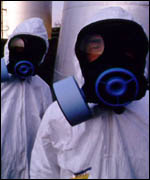

 Thanks to the training, I can pull on my respirator mask in under nine seconds - provided I am holding it ready, and know the drill is about to happen