|
 |
 | | | | | | |||||||||||||||||||||||||||||||||||||||||||||||||||||||||||||||||||||||||||||||||||||||||||||||||||||||||||||||||||||||||||||||||||||||||||||||||||||||||||||||||||||||||||||||||||||||||||||||||||||||||||||||||||
| | | You are in: Americas | |||||||||||||||||||||||||||||||||||||||||||||||||||||||||||||||||||||||||||||||||||||||||||||||||||||||||||||||||||||||||||||||||||||||||||||||||||||||||||||||||||||||||||||||||||||||||||||||||||||||||||||||||||||
|
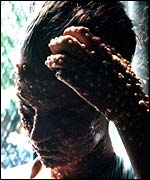
| | Tuesday, 7 January, 2003, 12:57 GMT Analysis: Disease as a weapon  The smallpox virus is highly contagious
President George W Bush has pledged to make available enough vaccines for the whole nation, despite the fact that the innoculations have serious side-effects and the disease was declared eradicated in 1980. Throughout history smallpox killed for generation after generation. It killed 30% of those infected and survivors were often badly scarred by the marks characteristic of the disease. $400m programme Smallpox was passed on through direct contact, infected bod fluids and contaminated objects like bedding or clothing.
President George Bush has announced a $400m programme which will offer smallpox vaccines to any US citizen who wants one. "Our government has no information that a smallpox attack is imminent, yet it is prudent to prepare for the possibility that terrorists, who kill indiscriminately, would use diseases as a weapon," he said. Britain too is stock-piling vaccines, while Germany, Japan and Australia are moving to secure more supplies. Israel has already inoculated 15,000 soldiers, police officers and medics.
In 2001 a group of US think-tanks simulated the effects of a biological attack in three American shopping malls. On the first day, there were 50 confirmed cases of smallpox. By the thirteenth day 2,600 people had died. The fictitious government was faced with civil unrest - people desperate for vaccines rioted and others fled infected areas. Dr Margaret Hamburg is a former public health official who took on the role of health secretary. She recalls that the initial challenge presented by the exercise was simply making the diagnosis, since smallpox has become unfamiliar to doctors. And there were also legal and ethical issues.
"And then of course would it make a difference? All of those questions are still being discussed and debated." The earliest reported example of using smallpox as a weapon comes from the 18th Century. It is said that the British Army distributed blankets infected with smallpox to native Americans. More recently, the Soviet Union's biological warfare programme developed smallpox weapons, according to those who worked there - including Dr Kenneth Alibek. He estimates that up to 700 scientists dedicated themselves to researching, developing and producing smallpox. 'Secret stocks' "According to the Soviet Union's military doctrine, smallpox was considered a strategic weapon," he said. "The Soviet Union would use these weapons in case of a total war between, for example, the Soviet Union and United States and other Western countries. "In case of such war, biological weapons would have been used for sure."
But Dr Alibek is convinced that other countries have their own secret stocks. "In 1993 we knew that North Korea was still continuing research and developing smallpox weapons," he said. "We know that Iraq was doing something with camel-pox virus. And some inspectors in the mid-1990s saw something marked smallpox.
According to recent reports, US officials believe Iraq, North Korea, Russia and France possess hidden stocks of smallpox. But as Western countries stockpile the vaccine to protect their citizens against the disease, medical experts are quick to point out that the vaccination itself is not without risk. It is estimated that if all US citizens are given the smallpox vaccine, 170 are likely to die from its effects. But bio-defence expert Kenneth Alibek says that, given the potency of smallpox, stockpiling vaccines is a precaution well worth taking. Potential threats "The smallpox virus is one of the most stable viruses known to man. It can survive in aerosol form for four days. It can survive in closed space for weeks or even two or three months," he said. "It's highly contagious. For any country which is suffering several hundred cases of smallpox which would result in thousands of new cases - their entire economy is going to go down." But Bill Durodie, research fellow at Kings College in London, says that all the talk of smallpox risks creating a public obsession with one issue while ignoring other potential threats. "There are hundreds if not thousands of micro-organisms out there which a terrorist could use instead of smallpox, " he said. "So are we now going to have to stock up vaccines for each of these too? I could name ebola, plague, botulin, or e-coli, to name just a few of those which could be used. "We also know that our actions tend to educate terrorists as well as cranks. And the one thing you can almost guarantee now is that they would be unlikely to try to use smallpox." | |
See also:  02 Dec 02 | Health 13 Dec 02 | Americas 03 Dec 02 | Health 12 Dec 02 | Americas 05 Nov 02 | Americas Internet links: The BBC is not responsible for the content of external internet sites Top Americas stories now: Links to more Americas stories are at the foot of the page. | |||||||||||||||||||||||||||||||||||||||||||||||||||||||||||||||||||||||||||||||||||||||||||||||||||||||||||||||||||||||||||||||||||||||||||||||||||||||||||||||||||||||||||||||||||||||||||||||||||||||||||||||||||
 | |
|  E-mail this story to a friend E-mail this story to a friend |
| |
| Links to more Americas stories |
| | | ||
 | ||||
 | | Back to top
| ||
| ---------------------------------------------------------------------------------- To BBC Sport>> | To BBC Weather>> | To BBC World Service>> ---------------------------------------------------------------------------------- © MMIII | News Sources | Privacy |







 The smallpox virus is one of the most stable viruses known to man