 The trams can reach a top speed of 50mph |
The first 'crash' on Nottingham's new tram system all started in a fish and chip shop. Finding his tram blocked by a lorry parked on Radford Rd, the tram driver stopped and searched for its owner, eventually finding him in the chippy.
After agreeing to move the obstruction, the unfortunate lorry driver immediately reversed into the stationary tram, damaging a glass panel.
That mishap aside, the final stages of installing Nottingham's system - the city's first tram network in 67 years - have been quite smooth.
There have been problems, such as complaints about the screeching wheels and distinctive bells, but Nottingham residents are gradually getting used to sharing the streets.
 | DRIVER'S VIEW BBC News Online filmed the Line One route from a driver's view - then sped it up |
However the true test will come in late March or early April, when people are allowed to use them.
At this stage the trams are running to a timetable, but the system has not yet been approved by the Railway Inspectorate, and therefore cannot carry passengers.
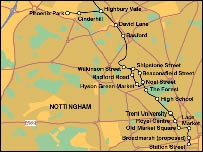
Assuming that approval is given, the city's 15 trams will start carrying passengers along Line One, a route between the central train station and the town of Hucknall, north of the city.
The line stretches 14km (8.7 miles), and about a third of that is shared with vehicles on city streets.
A spokesman for the Nottingham Express Transit (NET), Colin Lea, says people have come to terms with the trams.
He says: "People are getting used to it and know to listen out for the bell."
| PICTURE PERFECT |
But if any pedestrians are unlucky enough to find themselves in the path of a tram, all hope is not lost.
The trams are fitted with three braking systems, including powerful electromagnets which drop onto the tracks in emergencies.
Body-catching devices under the trams are also designed to prevent people coming into contact with the trams' deadly wheels.
Originally due to open last November, the �200m system was delayed due to "lots of little things", Mr Lea says.
"The main problem with a project like this is the lack of specialist staff.
"There are so many highly specialised things that can only be done by one or two people in the country, and those people are not always available."
See the entire Line One route 
|
Mr Lea cites the example of finding someone to create software to operate level crossings shared between cars, trams and trains.
Contractors are now carrying out "snagging works" - ironing out the final wrinkles along the network.
Drivers are also familiarising themselves with timetables and the trams, constructed in Derby, are being tested for reliability.
Simulated emergencies will also be carried out before the system wins final approval.
When work is finished, Nottingham will join a select group of regions and cities which boast a tram network.
The others areas Manchester, Sheffield, Croydon, Blackpool and the West Midlands.
Networks are also at various stages of development in Edinburgh, Leeds, Liverpool and South Hampshire.
In Nottingham, the next step will be installing Lines Two and Three.
If they go ahead, the track will extend to areas such as Clifton, Chilwell and Beeston.


 One-Minute World News
  News services
 E-mail this to a friend
  Printable version


 Watch the 'tram cam'

 Enlarge Map


