By Rebecca Morelle
Science reporter, BBC News |

The last working satellite tag in a walrus tracking research programme has stopped signalling. In April, researchers attached transmitters to eight of west Greenland's walruses in a bid to uncover their secret summer hide-out.
While many tags failed early on, one of the satellite devices showed a walrus migrating to Baffin Island in Canada.
The data will help discern the impacts of hunting, oil exploration and climate change on the animals.
The BBC News website has followed the walruses' progress over the last six months.
On the Walrus Watch map, walrus two, whose tag last signalled on 18 August, can be seen travelling more than 500km (300 miles) west from Hellefiske Bank, where it was tagged, to south-east Baffin Island.
The long journey across the Davis Strait took place over just a few days in the middle of May.
The 10-12-year-old female, who has a calf in tow, has remained close to the Baffin Island area, visiting various haul-out sites between May and August.
Erik Born, a biologist at the Greenland Institute of Natural Resources and lead researcher on the walrus tagging project, said: "We are really pleased that this satellite tag has been signalling for so long.
 Walrus two has settled to the south west of Baffin Island |
"Of course, we know the walruses go somewhere, so at least we had one who showed us where they can go." But Dr Born said it was impossible to form any firm conclusions about migration patterns based on the movements of a single animal.
And he added: "We cannot exclude that some of this population would have migrated north along Greenland's coast.
"You can see one walrus (walrus four) travelled north to Disco island, but its tag stopped working quite early on, so we do not know if it went further north, or like walrus two, travelled to Baffin Island."
Hunting quotas
However, Dr Born said that he suspected south Baffin Island was the most likely summer location for west Greenland's walruses.
Previous aerial surveys had revealed haul-out sites (areas where walruses rest when they are out of the water) along Baffin Island's coast, he explained, and recent genetic studies had shown close similarities between walruses found in west Greenland and those from this coastal region of Canada.
In August, the team headed to Baffin Island to attach more satellite tags to six walruses - this time fixing them to their tusks - to see if this really is the case.
 | The team saw an old friend while in Baffin Island 
|
Dr Born said: "These types of tags can last much longer than the tags we used in April - up to 18 months - so we will be able to watch if these walruses are migrating back to Greenland over the winter then back to Canada in the summer. "And we will also have to go out next year and maybe in the years after to put out more tags on Greenland's walruses, to make sure that we can have a sufficiently large sample size to make a firm conclusion."
While in Baffin Island, the researchers spotted one of the walruses they had previously tagged; walrus two, however, remained out of sight.
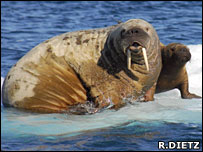
| Walruses are hunted for their meat |
If Baffin Island is where west Greenland's walruses settle over the summer, current hunting quotas may need to change. The animals are killed for their meat, which is a local delicacy as well as fodder for sleigh dogs, and ivory. Hunting of a small number of walruses is permitted each year by Greenland's authorities, but Baffin Island's walruses are also hunted by local Inuit.
Dr Born said: "If the walruses in west Greenland are the same walruses that are in Baffin Island, then hunting quotas will need to be re-set as if they are one population."
Climate connections
As well as looking at hunt quotas, the researchers also plan to use their data to see how local oil exploration could affect walrus populations.
|  When you look around the world, there are not a whole lot of walrus researchers When you look around the world, there are not a whole lot of walrus researchers |
"Here, the local movement we can see around the banks of west Greenland from all of the walruses is very useful," explained Dr Born. "One of the places companies are looking for oil is west of Disco Island, and it is interesting that we have found a connection between the walruses on the southernmost wintering ground and Disco Island (walrus four)."
The results would feed into a preliminary report for Greenland's directorate of mineral resources, he said.
 Climate change will affect the walruses' habitat |
In the longer term, the researchers are also hoping the results from this and future tagging studies will provide information on how this population of walruses might be affected by climate change.
"There is a connection between walruses, ice and climate," explained Dr Born.
"For example, there was a lot of ice this year, compared with other years, and we saw that the walruses stayed in this area for longer than we thought they would.
"However, to get good information about how climate is affecting walruses, we are going to need to go out and do these tagging studies for many years."
Overall, Dr Born said that despite facing the disappointment of losing many of the satellite tags early into the study he was pleased with this year's results.
He added: "When you look around the world, there are not a whole lot of walrus researchers, and I think one reason is that walruses are just such a difficult animal to study."
MIGRATION MAP Walrus 1: Male, 4-5 years Walrus 2: Female, 10-12 years - has yearling calf in tow Walrus 3: Anomalous data point Walrus 4: Male, 5-6 years Walrus 5: Male, 18-20 years Walrus 6: Female, 5-6 years Walrus 7: Male, 5-7 years (No data received from a tagged female and her son) |
The tagging study was run by the Greenland Institute of Natural Resources, in cooperation with the Danish National Environmental Research Institute and the Technical University of Denmark.


 One-Minute World News
  News services
 E-mail this to a friend
  Printable version


 Enlarge Image


 Walrus meets hunter


Bookmark with:
What are these?