Sacha Westerbeek is one of the people trying to help some of the one million Sudanese people who have fled their homes in what the UN is calling "the world's worst humanitarian crisis". She is working for the United Nations children's agency, Unicef, in Nyala, southern Darfur and is writing a diary for BBC News Online about her experiences.
Saturday 10 July
0800:
Today is a quiet day. I decide to stay in the office in order put in place a filing system and to follow up on outstanding requests from journalists for radio interviews.
To provide the media with the correct information is crucial but data collection is a challenge, especially since the number of Internally Displaced Persons (IDPs) is still on the increase and they are continuously on the move. It is estimated that the total number of IDPs in the Darfur region is now exceeding 1 million.
I have to keep track of the photos taken. The government issued me a photo permit to allow me to take pictures, which is of paramount importance to do my job. The Unicef donors want to know how their money is spent and when we report it is always nice to illustrate this with photos.
 Busina has five children - her husband was killed when their village was attacked |
Flipping - or actually in these days it is clicking - through them, I stop for a while at a photo which I took yesterday at Zalengi IDP camp. Busina looks at me with a desperate look in her eyes. Yesterday, I walked around to see how the people construct their huts and suddenly I felt somebody taking me by the hand. It is Busina.
She takes me to her "home". A small hut, not bigger than an average washroom. She asks me for plastic to cover the roof.
I feel useless and bad about the fact that I cannot give it to her instantly. Tarpaulin is part of the Non Food Items (NFIs) that the IDPs receive upon arrival in the camp. The rain is approaching and will be here in no more than an hour's time. I feel sorry for her.
She looks young and fragile, but has already 5 children: 3 boys and 2 girls. She has been here now for about 6 weeks and life is difficult. Her son is sick and her husband died when her village - Beida - was attacked. She also tells me that her donkey died - that was the big loss to her.
1900:
I just discussed some action points for the coming week with the head of office. I'll work on that tomorrow. Since I'm in Sudan I have not been able to read non-work related documents and I feel that I need to distract my mind a bit.
Friday 9 July
0705:
This is an exiting day. I'm travelling with some Unicef colleagues in a small convoy of the required minimum of 2 vehicles to Zalengi in West Darfur to assess the situation in the camp for Internally Displaced People (IDP) near the town.
On the way to Zalengi we have to stop many times at checkpoints to show our travel permit to the police. The military - manned by the government - checkpoints are easy. We slow down and give a friendly wave and there we go again.
 The 'Janjaweed' militia are accused of ethnic cleansing |
Along the road I was informed that we passed some of the Janjaweed. This is the first time that I really see "A Janjaweed". I've been told that one of the ways to identify them is to look at their shoes. They don't have army boots. This of course is not always the case as the Janjaweed - which means "horsemen" in the local dialect - could obtain shoes from the military or perhaps the government soldier does not feel like wearing boots that day as it is about 40c.
Today, slippers seem to be preferred by many government soldiers as it is Friday (prayer day), it is hot and it is raining heavily. So much for that theory...
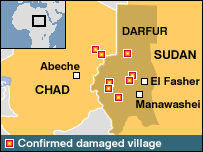
On the way to Zalengi - which is about 4 hours drive from Nyala - we see many destroyed villages. They look like ghost towns. It is strange to realise that one village is burned to the ground and the next, not even one kilometre away, is still intact.
It is explained to me that it just depends on from which tribe or ethnic group you are.
09:00:
In some of the destroyed villages we see that new people are settling in. I see a whole family working to cultivate the land, even using a camel to pull the plough.
Nowadays there is the danger that the crop might get spoiled. This year it was not possible to spray for locusts or grasshoppers due to the security situation.
Locusts are very common in this kind of mountainous area and it is hoped that they will not destroy all the newly planted crops.
1130:
We reach the camp and make an assessment to see how Unicef can further assist the ongoing interventions. The situation is dire. The IDP population is still increasing rapidly - now to about 80,000.
Many of them build huts downtown where it is much safer than the outskirts of town. This is a serious health hazard as there are not enough sanitation facilities.
1530:
After going around the camp and meeting with government officials and NGO partners, we head back to Nyala. The rain sets in by the time we leave Zalengi.
1930:
We are back at the office. A quick meal and then back to the laptop.
2305:
I'm almost finished with this story. Now I have to download my photos and try to connect to the Internet. 2300 is a "normal" time to finish the working day. Today was even the "weekend". It is a 7-day working week here with very long days. I hope to be in bed before midnight.


 One-Minute World News
  News services
 E-mail this to a friend
  Printable version

 Enlarge Map


