Sacha Westerbeek is one of the people trying to help some of the one million Sudanese people who have fled their homes in what the UN is calling "the world's worst humanitarian crisis". She is working for the United Nations children's agency, Unicef, in Nyala, southern Darfur and is writing a diary for BBC News Online about her experiences.
Thursday 8 July
Morning:
This morning I went back to the Kalma IDP (internally displaced persons) camp to visit one of the schools there which is supported by Unicef.
It presently enrols 2,150 children (1,263 boys and 887 girls). The school has 23 classes, 16 teachers and they teach the children in two shifts.
 Children are able to play in the camp without fear of attack |
As I walk about the school compound some girls look at me curiously. They follow me wherever I go and I'm pleased that I can practise my newly acquired knowledge of Arabic with them.
The girls are all from the same area - Shetaya, which is about 100km northwest of Kalma.
Aisha is excited as today is her first day at school.
She is in the 3rd grade and is dreaming about becoming a teacher.
The girls laugh and make fun and they share some salty tasting seeds with me.
For a moment I completely forget that I'm in an IDP camp where mainly women and children are still dying from malnutrition and disease.
Aisha she tells me that she is an orphan.
Some weeks ago, when fetching water with her two sisters she saw airplanes flying overhead and heard terrible noises.
 School children help Sacha with her basic Arabic |
When she went back to the village her home had been bombed. Her parents were dead. I've heard so many of these stories, but I still don't know how to react to this.
Aisha looks rather cheerful - she is still excited about her first school day in the camp.
Afternoon:
As the Unicef office is expanding and under construction, we still lack basic infrastructure here.
Just to give you an idea, there are 14 members of staff all needing to use the internet to download their emails. You can imagine the queue and the frustration.
This afternoon as I hurried to the office I stepped in some wet cement. I can tell you the workers were not happy, and neither were my shoes.
Wednesday 7 July
0700:
I wake up entangled in my mosquito net. My nicely set up construction of bamboo sticks, rope and bed net was not as solid as I anticipated when I was fighting mosquitoes in my sleep.
In the shower, the water pressure is not too bad, water not too brown and sandy and there are not too many different types of insects crawling around in the bathroom: a good start to the day!
0815:
I head for Kalma camp populated with about 53,000 IDPs. Kalma is a small village about 14km east of Nyala.
The host community is about 5km away from the IDP camp and they witness the daily influx of IDPs. Two weeks ago there were "only" 26,000 IDPs and in February 4,000.
 Sacha is worried that the rains will make life even harder |
Unicef is taking the lead in providing water and environmental sanitation, education, nutrition and child protection. Good progress has been made to provide the basic services but improvement can be made in many areas. The Ante-Natal Care clinic does not have soap or water available - and there are at least three deliveries per day.
Latrines have been built - but the target population does not yet know how to use them.
There are two schools but they lack plastic sheets to cover the roofs - and the rainy season has already started. At least 600 newly arrived children register on a daily basis.
The provision of basic services needs to be addressed, but also - who could anticipate that the camp population would double within two weeks?
1030:
I have to head back to Nyala. On the way I see four trucks loaded with IDPs. A couple riding a donkey with all their belongings on their back.
I see donkey carts carrying entire families. They are bringing all the belongings they can carry. They look desperate and tired. I feel slightly ashamed driving by in an air-conditioned 4x4. I promise myself I'll never complain about bad roads.
1115:
I'm back in Nyala to meet with a colleague from UNHCR. We discuss the challenge of data collection. The IDP situation is so fluid and changes day by day, which makes it very difficult to report on. Comprehensive data collection is a must.
1200: It is the first time that I'm able to access the internet. Downloading and sending necessary messages takes almost the entire afternoon.
1600:
Although the office officially closes at 1515, almost nobody is going home.
Work is never finished. How can we go home, eat and rest when there are so many people around us - even 40,000 IDPs in Nyala - who have no place to stay, no food or water?
1615:
The office is still worried. Two of our "education" colleagues went to Kubu (west of Nyala) and have not been able to report to the office since yesterday evening and they were supposed to be back today. It could be anything: HF Radio failure, car breakdown, or something more serious as there have been incidents of bombing, hijacking, shooting and robbery - We don't know. We just hope that they are fine.
1630:
I hear explosions. All the staff look a bit nervous. It turns out that it is a military passing-out parade.
So, a reason for a party. I hope it also welcomes our lost colleagues.
1750:
Good news. I just heard that our colleagues are in town. Problem with radio calls - it can happen.


 One-Minute World News
  News services
 E-mail this to a friend
  Printable version
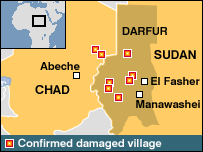

 Enlarge Map


