
So here I am, somehow, in the BBC, the home of most of the comedy I’ve loved since I was only yay high (imagine I am positioning my hand to indicate a low height, perhaps the height of a twelve-year old or a particularly ashamed man).
I’m one of the people lucky enough to have won a place on the BBC’s Room to Write scheme. Masterminded by Steven Canny and Laura Marks (BBC Comedy), Room to Write is setting out to find and develop the next wave of Scottish comedy writers. Twenty-two of us have made it this far, and as the scheme continues we must kill each other off with a series of traps, betrayals and pithy one-liners until only one survives, who will then rule BBC Comedy from his or her throne of funny skulls.
For an aspiring comedy writer this is the pot of gold at the end of the rainbow. You spend so long trying to get the industry to notice you that when they actually welcome you in you find yourself looking over your shoulder to see if it’s all a trap.
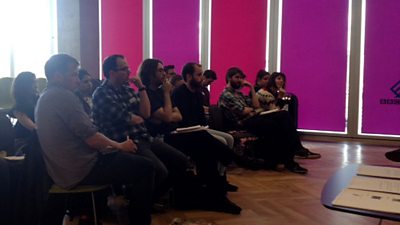
Each of us is being given the chance to develop an original sitcom script under the BBC’s guidance, with a number of ‘challenges’ along the way to develop our writing muscles - sketches, one-liners, topical, not topical, characters, storylines, opening 10 pages, and opening-10-pages-once-someone’s-explained-why-they’re-wrong.
For me Room to Write has been incredibly challenging and rewarding, and along with the expert feedback has provided arguably the most crucial resource an aspiring writer needs: a steady stream of deadlines.
Today we’ve gathered for the first time since the get-in for a day of workshops and masterclasses kindly organised by our fearless leader Laura Marks. Laura runs the Room to Write scheme and sets the challenges (especially her famed 24-hour sketch challenges which strike without warning and leave punchlines strewn in their wake) and has roped in two expert comedy writers to be our mentors for the day.
I’ve tried to capture some of the details. The following is how I remember it, but (disclaimer) it’s entirely possible that our speakers said none of these things and this was all a coffee induced hallucination.
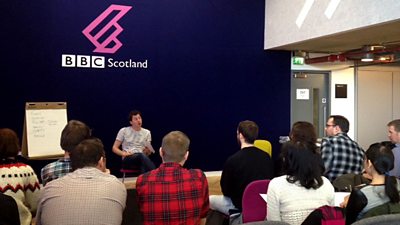
Our first speaker was Max Davis, a stand-up comedian and full-time writer for BBC Radio Comedy. A current holder of the coveted bursary writer position previously held by leading lights like Stewart Lee, Max spends his days writing for Newsjack, The News Quiz, The Now Show and anything else that needs material written or punched up, so he was an invaluable source of advice into what it’s really like to write comedy professionally.
Top tips from Max on writing for radio:
- If you want to work as a comedy writer, you have to learn to write topical. Topical comedy burns through so much material that deciding it isn’t for you is like cutting off one of your legs.
- Write to the show’s voice, not yours. Max used to fail to get sketches on air because he was really writing for his own imaginary sketch show.
- The angle you take on a story is crucial. Newsjack get dozens of submissions on the same story each week, and finding a fresh, surprising angle is crucial to getting your sketch on air.
- Pick the right story. Some news items are so serious it’s difficult to find a funny angle on them, but on the flipside, a light story that’s already funny is tough to make funnier in a sketch.
- If you’re really making a commitment to topical, you should read everything. Get into the habit - read the broadsheets, read the tabloids, and have an opinion on everything.
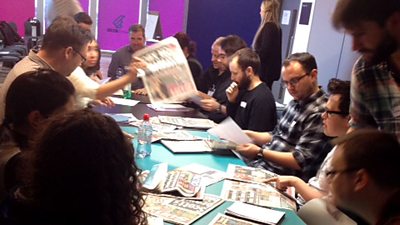
After the tutorial Max led us in a topical comedy writers’ room. We’d all brought in newspaper clippings we thought could fuel funny sketches (big thanks to missing dictator Kim Jong-Un for reappearing right after I sent our finished sketch to Newsjack - this is the worst thing you've ever done Kim). One writer would pitch a story, others would jump in with funny angles, and then we’d pair off to see what we could come up with before performing the final results in front of the group. This was a brilliant insight into writing topical material to deadline, and also brought the world Sandy Bouttell’s surprisingly strong Transfomer impression.
Our second speaker was the very funny Kieron Quirke, the writer (with Robin French) of hit BBC Three sitcom Cuckoo. Cuckoo stars Greg Davies and a Famous American - previously improv superstar Andy Samberg, now retired werewolf Taylor Lautner, and for series 3 the late Ayn Rand as Cuckoo’s quirky aunt (tbc).
Top tips from Kieron on writing sitcom:- Sitcom is not about jokes. Sitcom is about characters wanting things and pursuing them. Jokes are decoration. (Max took the same view: sketch is joke-led, sitcom is character-led.)
- Start by breaking down the storyline beat-by-beat. For Kieron this would be 2.5 to 4 pages, so fairly detailed.
- Next: write the wonderfully named Vomit Draft. Kieron and his co-writer each take half the script and take 2 hours to write the entire thing - this being the Vomit Draft it can include lines like ‘And then someone says something hilarious!’ They then swap halves and rewrite for another 2 hours, and continue until the script has started to take shape.
- Be willing to throw your work away. When you’re new, you cling to scenes that work like nothing on Earth, but sometimes you need to throw funny stuff away to make the script work as a whole.
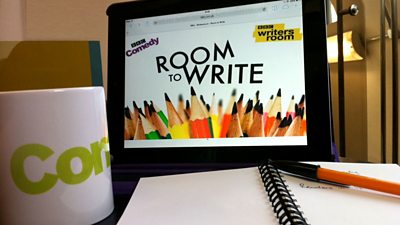
For me the initiative has been a fantastic opportunity to meet other writers and an invaluable chance to develop a sitcom script under expert guidance. We’re all working away on our pilot scripts, set everywhere from present-day food banks to the First World War.
Laura is already planning another masterclass for December at which all remaining comedy secrets will be revealed, and then the fame and fortune which to all UK-based freelance comedy writers are destined will finally be ours. We will circle Britain in our shiny gold helicopters, scribbling hilarious topical sketches on the events we see below and dropping them from the sky to an amused populace, before retiring to our island mansions for supper and hijinks. As I recline in my (also gold) armchair and sip from my also gold wine glass, I will know I have Room To Write to thank for my comedy utopia. Thank you Room to Write. Sorry I drank all the coffee.
Read a blog giving some news and advice from the Room to Write submissions
