
BBC World Service reporter James Fletcher in Beijing
For two weeks, the birds' nest stadium, which sits just across the road from the media village, has glowed an ethereally beautiful red and gold through the night - a stunning structure that never failed to stop me in my tracks every time I saw it.
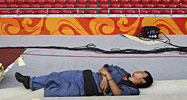
A worker asleep in the stadium the day after the Olympics closed
More Beijing Diary
But when I got up just before dawn this morning, the Olympic Green and its buildings were in darkness, lit only by the rising sun, as Monday dawned and post-Olympics China began. The Olympic party is over.
If you saw the pictures of China's leaders sitting po faced through the Olympic ceremonies, you'll know they aren't prone to big public displays of emotion.
But in the privacy of their homes after Sunday's closing ceremony, I like to imagine there might have been some smiles and hi fives.
They pulled off one of the great Olympic games of modern times.
Standing opposite the Birds' Nest this morning it was hard to believe - two weeks ago there were so many things that could go wrong, it seemed safe to bet that at least one of them would.
But there have been no major protests, no terrorist attacks, no transport meltdowns, no events cancelled due to pollution ... and China's leaders have the successful games they craved.
Before I came to China, I felt this games was exciting because the world's biggest sporting event was meeting the world's most interesting political story.
Some people will feel that the sporting success has let China off the hook politically. The farce of the supposed protest parks, where no protests were actually allowed, was a reminder that on some issues the Chinese government still has a long way to go.
Those problems haven't gone away, but for the two weeks of the Olympics at least, the sport triumphed.
The Birds' Nest provided the perfect backdrop for the stunning ceremonies and the record shattering antics of sprinter Usain Bolt. And a few hundred metres across the green, the Water Cube provided a similarly perfect arena for the super-human achievements of swimmer Michael Phelps.
But it's the people of Beijing and China who have made the biggest impression on me. From five to 75-years-old, almost everyone agreed that this was the biggest and most important event of their lifetime.
They were always smiling, always friendly, always curious, and always wanting to take photos with a foreign journalist. They were sometimes nervous to talk to the media, but I got the sense this was as much about not wanting to spoil the games with an imperfect answer as it was about fear of retribution from the authorities.
I had conversations with volunteers, a soldier, workers, young professionals, students, the young and old, and they all relished the chance for the world to come to China, and see it with their own eyes, and get beyond the clichés.
It will be interesting to see where China goes from here. One of the biggest questions is whether a successful games will give the Chinese and their government more confidence - to be more open and to accept some criticism from the rest of the world.
As I failed to predict how successful the games would be, it would be unwise of me to go out on a limb and make any bold predictions about how the games will change China.
So I'll fall back on an old favourite quote. When asked by Henry Kissinger what he thought of the French Revolution, China's first premier Zhou Enlai is said to have replied: "It's too early to say".

