
BBC World Service news reporter James Fletcher is heading to Beijing to report on his first Olympic Games. During the Games, he and other members of the News team will be sending reports on life in and around Beijing in the Beijing Diary. Here he talks about his pre-Beijing excitement.
There aren't many global events more exciting than the Olympics, and there aren't many global stories more compelling than China's re-emergence as a super-power. Sport and politics collide in one of the world's great cities, and Beijing 2008 should be a fascinating couple of weeks.

Related BBC links
It'll be the first Olympics I've covered as a journalist, though not my first games. I hail from Sydney, where people like to describe the 2000 Olympics as the "best games ever."
The Beijing and Sydney games share some things in common. Before Sydney, there was a lot of criticism of the cost of the games, and some people (including me) felt that the influx of tourists, potential traffic problems, and general hassle made getting out of the city during the games a much more attractive option.
Fast forward to Beijing, and some people are again asking "is it all worth it?" The cost is huge, security measures are a burden, people and places alike are being cleaned up. Visa restrictions have meant some expats have had to leave, and international tourist numbers haven't lived up to the hype, so some businesses are feeling the pinch.
In the end I didn't flee Sydney. I was swept up in the enthusiasm, cheered with the rest of the country when Cathy Freeman won a fairytale victory in the 400m, loved the rare feeling that a city of four million people plus overseas visitors were all on the same wavelength ... and the traffic was better than ever (probably because no-one went to work). After the games, the naysayers were pretty thin on the ground ... two billion dollars seemed a small price to pay for the "best games ever" (did I mention that already?).
Can Beijing pull off the same thing? I was there in May, and it's a thriving, cosmopolitan, exciting city whose people are excited and ready to enjoy the games. I also found out first hand why Beijingers have a reputation as being some of the most hospitable and laid-back people in China. And if China's champion athlete Liu Xiang can win gold in the 110m hurdles, 1.3 billion people will cheer as one, and maybe the world will join them to celebrate.
But there are some huge practical challenges: the heat, the pollution, the traffic, and the language and cultural differences. Not much the Chinese government can do about the heat, but it's doing everything within its power (and for the Chinese government, that's a lot) to solve the others.
Dealing with protests
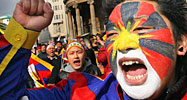
How will the Chinese officials deal with protests?
Then there's the politics. Since it embarked on the path of reform and modernisation in 1978, China has notched up some huge achievements, like the economic development that has lifted hundreds of millions of people out of poverty. But as China plays a greater role on the world stage, its policies at home and abroad have come under increasing scrutiny.
Human rights, Tibet, China's links with Sudan ... it's likely there will be protests of some form at the games, and one of the biggest variables is how the authorities will respond ... I'm not sure they know themselves.
And it's not just the authorities - criticism of China from protesters or the media is likely to be met with increasing nationalism among ordinary Chinese.
Fear of protests and criticism is one reason why the authorities are ramping up security. They're determined to get through the games without incident, but even if nothing major happens, will the security measures simply put a lid on the fun?
It may seem that way to foreigners, but lots of Chinese will be coming to Beijing for the games but many commentators suggest that it's them the government is trying to impress.
However it unfolds, we'll be out and about in Beijing, getting around the city to bring you the games in all its colour. Young and old, rich and poor, athlete and spectator - we'll be trying to speak to them all to understand how China got to this point, and guage the success of the Olympics.
I'll be out there with Mark Sandell, who edits World Have Your Say, and Rebecca Kesby, who's one of the presenters of the World Today. Between us we'll be posting our impressions and experiences here. You can give us your input at the World Have Your Say blog - let us know your questions about China and the olympics, and what you want to hear from our coverage. And don't forget to keep an eye on Your Story where you can hear the story of the Olympics directly from the people involved.

