
BBC World Service news reporter James Fletcher in Beijing
The second Russia v Georgia clash of the games, and cue the headlines. I guess they were inevitable - two nations in the throes of military confrontation meeting on the sporting field is one thing, but when that sport happens to be beach volleyball, it's a sub-editor's dream.
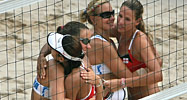
The ladies were pleasant before the match, not so much after
More Beijing Diary
Related BBC Links
It's also a spectators' dream (no, not because of the bikinis). A beach volleyball game is forty-five minutes of full-on, crowd- participating, cheer-leading, cheesy pop sing-a-long, razamatazz overload.
Between every point there's a blast of Cotton Eye Joe, or Centrefold by the J Geils Band. If there's a longer break, the cheerleaders come out and dance around. And every now and again, the MC will come out to hype the crowd up (with simultaneous Chinese hype translation).
My favourite was the Mexican wave - first at full pace, with pretty good participation. Then a variation I hadn't seen before - the Greek wave. Cue the music from Zorba the Greek - the one that starts slow and ends fast - and the wave does the same thing, beginning at snail's pace and eventually speeding up until it disintegrates into hands in the air chaos.
By the time the players came on, the stadium was three-quarters full, and the largely Chinese crowd gave both teams a rousing cheer. The players shook hands and hugged each other, and it began to look like this wasn't going to be a grudge match at all.
I probably should have realised this when I read the team list - it turns out the Georgian players, Rtvelo and Saka, aren't Georgian at all - they're Brazilian. And as far as I'm aware there aren't any long simmering Russian/Brazilian feuds.
So this isn't a story about conflict, it's a story of two wandering ball players who found a home in a land not famed for its beaches, had their applications for Georgian passports personally approved by President Saakashvili, and adopted Georgian names to play under.
Anyway, game on! Russia took the first set easily, and it looked like this was going to be a damp squib.
But then in the second, something kicked in, and the 'Georgzilians' suddenly found their form. The lead swapped several times, there were some amazing rallies, and the crowd suddenly got a lot more involved.
There were ten or so guys wearing Brazilian shirts, with green wigs on, shouting "Georgia jiayou!" (a corruption of the Zhongguo Jiayou - Go China chant you hear everywhere). And the rest of the crowd agreed.
Spurred on, the Georgians survived a match point to take the set and even things up. By now the crowd were firmly on their side, the chants of "Georgia jiayou" were getting louder, and it seemed Rtvelo and Saka could do no wrong. They were everywhere, setting and spiking like there was not tomorrow. The Russians started to look beaten.
And they were. A few more rallies full of leaping smashes and despairing dives to save the ball, and the Georgians had it in the bag. The crowd were on their feet.
The handshakes at the end were slightly less friendly than at the beginning, and after the match the Russians made some pointed comments about the Brazilians' flexible nationality but anyone expecting a repeat of Hungary vs Russia at Melbourne in 1956 was disappointed.
But it was a fantastic game - exciting, nail-biting, brilliant talent on display. All the things the Olympics should be about - at what other event would you get Russia against Georgia (who are actually Brazilians), while Mexican waves sweep round an artificial beach in Beijing.

