 | | | | | | | ||||||||||||||||||
| | |||||||||||||||||||||||
S. Africa: The Zuma bandwagon | ||||||||||||||||||||||||
Although the disaster-prone Jacob Zuma's suitability for the presidency of the African National Congress (ANC) is questionable, he has become the focal point of a campaign to return the party to the democratic traditions it once proudly upheld. Without formally announcing his candidacy, Zuma, the ANC deputy leader, is threatening to go head-to-head with President Thabo Mbeki or one of his protégés in party elections due next year. ANC tradition For three decades in exile and under attack from the apartheid regime, the ANC avoided electoral contests, seeing them as divisive and preferring a single leader, Oliver Tambo, to serve as an "embodiment of unity". The party's emphasis on unity continued after its unbanning in 1990, with the best example being the decision of then-President Nelson Mandela to anoint Thabo Mbeki, respected for his intellectual prowess and groomed as heir apparent by the late Tambo, as his successor. Yet the ANC, founded in 1912 by a cross-section of ethnic and class groups, had a rich tradition of free expression and electoral contests in the 48 years prior to its banning. The culture of president-for-life and anointed successors was alien to the ANC in this period, when different ideological groups fought for control of the organisation and eight different presidents led the party. In post-apartheid South Africa, the ANC would have been expected to let democracy flourish. Instead, it has displayed the siege mentality of its exiled wing. Culture of sycophancy This has been especially the case under Mbeki's leadership. As a result of the centralization of power, Mbeki has increasingly become seen as the dispenser of patronage, fuelling a culture of sycophancy. When he was part of Mbeki's inner-circle, Zuma once infamously remarked that South Africa's constitution was not "above" the ANC, showing his failure to distinguish between loyalty to the party and country; between a multiparty democracy and a one party state. This on its own ought to count against him in the race for the presidency, but he has shrewdly exploited his legal tribulations– a rape charge, of which he was cleared in May, and a corruption trial, due to start in July – to project himself as a 'people's leader'. Mbeki's intentions are unclear, but speculation in ANC circles is that he wants to stay on as ANC president while handing the presidency of the country to a woman, Phumzile Mlambo-Ngcuka – currently his deputy in government. Women's rights and chauvinism This could harm the cause of women's rights. Mlambo-Ngcuka will not be a leader who fought and won an election on merit, instead, she will be the benefactor of Mbeki's patronage; a woman who took orders from him. Male chauvinism is currently rampant in the Zuma camp, something that he personally fuelled when he took the witness stand to defend himself against the charge that he raped a 31-year-old woman. Espousing a reactionary brand of Zulu culture, Zuma described her vagina as her "father's kraal" and admitted entering it without a "husband's coat". To counteract South Africa's powerful feminist lobby, Zuma has brought women who uphold conservative family values into his campaign team. They were out in full force at his rape trial in Johannesburg, praying to the ancestors for his salvation; and pleading with Jesus to "help this lady (the rape complainant) keep her legs closed". He is also stoking the tribal embers with many of his supporters now donning T-shirts with the words "Jacob Zuma, 100 per cent Zulu boy" emblazoned on them. This is unfortunate. From dousing the flames of Zulu nationalism that Inkatha Freedom Party leader Mangosuthu Buthelezi once ignited, Zuma is now fanning them. Battle for the soul of the ANC Although uncomfortable with Zuma's chauvinistic streak, the general secretaries of the Congress of South African Trade Unions and South African Communist Party, Zwelinzima Vavi and Blade Nzimande respectively, have thrown their weight behind him. This is largely because Zuma has suggested, albeit vaguely, that his economic policies will be to the left of the Mbeki government, and that he will allow the trade union movement to counterbalance the black business class that currently holds sway. As journalist Cyril Madlala noted in Johannesburg's Business Day newspaper, a new fault line between the "black elite" and the "poor hordes" has emerged in the post-apartheid era. That Zuma was part of the new elite before his sacking as the country's deputy president last year does not matter. That a judge has already convicted his former financial adviser of corruption does not matter. That he himself has been accused of soliciting a bribe from a foreign company does not matter. Only one thing matters to Zuma's supporters: someone has finally stood up to Mbeki and the new elite that he personifies. |
| |||||||||||||||||||||||
| ||||||||||||||||||||||||
| ||||||||||||||||||||||||






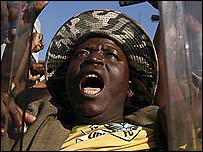

 S. Africa: The Zuma bandwagon