 | | | | | | | ||||||||||||||||||||||||||||||||||||||||||||||||
| | |||||||||||||||||||||||||||||||||||||||||||||||||||||
Nigeria: Burning with rage | ||||||||||||||||||||||||||||||||||||||||||||||||||||||
Nine foreign oil workers on contract to the Shell multinational company in Escravos in the Niger Delta retired to bed peacefully on their barge on Friday, February 17 Unknown to them a gang of heavily armed men were lurking in small boats in the surrounding waters. Three hours into Saturday, the gang crept on to the barge and woke them up, threatening to shoot anyone who offered the slightest resistance. The men – from various countries, including the UK – surrendered meekly. That was the end of their peaceful night and the beginning of a nightmare in the swamps of the Niger Delta. A new militia group A new chapter in the drawn-out macabre drama of violence, resistance, intrigue and poverty in the oil-rich Niger Delta opened that weekend. The hostage-takers identified themselves in emails and phone calls to media houses as members of the Movement for the Emancipation of the Niger Delta (Mend). This was ostensibly a new group in the area, where there are scores of militia groups, all claiming to fight for economic and political rights. In fact what was new about the group was only its name. According to various reliable sources, Mend was the new name of the Niger Delta People's Volunteer Force (NDPVF), formerly led by Alhaji Mujahid Dokubo-Asari. The group's background It came into being after the arrest and prosecution of Dokubo-Asari and Diepreye Alamieyeseigha, the disgraced ex-governor of Bayelsa State and self-styled 'governor general of the Ijaw nation'. Both men were regarded highly as leaders among the dominant Ijaw ethnic group of the region. Dokubo-Asari was arrested in September last year and charged with treason, then Alamieyeseigha was arrested in December, the day he was removed from office by the state's legislative assembly for alleged money laundering. Demands It was little surprise when Mend's major demand after taking the January 11 hostages was the unconditional release of the two men. Other demands were for all oil companies and the federal government's military Joint Task Force to withdraw from the region. Other militant groups expressed support for the demands. Their objective was to get the companies to negotiate directly with them – a move that could undermine the federal constitution which states that mineral resources anywhere in the country belong to the federal government. The Delta's first rebel The first ever 'rebel' from the Niger Delta was Isaac Adaka Boro, a young Ijaw man and university student. He left school in the early 1960s to lead a protest group against the exploration of oil in the region under the authority of the federal government. He argued that the oil belonged to the people of the Niger Delta as a natural heritage and it should be to their exclusive benefit. He armed his group and declared the secession of the Niger Delta. The Nigerian government reacted decisively. The army arrested him and members of his group. They were charged with treason. At the end of the trial they were condemned to death. The government commuted the sentence. Biafara Boro was in prison when the Nigeria-Biafra crisis started. The Niger Delta was at the time part of the Eastern Region of Nigeria which declared itself the Republic of Biafra. Boro was granted amnesty and he was released. He enlisted in the Nigerian Army in the war against the secessionists. He was reported as saying that he would not swap his Nigerian citizenship for that of a Biafran under domination by Igbo people. He died in active service. Ken Saro-Wiwa The seed of his rebellion against perceived injustice in the Niger Delta germinated slowly, eventually producing the writer Ken Saro-Wiwa. Ken substituted Boro's gun for his pen – and it was a very powerful weapon indeed. He was not Ijaw. He was from the much smaller Ogoni ethnic group. He travelled widely around the world, presenting the case of the people of the Niger Delta, and the devastation and deprivation brought on his own people by oil companies and the Nigerian government. The then-government of General Sani Abacha moved ruthlessly against him and his supporters in the Movement for the Survival of the Ogoni People (Mosop). Government action A special military task force was set up to violently rout the unarmed activists. Hundreds of people were killed in the operation. The climax was the arrest, trial and execution of Saro-Wiwa and eight of his closest supporters. The execution was greeted with outrage around the world. At home it won converts in their millions to the cause of the people of the Niger Delta. The seed sown by Isaac Adaka Boro and watered by Ken Saro-Wiwa had now rooted itself in the minds and hearts of Niger Deltans, and the Nigerian nation is currently reaping the harvest of protests and rebellion. *A full version of this article appeared in the April - June 2006 edition of Focus on Africa magazine |
LOCAL LINKS EXTERNAL LINKS The BBC is not responsible for the content of external internet sites | |||||||||||||||||||||||||||||||||||||||||||||||||||||
| ||||||||||||||||||||||||||||||||||||||||||||||||||||||
| ||||||||||||||||||||||||||||||||||||||||||||||||||||||






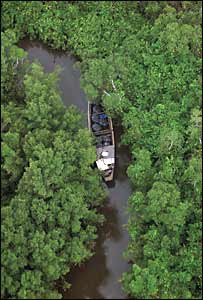


 BBC News: The Nigerian Delta's troubled waters