» Where do you want to go?
What is the Solstice?
Celebrating the Solstice
Significance of Stonehenge
 Multimedia:Watch our coverage from 2002 Multimedia:Watch our coverage from 2002
Who are the druids?
Webchat with Terry Dobney, Keeper of the Stones at Avebury
Multimedia: Watch 'Inside Out'
 | | What is the solstice? | |
 The Earth rotates upon its axis. But the axis is inclined at an angle of 23 degrees from perpendicular to the plane of its orbit. The summer solstice marks that day of the year when the North Pole is tilted farthest towards the Sun. Consequently, the Sun reaches farthest north of the equator. Although we mark the occasion by greeting the sunrise, the actual time of the Solstice is at 2:24 PM. The word solstice means ‘sun stands still’. So for a few days around June, 21 the Sun will appear to rise and set at exactly the same places. During the days the Sun will appear at its highest, around 62 degrees at noon. The Earth rotates upon its axis. But the axis is inclined at an angle of 23 degrees from perpendicular to the plane of its orbit. The summer solstice marks that day of the year when the North Pole is tilted farthest towards the Sun. Consequently, the Sun reaches farthest north of the equator. Although we mark the occasion by greeting the sunrise, the actual time of the Solstice is at 2:24 PM. The word solstice means ‘sun stands still’. So for a few days around June, 21 the Sun will appear to rise and set at exactly the same places. During the days the Sun will appear at its highest, around 62 degrees at noon.
| | Celebrating the Solstice | |
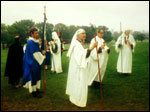 Many ancient civilisations marked the Summer Solstice, seeing it as a time to celebrate the forces which controlled the natural cycle of life, death and rebirth. From Stonehenge to Peru and from China to Egypt, ancient civilisations erected structures to mark these important events. Even today hundreds of people will be marking the event by visiting Stonehenge and watching the Sun rise over the Stone Circle. Many ancient civilisations marked the Summer Solstice, seeing it as a time to celebrate the forces which controlled the natural cycle of life, death and rebirth. From Stonehenge to Peru and from China to Egypt, ancient civilisations erected structures to mark these important events. Even today hundreds of people will be marking the event by visiting Stonehenge and watching the Sun rise over the Stone Circle.
| | Significance of Stonehenge | |
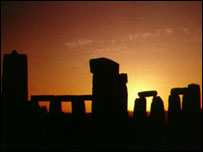
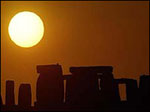 The Sun rises over the monument at around 4:50 am. Recent summer solstices have been marked by shrouds of low cloud hanging over Salisbury Plain although the sun does occasionally shine for the Solstice. If you want to avoid an unnecessarily early alarm call, then remember to check the forecast. The Sun rises over the monument at around 4:50 am. Recent summer solstices have been marked by shrouds of low cloud hanging over Salisbury Plain although the sun does occasionally shine for the Solstice. If you want to avoid an unnecessarily early alarm call, then remember to check the forecast.
| | Multimedia:Watch our coverage from 2002 | |
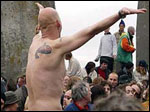 An estimated 18,0000 people turned up to watch the sunrise over Stonehenge this morning, 4,000 more than last year. As the sun, obscured by thick cloud, rose over the stone circle at 4:42am BST revellers beat drums banged gongs and blew whistles. An estimated 18,0000 people turned up to watch the sunrise over Stonehenge this morning, 4,000 more than last year. As the sun, obscured by thick cloud, rose over the stone circle at 4:42am BST revellers beat drums banged gongs and blew whistles.
"It's such a cool place to be," said John Rothwell, a "traditional British witch" and computer technician from Telford in central England. "People have been doing this since year dot, even though we have no written records of why. Everybody needs a reason to gather together, a place of reverence." VIDEO: Click here to see our exclusive video of the Solstice celebrations in 2002.
Streaming video/audio requires Real Player.
SeeBBC download guide and Free Real player | | Who are the druids? | |
First appeared in BBC News Online, June 21st 1999 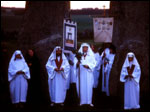 The origins of the Druids were as important figures or "religious professionals" among the Celts, who came to Britain in 1500 BC. In this pre-Christian era, Druids acted as judges, doctors, diviners, mages, mystics, and clerical scholars, in other words, they were the intelligentsia of the time. The origins of the Druids were as important figures or "religious professionals" among the Celts, who came to Britain in 1500 BC. In this pre-Christian era, Druids acted as judges, doctors, diviners, mages, mystics, and clerical scholars, in other words, they were the intelligentsia of the time.
They knew poetry, philosophy, astronomy and science inside out and were considered the bravest and most wise and respected members of Celtic society. Another of their important functions, according to Celtic tales and mythologies, was they were able to exhibit a range of magical powers, such as divination and prophesy, healing, levitation, shapechanging and they could even control the weather. Amazingly, over 20 centuries later, the Druids still exist, and around 10,000 Druids still practise in Britain. In 1989 the Council of British Druid Orders was formed with just two or three founding member orders, which, according to history and legend, had been in existence for 1,500 years. Some may put the "re-emergence" of Druidism down to the fact that it has once again found a place in time. One reason is the growing interest in the environment and the myths and legends of England, which are linked with the wave of New Age travellers dotted around the British countryside. Click here to read this article in full. | | Webchat with Terry Dobney, Keeper of the Stones at Avebury | |
Click here to read a transcript of Terry Dobney's live webchat with BBC Wiltshire in which he discussed druid orders, their significance in modern times and the importance of Wiltshire's sacred sites. | | Multimedia: Watch 'Inside Out' | |
 BBC Bristol's Inside Out continues on Monday 16th June at 1930hrs. One of the tales concerns Zoe Price from Glastonbury who was brought up with her half-brother and sister Rowan by their dad after her mum, Denny Price, walked out on the family and became a traveller before ending up twenty years later as the archdruidess of the Glastonbury order of druids. BBC Bristol's Inside Out continues on Monday 16th June at 1930hrs. One of the tales concerns Zoe Price from Glastonbury who was brought up with her half-brother and sister Rowan by their dad after her mum, Denny Price, walked out on the family and became a traveller before ending up twenty years later as the archdruidess of the Glastonbury order of druids.
VIDEO: Click here to see streaming video of Zoe's story(Courtesy of BBC TV's Inside Out),  What do you think about Zoe's experience and how her mum chose to leave her family and become a druid? Was she right to follow her feelings or was she being at all selfish in her decision? And what do you make of the outcome?! Watch the video (here) and then tell us with your thoughts. What do you think about Zoe's experience and how her mum chose to leave her family and become a druid? Was she right to follow her feelings or was she being at all selfish in her decision? And what do you make of the outcome?! Watch the video (here) and then tell us with your thoughts.
| | Add Your View | |
|