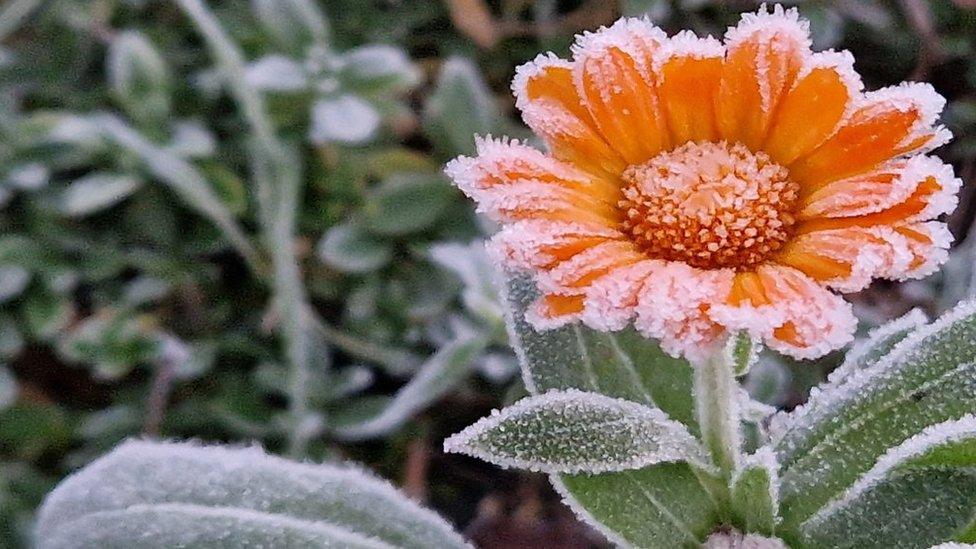
Ice weather for pancakes
Ice pancakes are the obvious place to start on Shrove Tuesday, but they are not the only eye-catching formations ice crystals can create given the right conditions.
The pancakes can vary in width from 30cm (1ft) to 3m (10ft), can be as deep as 10cm (4in), and are caused by the freezing of foam floating on a river's surface.
As the water starts to freeze it forms clumps of ice crystals which bump into each other and eventually coalesce to create round discs resembling pancakes.

While ice pancakes look solid they're actually quite slushy
Ice spikes
These curious spikes of frozen water can form in small pools or bowls of water when the top layer develops an "icy" skin.
If there is a small hole in the ice, liquid water is pushed through it and when it freezes it forms the basis of an ice spike.
As more water flows through the spear grows, but that only tends to happen when the water freezes slowly and if there is a little bit of breeze.
It is basically like an upside down icicle, but instead of gravity forcing the water down, when the density of the water increases as it freezes it pushes the water upwards.

This ice spike "grew" from a bucket a garden in Hayfield, Derbyshire, last year

The conditions were just right for this ice spike to form in Tomasz Kolodynski's bird bath in Dorset a few years ago
Hair ice
A dead ringer for a Santa beard, hair ice is also known as frost beard, ice wool, or frost flowers.

These delicate finely-wrapped filaments of hair ice were found in Enniskillen, Northern Ireland
The hundreds of fine strands of ice crystals develop on winter nights when temperatures drop just below zero but only where a fungus called Exidiopsis effusa is growing on rotting wood.

BBC Weather Watcher HRHPOP spotted this unusual ice in East Renfrewshire
Without the fungus present the ice would form crusts instead.
Ice pellets

The tiny ice pellets can form a sort of marshmallow effect when they fall on to already lying snow. Freezing rain can have the same effect
Ice pellets are created when a snowflake begins melting as it passes through warmer air as it falls towards the ground. If it happens to pass through a layer of colder again it develops a thin layer of ice and hits the ground as a pellet.
Listen: Ice pellets make a noise as they bounce off already frozen surfaces
They can bounce on impact making a very audible sound when they hit other very cold surfaces, and are not easy to squash underfoot.
You are likely to see them during cold weather outbreaks in the spring.
In more turbulent clouds like cumulonimbus in the summer the precipitation is more likely to fall as hail. However, ice pellets will form in shallower and less vigorous cloud formations.

This is an extreme close up of an ice pellet that fell on already melting snow
Weather terminology varies around the world and in the US the term ice pellets is used to refer to what is called sleet in the UK.
Follow BBC Weather online, on X, external and on Instagram, external.
- Published17 January 2024
- Published21 January 2024
- Published1 December 2023