“Having a disability might change the way you do things with your child, but it’s never going to stop you from being a great parent.”
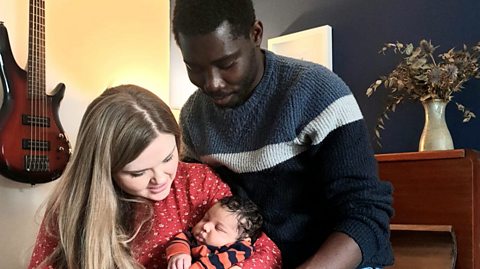
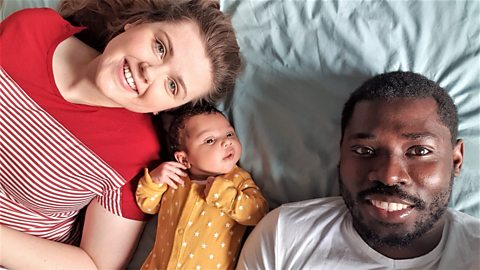
Becoming a mum for the first time has its challenges and when your experience of life is slightly different to others, there are extra considerations that need additional support. Hannah, Jouvé and baby Matthew are one of our Tiny Happy People Families. Hannah has been impacted by hearing loss from a young age and wears hearing aids in both ears. After giving birth to Matthew in December 2020 – she is reflecting on how her hearing impairment has brought new and unexpected challenges to her role as a mum.
It’s totally natural to worry about your baby
“I find myself checking on Matthew all the time because I am scared that he will be crying and I won’t be able to hear him. I worry so much about missing things,” says Hannah.
This anxiety is to be expected with a new-born, Speech and Language Therapist Janet Cooper says: “All parents worry about their children. You can’t wait for them to go to bed, and then the moment they’re asleep, you worry until they wake up again”.
It’s really important that all parents understand how to interact with and respond to their child, even before they are born. “Babies are able to hear from about 24 weeks in the womb, and they are born recognising familiar voices,” Janet explains. “Babies don’t see that well for the first 12 weeks, so things like sound are a really important part of the attachment process and help to build the relationship between parent and child,” she says.
All parents worry about their children. You can’t wait for them to go to bed and then the moment they’re asleep, you worry until they wake up again.
'Serve and return’ interactions: responding to your baby
Janet explains how important it is for parents to encourage babies to make vocal sounds. “Babbling tends to start at 5 or 6 months old. Before that, it’s accidental practise and imitation of things like smiling or chuckling. They are getting ready to speak; the more you stimulate that, the more likely it is to happen,” she says.
“Responding to your baby’s vocal sounds is called a 'serve and return interaction'" Janet explains. “When an adult responds to the infant with sounds or eye contact, neural connections are built and strengthened in the baby’s brain that support the development of their communication skills.”
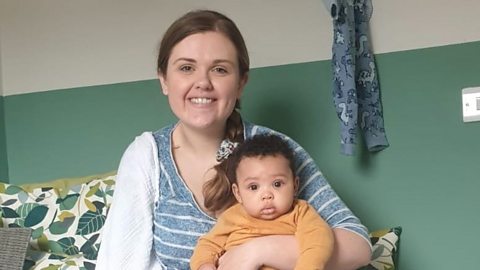
Having a hearing impairment, Hannah is really aware how important it is to make plenty of eye contact and sounds when interacting with Matthew. “I spend my whole day talking and singing to him. I think he’s probably sick of listening to me!” she says.
Despite needing hearing aids from a young age herself and experiencing profound hearing loss without them, Hannah doesn’t have a speech impediment, which she says is relatively unusual for people with her level of hearing. She credits her own mother’s behaviour for the development of her speech and language skills, saying “my mum was so good at making sure I was always looking at her when she was speaking and repeating things if I didn’t hear them. I think that really helped me with my speech and language development.”
What if my child also has a hearing impairment?
Matthew is responding well to sounds around him - "he’s at that age now where he is really responding to people, which is lovely. He laughs a lot – mainly at Jouvé!” says Hannah. However, she was nervous when he was first born.
“There are lots of health checks, but it was the hearing screening test that I was most worried about. When the health visitor asked if I had any concerns, the question of whether Matthew might develop a hearing impairment was the main one I had,” she adds.
Hannah’s family knew about her hearing impairment from a relatively young age, but it wasn’t detected from birth. With advances in technology today a neonatal screening would identify Hannah’s specific type of hearing loss much earlier on, Janet explains. “Spotting it early is the key. Go to your health checks, and if you have any concerns that your baby isn’t hearing then seek help as soon as you can,” she says. “Be aware of your child’s behaviour: if they seem like they are misbehaving, it may be because they misheard a certain letter in a word. If they have a mild hearing loss, then they won’t be able to discriminate between similar sounding consonants,” she adds.
Go to your health checks, and if you have any concerns that your baby isn’t hearing then seek help as soon as you can.
Janet outlines some key things that parents and carers can do to support a child with their hearing impairment:
- Get down to the child’s level when speaking to them .
- Repeat something if you’re not sure that they have heard you correctly.
- Use visual cues and gestures when speaking.
- Face each other when you read to them so that they can see your mouth moving.
- Reduce background noise; have times when you turn the TV and radio off to allow your child to tune into speech.
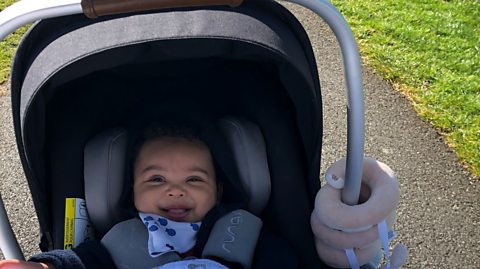
- Use a parent-facing pushchair where possible.
- If your child is given hearing aids, make sure they wear them. They will miss a lot of crucial information if they don’t.
- If they use sign language, then take the time to understand what those signs and gestures mean. It will support and enhance their spoken language development.
There is no such thing as the perfect parent
Hannah hopes that if Matthew does develop a hearing impairment, he will be able to cope and adjust to it as well as she has. “Because I feel that I have managed well with my own hearing impairment and been able to do what I want to do, I hope that if Matthew does have one, then we can help him do the same,” she says. “It doesn’t need to hold him back in any way. He can go on to do whatever he wants to do in life, in the same way I’ve been able to. That is my hope anyway, but there is obviously a bit of anxiety about it."
When a hearing impairment is inherited, a lot of parents blame themselves and feel guilty. “Parents naturally blame themselves for everything because they are striving for perfection, but there is no such thing,” Janet says. “You can’t control genetic and medical factors, but you can control the environment and the stimulation. It’s about putting the right things in place and doing the best you can with what you’ve got.”
Lack of understanding
For Hannah, these natural worries and anxieties were heightened by a lack of support and understanding for parents like her.
“Finding the right baby monitor was really tough. I thought someone somewhere would have compiled a nice website to give us lots of options to choose from, but we didn’t find it to be like that,” she says. “I was getting really frustrated and downhearted because a lot of the monitors marketed for deaf parents or those with hearing impairments are quite old-fashioned. Jouvé did a lot of research and was eventually able to buy one with a wristband that vibrates when Matthew cries, but it wasn’t easy.”
So far, Hannah hasn’t had to spend a night alone with Matthew, but she is worried about what will happen when Jouvé goes away or has to work nightshifts. “I had anxiety about it before Matthew was born, and I do worry about what might happen if the baby monitor doesn’t work,” she says. Despite her hearing aids being uncomfortable to sleep in, Hannah thinks that she will probably sleep with them in to give her peace of mind, adding “Jouvé will come home and find me exhausted, not because I’ve been looking after Matthew, but because I won’t have slept a wink!”
It’s lovely to have this opportunity to show people that you can have a hearing impairment and still have a very happy life.
Hannah’s advice for other parents with a hearing impairment
“It’s lovely to have this opportunity to show people that you can have a hearing impairment and still have a very happy life,” says Hannah. “I want to help other parents realise that.”
Ask for help
“Don’t be afraid to tell people what it is that you need. If someone hasn’t quite understood that things are harder for you, then let them know,” says Hannah. “I still feel ashamed to ask for help – it’s really embarrassing to ask someone to repeat themselves four times! Get people around you who really do understand and can support you.”
Don't feel guilty
“You don’t need to feel guilty about having an impairment because you will do the best thing for your child. You just need to figure out what that looks like for your family,” says Hannah. “It’s never going to be detrimental to your parenting because you’ll figure out your own way of doing things and that’s absolutely fine. It’s not something that should ever hold you back.”
Be kind to yourself
“Having an impairment might change the way you do things with your child, but it’s never going to stop you from being a great parent,” says Hannah.“Be kind to yourself. It’s about being in tune with your child. All parents have to learn what their child’s unique way of being is. Do the best you can. Grow together,” adds Janet.
Further help
Check out RNID - (Royal National Institute for Deaf People) andCODA - (Children of Deaf Adults) for useful resources and support.