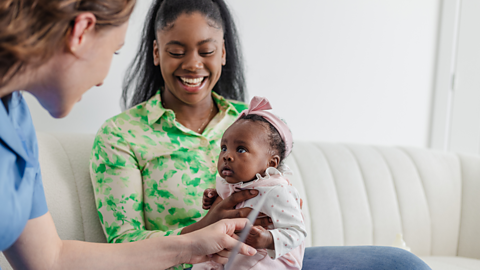
As a grandparent, it's sometimes hard to know the best way to start a conversation with a grandchild.
Early years practitioner Lisa Jones has some top tips in the video below. These should hopefully get the chat flowing between you in a way that will benefit their learning and help you have the best time together.
Lisa
If you don't spend much time around little ones, or even if you do, it's sometimes hard to know the best way to start a conversation. Here are my tips to get you chatting.
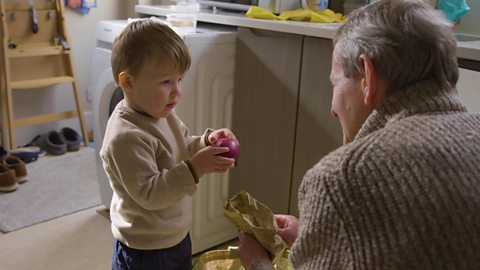
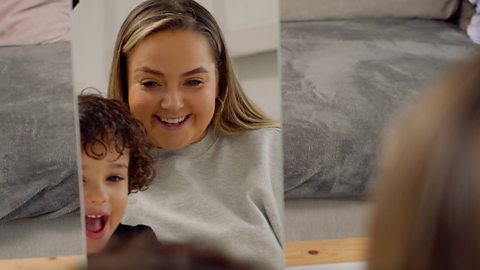
Try and be face to face and keep at eye-level.
Grandma
Where do I get the oranges from?
Grandson
In the kitchen!
Grandma
In the kitchen?
Grandson
Yeah!
Lisa
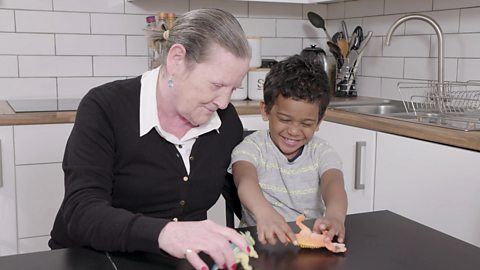
It's great because you kept eye-to-eye contact while you were playing there.
Make sure you take turns when you are chatting to them.
Grandma
What would you like for your dinner Mr Dinosaur?
Grandson
I want oranges!
Grandma
Oranges!
Lisa
You were really listening to what he was saying.
Grandma
Thank you.
Lisa
It's really helpful to make connections between ideas when you are chatting. For example, if he is using a word like 'tail', we can ask 'what other animals have tails?'
Grandson
A dinosaur.
Lisa
A dinosaur's got a tail.
Grandma
What about the fish you saw in the tank? Has that got a tail?
Grandson
Yeah.
Grandma
Okay!
Lisa
It had a colourful tail, didn't it?
Lisa
That was great. I could really see that you were helping make connections out of his ideas there.
Grandma
That's really nice to hear. I'm glad to know I'm on the right track to helping him along.
Lisa
Try using words they say in longer sentences. This will help them understand the meaning of the word and the different ways they can use it.
Grandma
Where do the dinosaurs live?
Grandson
In the forest.
Grandma
Do you like dinosaurs walking in the forest?
Grandson
Yeah.
Grandma
I like walking my dog in the forest.
Lisa
That was great and using sentences like this will really help your child's understanding of words such as forest.
Bye, bye Mr Dinosaur! Bye!
Grandma
Where is he going?
Grandson
Walking in the forest!
Lisa
Keep making conversations whenever you can. Every interaction is a chance to practise their speech and language skills.
Tips for talking to grandkids
Get face to face
Children learn best when you're able to make eye contact with them. This way they're able to see you making the word sounds with your mouth and facial expressions and they're much more likely to be engaged and listening as you speak.
Face to face contact is important for very young children, as they learn the basics of forming words from watching you move your facial muscles. It's equally important for engaging toddlers and pre-school children.
Take turns
Taking turns is a key skill that children need to learn to have proper conversations and the more practice they have at this, the better.
If you wait for them to respond, you'll engage them in the chat and get them used to the back and forth of conversation.
Help make connections between words
Prompt them to make connections with other times they could use the words they know. For example, if they use the word 'tail', you could say 'yes, the dinosaur has a tail. What other things have tails?'.
The more they are used to hearing a word refer to similar things in different situations, the better understanding they'll have of that word's meaning.
Expand their words into sentences
If they're saying the odd word by itself, it can be useful for children to hear the word expanded into a full sentence. For example, if they say 'forest', you could say 'yes, he's walking in the forest. I like walking my dog in the forest'.
Over time, they will hopefully be able to start building fuller sentences themselves by hearing them used this way.