Your child is learning new things every day. And just as you can help them with their language and reading, there are also ways you can boost your preschooler’s number skills.
This is especially important as learning to count is SO much more than just one, two, three says Camilla Gilmore, Professor in the ESCR Centre for Early Mathematics Learning at Loughborough University.
“As parents, reading to your child probably comes quite naturally. But the thought of doing maths with them can seem intimidating. My advice is to have fun with it and make it a natural part of your day: from counting the number of jumps your child can do to playing easy board games.”
Watch our short video below to find out more.
Your toddler's probably cleverer than you think. Did you know that they're born with counting scales? It's not like they can solve complex sums and equations, not yet, but they have got no problem sorting things into groups.
It's not anything they've learned, their brains are simply set up to do it. And from around the age of three, they may begin to understand the ideas of more and less, bigger and smaller. And when they connect that with the words we use for counting, that's when their maths understanding can really take off.
It's great to count with them regularly, because the more they hear it, the sooner they'll get it. Teach them how to count on their fingers. Count different things at home and when you're out and about, and name them as you count them so that they'll understand that we can count absolutely anything.
When do children learn to count?
Your toddler or preschooler is surrounded by numbers every day: from simple counting in nursery rhymes to the numbers on houses or passing buses.
But while they may be happily ‘counting’ from one to five (or more), it’s unlikely your child knows what the numbers actually mean.
Learning to count and learning about numbers is a really complex process. Much more than it might seem from the outside”
“Lots of two-year-olds can already say the number sequence one, two, three, four, five, which is one of the early signs of learning to count. But while they’ve learnt to say the words for the numbers, and can say them in the right order, there’s lots more they have to do before they understand what those numbers actually represent.
“If you ask them to hand you one toy, for example, they probably can. If you ask them to give you three toys it’s unlikely they’d be able to. That might not come until they are between three and four-and-a-half.”
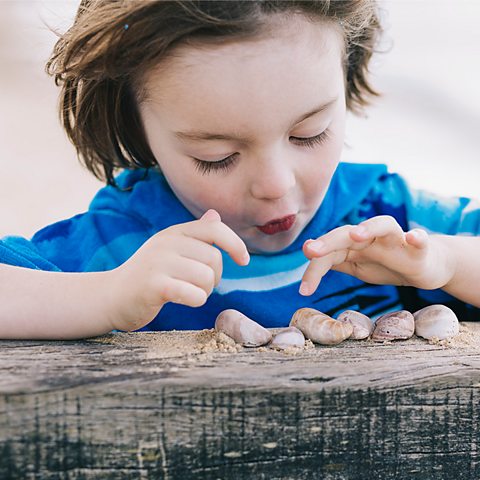
How do children learn to count?
When your little one has learnt how to say numbers in the right order, usually going up to five or 10, it’s then on to the hard(er!) bit.
“They then have to learn how we count”, says Camilla. “That means understanding that we put one word with one item. In other words, you can’t point to a single teddy and say ‘one teddy, two teddy’.”
They also need to learn something called the Cardinal Principle, which sounds complicated but is something we all do without thinking. “This is where a child understands that when you are counting, the last number you say means how many there are altogether”, explains Camilla.
The way children go about learning this is really fascinating. They seem to grasp it very slowly, learning one number at a time.
To help them, ask your child to pass you one spoon or one toy car.
“They’ll be able to do this and get the idea of what ‘one’ means. But if you ask for three spoons or cars, they wouldn’t know how”, says Camilla. She says that within the next few weeks or months your child will begin to understand how many two is. A couple of months later, they’ll work out what three is and then four.
“It’s around this stage that they suddenly seem to understand counting. At that point, they then can give you as many items as they know how to count. This is when we consider them to understand what counting is, and what numbers mean.”
Easy ways you can help your child learn to count
The process of learning to count might sound complicated, but the ways you can help your child learn are super simple. Camilla suggests trying these easy number games and activities with your toddler or preschooler:
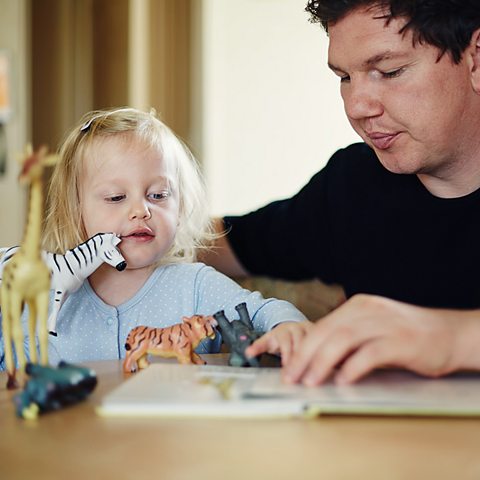
1. Start early
You can start talking to your baby about numbers and counting before they can even talk.
It’s exactly the same as the advice about reading and talking to babies for their language development
“You can help your child learn the counting sequence through singing nursery rhymes with numbers in them or reading them number books”, says Camilla.
As you go, show them the number words and digits. Why not try singing Three Little Speckled Frogs or 1, 2, 3, 4, 5, Once I Caught a Fish Alive - Nursery Rhyme.
2. Keep it simple
As they get a bit older, make counting part of your day.
“You don’t have to sit down and do anything special”, says Camilla. “Make it as simple and as fun as you can. Do it when you’re climbing the stairs or when you’re out and about by counting cars or butterflies.”
3. Count things your child can’t touch
Part of learning to count is understanding there are lots of different things that can be counted, says Camilla.
“Children tend to think the only things you count are actual objects, but numbers are much more than that.”
She suggests counting anything from smiles to claps to help your preschooler understand they can’t always physically hold or touch what they are counting.
4. Try board games
Simple board or card games are a really fun way to teach numbers and counting.
“Look for a game that involves counting squares or moving a counter along”, says Camilla. “Or find a game that involves collecting things and counting up to see who has the most at the end.”
5. Use maths ‘language’
Try adding words like ‘more’, ‘less’, ‘bigger’ and ‘smaller’ when you chat with your child.
“Using some simple maths language will help your child start to get the early ideas of subtraction and addition long before they actually learn it”, says Camilla.
6. Put things in groups
Another key part of counting is something called ‘subitising’. This is when you look at a group of objects and instantly know how many there are without having to count them.
“As adults we can do this with up to five or six objects”, says Camilla. “When children are young, they can do this with up to three items. Boost this skill by putting things into groups of two or three and saying the number. This will help your child with their visual recognition of the quantity as well as the number.”
7. Use your fingers
You’ve got all the tools you need to help your child learn to count: your fingers!
“Using your fingers to show one, two, three when you are counting and when you are saying number words is really helpful”, says Camilla. “This is a great way to get your child to link the number words to the actual amounts.”
8. Mix up your counting
When your child has got to grips with simple counting, make things a bit trickier by counting backwards, counting in steps or counting on from a number.
“If you ask a child to start at one, they may be able to count quite happily up to 10”, says Camilla. “But if you ask them to count on from three, they may struggle. But this is a really important skill that will help them later with their simple addition and subtraction skills.”